


Global disease prevalence: Skin cancer is the most common malignant tumor worldwide; the incidence rate is extremely high among Caucasians, with ultraviolet (UV) exposure being a primary causative factor.
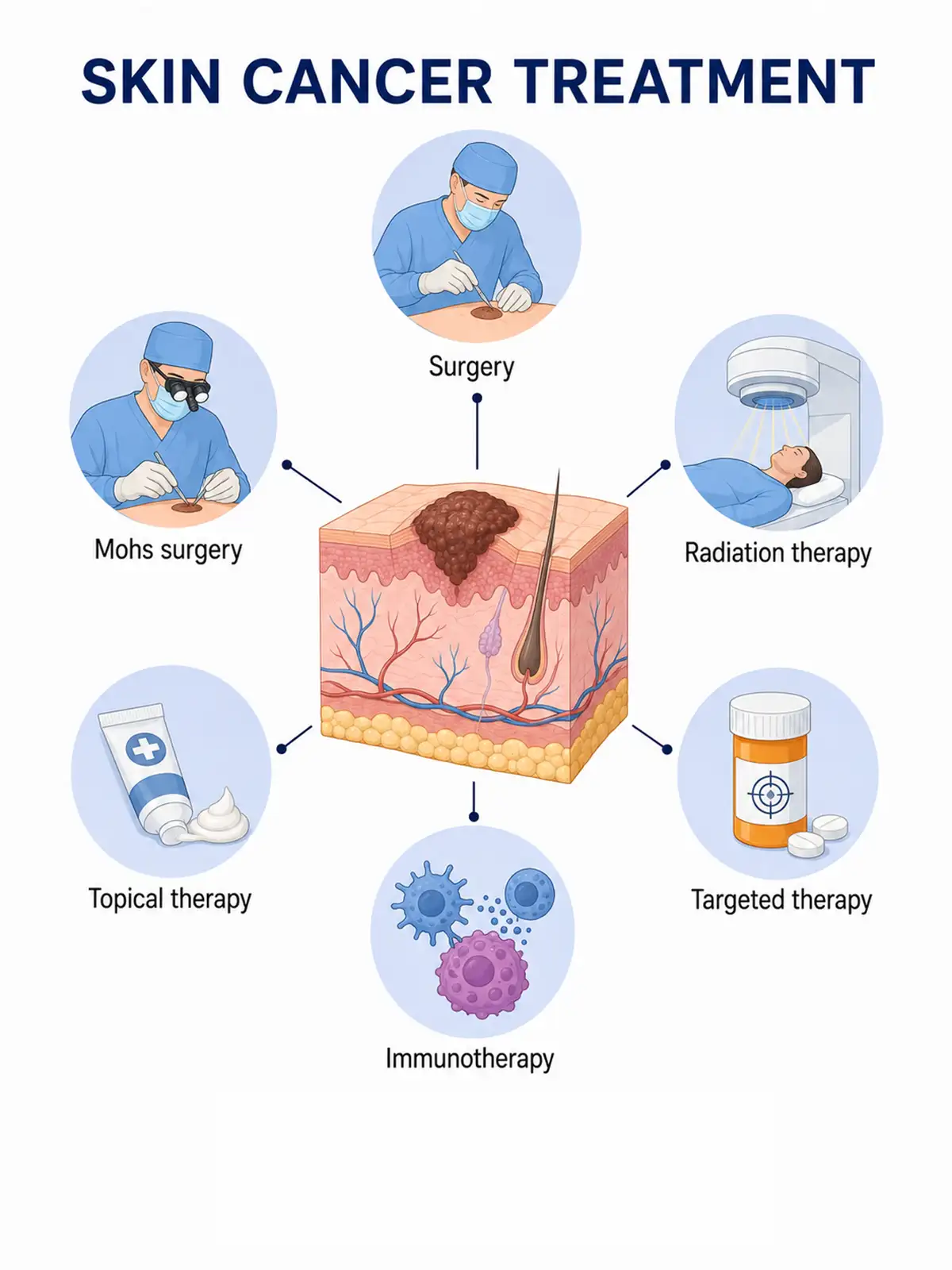
Treatment based on skin cancer stage
Early treatment (involving a localized, small tumor with a favorable response)
specifically surgical resection—can effectively control tumor progression, and the prognosis for early-stage patients is relatively good.
Intermediate-stage treatment (addressing local spread, inhibiting growth, and delaying progression)
employs a comprehensive approach—combining surgery with radiotherapy—to control further tumor spread while preserving skin function and appearance to the greatest extent possible.
Treatment for advanced disease (distant metastasis; aimed at symptom relief and survival prolongation)
primarily employs systemic therapies such as chemoradiotherapy, immunotherapy, and others to alleviate clinical symptoms and extend patient survival as much as possible.
Why choose Fosun Health for skin cancer treatment
Skin cancer diagnosis and treatment at Fosun Health are managed by a specialized cutaneous oncology center; the team possesses extensive experience in Mohs micrographic surgery, photodynamic therapy, and comprehensive treatment for advanced-stage disease.Leveraging a global medical network, patients have access to cutting-edge international treatment regimens, including Mohs micrographic surgery, photodynamic therapy, CyberKnife M6 stereotactic radiosurgery, targeted therapy, and immunotherapy.
For complex cases such as advanced or recurrent skin cancer, an MDT—comprising experts from dermatologic surgery, medical oncology, radiation oncology, and plastic/reconstructive surgery—formulates the optimal treatment plan; a cross-border consultation mechanism provides patients with second opinions from top-tier centers abroad.
Foshan Fosun Chancheng Hospital is equipped with the CyberKnife M6 precision radiotherapy system, enabling stereotactic radiosurgery for unresectable, locally advanced skin cancer.With extensive experience in Mohs surgery and photodynamic therapy for skin cancer, the hospital integrates precision radiotherapy and targeted therapy to provide patients with personalized, comprehensive care.
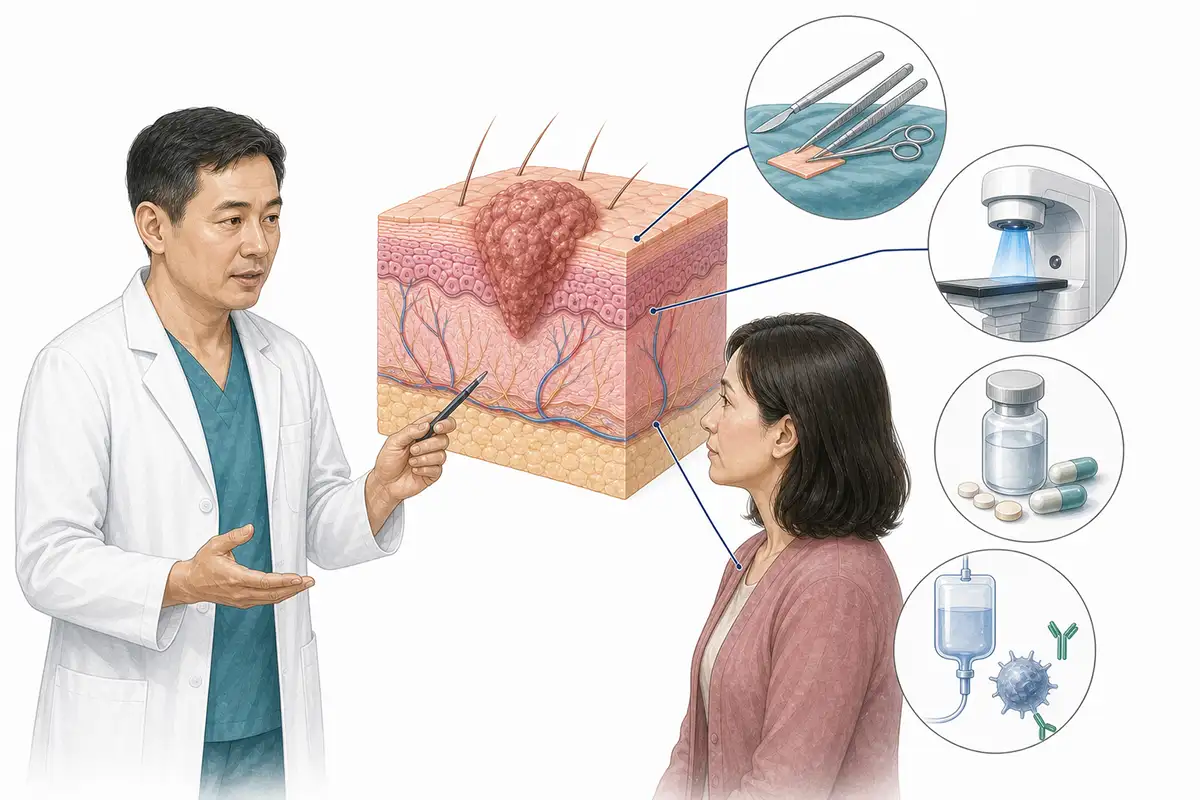
Skin Cancer Treatment Methods
1.Wide local excision
For most localized non-melanoma skin cancers, local excision or wide local excision may be selected based on tumor type, size, location, and depth of invasion; Mohs micrographic surgery may be considered for certain high-risk lesions.
Treatment advantages:
① Local control: Direct resection of the primary cutaneous tumor.
② Clarify margins: The resected specimen can be used to determine whether the tumor meets pathological margin requirements.
③ Tissue preservation: For lesions located in critical functional areas (e.g., the face), Mohs surgery allows for maximum preservation of normal tissue while ensuring complete tumor removal.
④ Reduction of local recurrence: Appropriate surgical resection helps lower the risk of residual disease and local recurrence.
2.CyberKnife precision radiotherapy
CyberKnife precision radiotherapy may be considered on a case-by-case basis for certain small skin cancers and metastatic lesions that are in challenging locations, unsuitable for conventional surgery, or present as localized recurrences.
Treatment advantages:
① High-precision irradiation: Concentrated irradiation targeting specific lesions.
② Non-surgical treatment: No traditional surgical resection required.
③ Management of local recurrence: Can be used for residual or recurrent lesions following prior treatment.
④ Reduction of radiation exposure to surrounding tissue: Minimize radiation exposure to adjacent normal tissues through dose optimization.
3. VitalBeam linear accelerator precision radiotherapy
For selected cases of skin cancer that are unsuitable for surgery, difficult to excise with satisfactory margins, or locally recurrent, precision radiotherapy may be considered based on lesion location and extent.
Treatment advantages:
① Precision irradiation: Formulate an individualized radiotherapy plan based on the extent of the lesion.
② Non-surgical treatment: Can be used for certain patients who are not candidates for surgical resection.
③ Local control: Irradiation targeting primary or locally recurrent lesions.
④ Applicable to special sites: Can serve as a local treatment option for lesions located in areas of critical functional or cosmetic importance, such as the face or nose.
4.Cryoablation
Cryotherapy may be considered for certain small, superficial skin cancer lesions eligible for local treatment, based on factors such as pathological type, lesion size, depth, and location.
5.Immunotherapy
Activates the body's immune system to recognize and attack cancer cells, providing an effective treatment option for patients with advanced skin cancer.
6.Photodynamic therapy
A photosensitizer is applied and activated by light of a specific wavelength to precisely kill cancer cells;this method is suitable for early-stage superficial lesions.
7.Targeted therapy
Precision targeting of specific targets such as the Hedgehog pathway offers good efficacy and manageable side effects, making it suitable for patients with advanced disease.
8.Comprehensive therapy
Formulate an individualized comprehensive treatment plan based on the patient's specific condition, combining modalities such as surgery, radiotherapy, and local therapies to enhance therapeutic efficacy.
9.Supportive care
Approaches such as nutritional support, psychological counseling, and symptom management can comprehensively improve the patient's physical condition and quality of life.
Post-treatment care
After treatment, you must avoid direct sunlight and use sunscreen, keep the skin clean and dry, attend regular follow-up appointments as instructed, and actively cooperate with subsequent treatment.
Post-treatment examinations
Regular skin examinations and follow-up imaging are required after treatment to detect local recurrence or distant metastasis in a timely manner.
Conclusion
Although common, the risks associated with skin cancer cannot be overlooked; successful treatment hinges on early detection, diagnosis, and intervention, as well as selecting the appropriate treatment plan and adhering to follow-up care.


