


Indications
1. Applicable conditions
• Lesions exhibiting significant displacement due to respiration or organ movement (e.g., in the lungs, liver, or pancreas), requiring dynamic tracking to prevent off-target irradiation
• Lesions immediately adjacent to critical structures such as the spinal cord, cranial nerves, or major blood vessels, where surgery entails significant trauma and risk
• Cases with residual or recurrent local lesions following surgery or conventional radiotherapy/chemotherapy; used as a local supplementary treatment.
• Elderly patients with multiple underlying conditions who cannot tolerate open surgery and seek non-invasive, short-course local interventions.
2. Common indications
• Intracranial lesions: Primary brain tumors, brain metastases, trigeminal neuralgia, intracranial arteriovenous malformations
• Head and neck tumors: primary solid tumors, cases requiring postoperative re-irradiation
• Thorax: Primary lung cancer, multiple pulmonary metastases
• Abdomen: Primary liver cancer, liver metastases, pancreatic cancer (inoperable / preoperative adjuvant radiotherapy)
• Spine: Vertebral metastases, benign spinal canal lesions, spinal cord vascular malformations
• Pelvic region: low-to-intermediate risk prostate cancer, recurrent pelvic tumors
Technical advantages
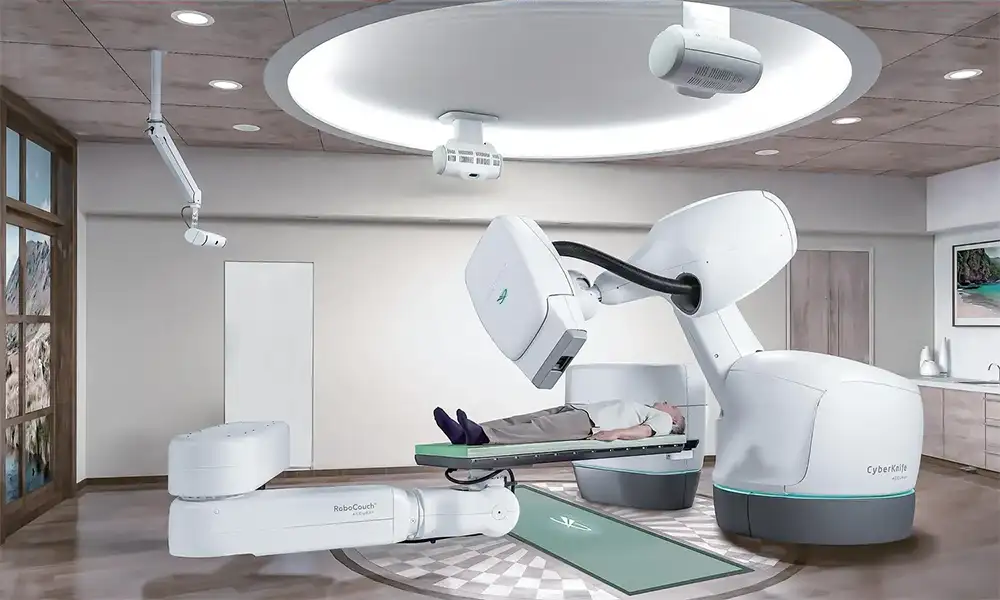
CyberKnife represents a form of high-end stereotactic radiosurgery (SRS/SBRT). Unlike conventional radiotherapy, it offers unique advantages in targeting complex or mobile lesions; it is incorporated into a personalized, comprehensive treatment plan following a multidisciplinary team (MDT) assessment.
1. Entirely non-invasive; no anesthesia required
No incisions or puncture wounds are required; most patients can undergo treatment simply by lying flat. Neither general nor local anesthesia is necessary, resulting in a lower physical burden.
2. Sub-millimeter high-precision irradiation
The robotic arm delivers radiation from multiple angles and shapes the beam in 3D to match the tumor's irregular contours; the radiation dose is highly concentrated in the target area, while the dose received by surrounding normal tissue is significantly reduced.
3. Dynamic respiratory tracking to adapt to moving lesions
Equipped with a synchronized respiratory tracking system that captures real-time tumor displacement during treatment and automatically adjusts the radiation beam angle, thereby resolving targeting errors caused by the respiratory movement of organs such as the lungs and liver.
4. Highly adaptable for lesions near sensitive organs
For high-risk lesions located near the brainstem, spinal cord, optic nerve, or major blood vessels, radiation dosage can be precisely constrained to control the lesion while minimizing the risk of radiation exposure to critical tissues.
5. Few sessions required; can be completed on an outpatient basis
Short-course hypofractionated regimens are commonly used, typically completing the entire treatment in 1 to 5 sessions; this avoids prolonged hospitalization and allows patients to better manage their daily routines and follow-up appointments.
Technical features
The standardized precision radiotherapy center is equipped with a new-generation CyberKnife system, and the entire diagnostic and treatment process adheres to domestic expert consensus on radiosurgery.
1. MDT: Upfront assessment and personalized treatment planning
For every patient, a multidisciplinary consultation involving oncology, radiotherapy, radiology, and surgery is conducted first to determine the role of CyberKnife therapy within the overall treatment strategy. This ensures seamless integration with surgery, interventional therapy, and targeted immunotherapy, rejecting the "one-size-fits-all" approach of relying on a single piece of equipment.
2. Precision planning and closed-loop quality control based on 4D imaging
Utilizes 4D-CT fused with contrast-enhanced MRI for localization; gold markers are implanted in mobile lesions as needed to enhance tracking accuracy; radiotherapy plans undergo dual-review by medical physicists; radiation doses to organs at risk—such as the spinal cord and brainstem—are strictly controlled; and a comprehensive quality control workflow covering "localization-planning-treatment-review" is implemented.
3. Real-time intraoperative image correction
Patient positioning is verified via scanning before each treatment. Lesion location is dynamically monitored throughout the session; the beam direction is adjusted immediately upon any displacement to ensure precise coverage of the target area during every irradiation.
4. Full-cycle follow-up management
Upon completion of treatment, a stratified follow-up record is established. Periodic imaging reviews assess changes in the lesion while monitoring for radiotherapy-related reactions, allowing for dynamic adjustments to the subsequent comprehensive intervention schedule.
Technical definition
CyberKnife (a robotic stereotactic radiosurgery system) is a six-axis robotic radiotherapy device equipped with a compact linear accelerator; it falls under the category of stereotactic radiotherapy (SRS/SBRT).Utilizing real-time image guidance and respiratory tracking technology, it delivers X-rays from multiple angles across the entire spatial range to precisely focus on the tumor target. It enables high-precision, non-invasive local radiotherapy for lesions throughout the body without requiring a head fixation frame; clinical operations adhere to expert consensus guidelines for multi-site CyberKnife treatment.
Working principle/mechanism
1. Multi-angle 3D dose shaping
The accelerator is mounted on a flexible robotic arm capable of delivering narrow beams from thousands of angles. These beams converge within the tumor to create a high-dose zone; the dose attenuates rapidly with distance, thereby reducing radiation exposure to surrounding normal tissues.Local intervention is achieved by damaging the DNA double strands of tumor cells, thereby inhibiting cell division and proliferation.
2. Real-time image tracking and correction
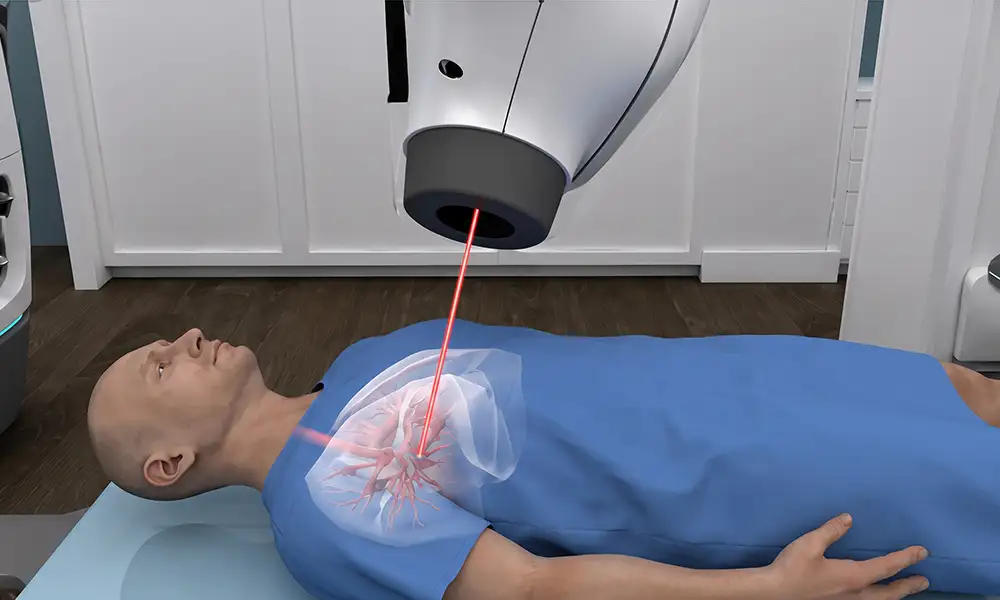
Fluoroscopic images are continuously acquired before and during treatment to compare changes in the positions of the lesion, fiducial markers, and skeletal structures. A dynamic tracking algorithm is activated to account for respiratory motion, automatically adjusting the robotic arm's irradiation angle to maintain continuous alignment with the moving tumor target.
Treatment process
1. MDT: Comprehensive assessment
Assess suitability for CyberKnife therapy by evaluating contrast-enhanced CT/MRI scans, prior treatment history, and organ tolerance; define radiotherapy goals and timing; and coordinate the sequence of combined therapies.
2. Patient immobilization and 4D localization scanning
Fabricate a personalized immobilization mold and perform localization CT scanning; implant gold markers for lesions with significant respiratory motion as needed, and capture 4D respiratory images for target tracking and planning.
3. Target volume delineation and radiotherapy plan review
Physicians delineate the tumor target area and critical organs requiring protection, while medical physicists optimize beam angles and fractional doses; the treatment plan is implemented only after undergoing a dual review by both the physician and the physicist.
4. Implementation of fractionated radiotherapy
Patient positioning is verified via imaging prior to each treatment session. Lesions are dynamically tracked throughout the procedure, and multi-angle irradiation is completed according to the plan. The entire process is non-invasive, involves short treatment times, and is typically performed on an outpatient basis.
5. Standardized follow-up and re-examination
Scheduled follow-up imaging and blood tests are conducted after treatment; changes in the lesion and radiation-related reactions are monitored, and subsequent supportive care or systemic treatment plans are adjusted as needed.
Safety and Precautions
1. MDT: Preoperative assessment as the foundation for safety
Comprehensively assess tumor burden, the distance between lesions and sensitive organs, and the tolerance of the heart, lungs, liver, and kidneys; predict the risk of radiation reactions and formulate a tailored fractionated dosage plan.
2. Real-time imaging monitoring throughout the procedure to reduce the risk of off-target delivery
Fluoroscopic tracking systems dynamically adjust the radiation delivery position, reducing unnecessary radiation exposure to normal tissues.
3. Mild, short-term reactions following treatment
Some individuals may experience mild fatigue or slight skin discomfort in the treated area. These are usually transient symptoms that gradually resolve with appropriate symptomatic care as advised by the medical team.
4. Skin care requirements
During the course of radiotherapy and for several months afterward, avoid exposing the treated area to direct sunlight, friction, or irritating cleansing/skincare products;contact medical staff immediately if redness, swelling, or skin breakdown occurs.
5. Prompt medical consultation for abnormal symptoms
If symptoms such as persistent headache, nausea and vomiting, limb numbness, persistent fever, or severe skin damage occur, a follow-up assessment is required immediately.
6. Unified planning of combination therapy by the multidisciplinary team
CyberKnife can be combined with interventional therapy, targeted therapy, immunotherapy, and ablation; treatment intervals and medication cycles are coordinated by a multidisciplinary team (MDT), and patients must not independently interrupt follow-ups or alter treatment plans.
FAQs
1. What is CyberKnife?Is it actually a "knife"?
CyberKnife is not a surgical scalpel but a robotic stereotactic radiosurgery system. It focuses high-energy X-rays on the lesion from multiple directions, achieving local treatment by damaging tumor cell DNA;the entire process typically involves no surgery or incisions.
2. How do the real-time image tracking and respiratory synchronization technologies of the CyberKnife M6 work?
During treatment, the system continuously verifies the position of the lesion or relevant anatomical landmarks using imaging.For lesions in areas that move with respiration—such as the lungs, liver, or pancreas—the beam direction can be adjusted based on respiratory motion models to ensure the radiation remains focused on the target area as consistently as possible.
3. Which diseases is CyberKnife suitable for treating?
Suitable for selected localized lesions in the intracranial region, head and neck, spine, lung, liver, pancreas, prostate, and pelvis, as well as certain metastatic or recurrent lesions.Suitability for CyberKnife treatment is determined not only by the disease type but also by a comprehensive assessment of lesion size, number, and location, as well as prior radiation doses and the tolerance of adjacent organs.
4. How does CyberKnife differ from conventional radiotherapy, linear accelerators, and surgery?
Both CyberKnife and conventional linear accelerators are radiotherapy devices, but CyberKnife emphasizes robotic multi-angle irradiation, real-time tracking, and short-course stereotactic treatment.It cannot entirely replace surgery or other radiotherapy equipment; the specific choice depends on the patient's condition and treatment goals.
5. Does the treatment require the implantation of gold markers, anesthesia, or hospitalization?
The treatment itself generally does not require anesthesia and can usually be performed on an outpatient basis.For certain soft-tissue lesions or those subject to significant respiratory motion, the prior implantation of gold markers may be required; however, some lesions can be tracked directly using bony structures or imaging characteristics—a determination made by the radiotherapy team.
6. How many treatment sessions are generally required?What are the potential side effects?
Stereotactic therapy typically involves 1 to 5 treatment fractions, though this regimen is not suitable for every patient.Side effects depend on the treatment site, radiation dose, and prior treatments; they may include fatigue, nausea, and local skin or organ reactions, with rare severe reactions potentially appearing after a delay.


