


What is medullary thyroid cancer?
Medullary thyroid cancer is a tumor formed by malignant proliferation of thyroid parafollicular C cells. C cells secrete calcitonin to regulate calcium and phosphate metabolism. Unlike cancers arising from follicular cells, medullary carcinoma does not take up iodine.
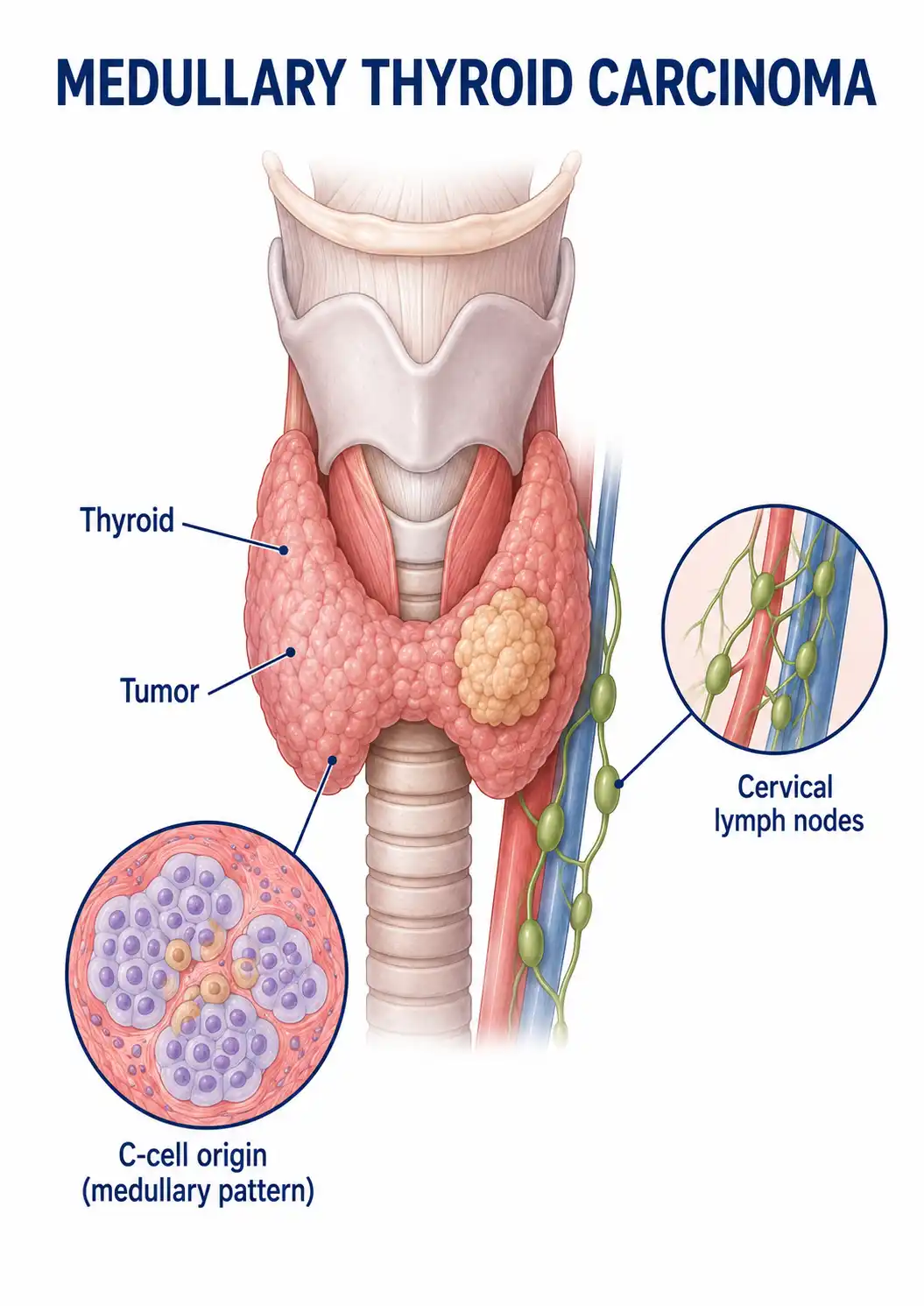
The global situation regarding medullary thyroid cancer
Medullary thyroid cancer accounts for about 5% of thyroid cancers. It may be sporadic or inherited as part of multiple endocrine neoplasia type 2. Overall incidence is low, but its clinical significance is important.
Consult a doctor regarding cancer-related issues.
Anyone with a neck lump accompanied by persistent diarrhea, facial flushing, or excessive sweating, or a family history of medullary thyroid cancer, should promptly consult an endocrinologist or thyroid surgeon.
Main types of medullary thyroid cancer
1. Sporadic medullary carcinoma
Accounting for about 75% of medullary thyroid cancers, it has no family history, is usually unilateral, and commonly occurs at ages 40-60.
2. Hereditary medullary carcinoma
Accounting for about 25%, it is associated with germline RET mutations and forms part of multiple endocrine neoplasia type 2, potentially accompanied by pheochromocytoma and parathyroid hyperplasia.
3. MEN2A
The most common hereditary type combines medullary thyroid cancer with possible pheochromocytoma and hyperparathyroidism. Family members require genetic screening.
4. MEN2B
Less common but more aggressive, it begins early and is accompanied by mucosal neuromas and a marfanoid body habitus. Prognosis is poorer than for MEN2A.
5. Familial medullary carcinoma
It presents only as medullary thyroid cancer without other endocrine tumors and is the mildest phenotypic subtype of MEN2.
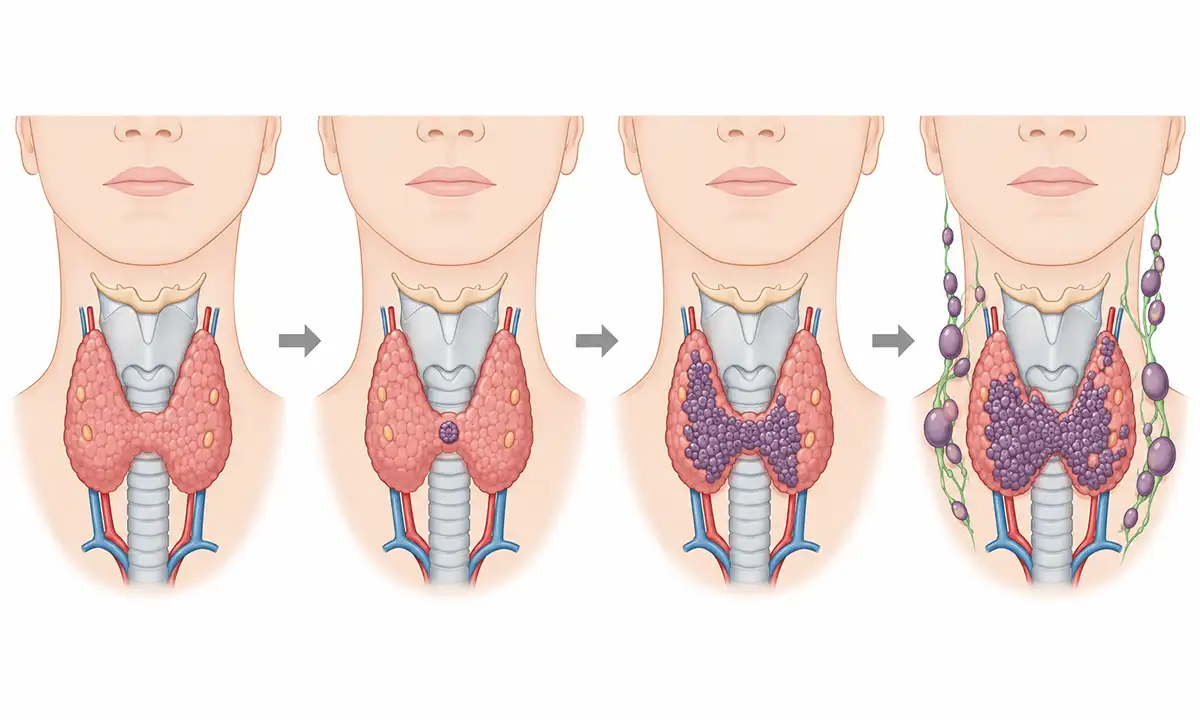
Typical symptoms and signs of medullary thyroid cancer
1. Neck lump
A painless, relatively hard lump in the thyroid region is the most common initial symptom. Growth may be rapid or slow.
2. Diarrhea
Tumor secretion of calcitonin and other biologically active substances causes persistent watery diarrhea, from several to more than ten times daily, a characteristic manifestation.
3. Facial flushing
Episodic facial flushing and excessive sweating are associated with tumor-secreted vasoactive substances and may precede or accompany diarrhea.
4. Hoarseness
Recurrent laryngeal nerve invasion causes hoarseness, indicating posterior tumor infiltration and serving as an important sign of progression.
5. Difficulty swallowing
An enlarging tumor compressing the esophagus causes swallowing discomfort, particularly when eating dry, hard foods.
6. Enlarged cervical lymph nodes
Medullary thyroid cancer can spread early to cervical lymph nodes, producing palpable hard, enlarged nodes on the side of the neck.
How is medullary thyroid cancer diagnosed?
1. Calcitonin testing
Elevated serum calcitonin is the most specific marker. Markedly elevated basal and stimulated levels support diagnosis.
2. Carcinoembryonic antigen testing
CEA is often elevated in medullary carcinoma. Combined testing with calcitonin improves diagnostic accuracy and supports postoperative monitoring.
3. Ultrasound
Thyroid ultrasound assesses tumor size, shape, blood flow, and cervical lymph node metastasis.
4. Fine-needle aspiration biopsy
Aspiration cytology with positive calcitonin immunohistochemical staining confirms the diagnosis and is important for preoperative confirmation.
5. RET genetic testing
All medullary carcinoma patients undergo RET mutation testing to determine hereditary status and guide family screening.
6. Excluding pheochromocytoma
Patients with hereditary medullary carcinoma must be assessed for coexisting pheochromocytoma before surgery. Twenty-four-hour urinary catecholamines and blood metanephrines are necessary tests.
What treatments are available for medullary thyroid cancer?
1. Surgical treatment
Total thyroidectomy with bilateral central and lateral neck lymph node dissection is the standard procedure, more extensive than surgery for differentiated cancer.
2. Targeted therapy
Multitarget tyrosine kinase inhibitors such as vandetanib and cabozantinib have been approved for advanced medullary carcinoma and control progression.
3. Genetic counseling
A hereditary diagnosis requires genetic counseling, RET testing of family members, and preventive thyroidectomy.
4. External beam radiotherapy
External beam radiotherapy controls local progression of unresectable locally advanced tumors or postoperative residual disease.
5. Palliative care
Comprehensive treatment for advanced metastatic disease aims to control symptoms, relieve suffering, and improve quality of life.
6. Hormone replacement
Lifelong thyroid hormone replacement is needed after total thyroidectomy to maintain normal metabolism.
7. Follow-up monitoring
Regular postoperative calcitonin and CEA testing, neck ultrasound, and imaging are required, with close long-term follow-up.
8. Preventive surgery
RET mutation carriers may undergo preventive total thyroidectomy in childhood to prevent medullary carcinoma.
Conclusion
Medullary thyroid cancer has distinctive biological behavior and is closely associated with calcitonin secretion. Genetic testing to establish hereditary background, timely surgery, and standardized long-term follow-up help improve prognosis.


