


What is parotid gland cancer
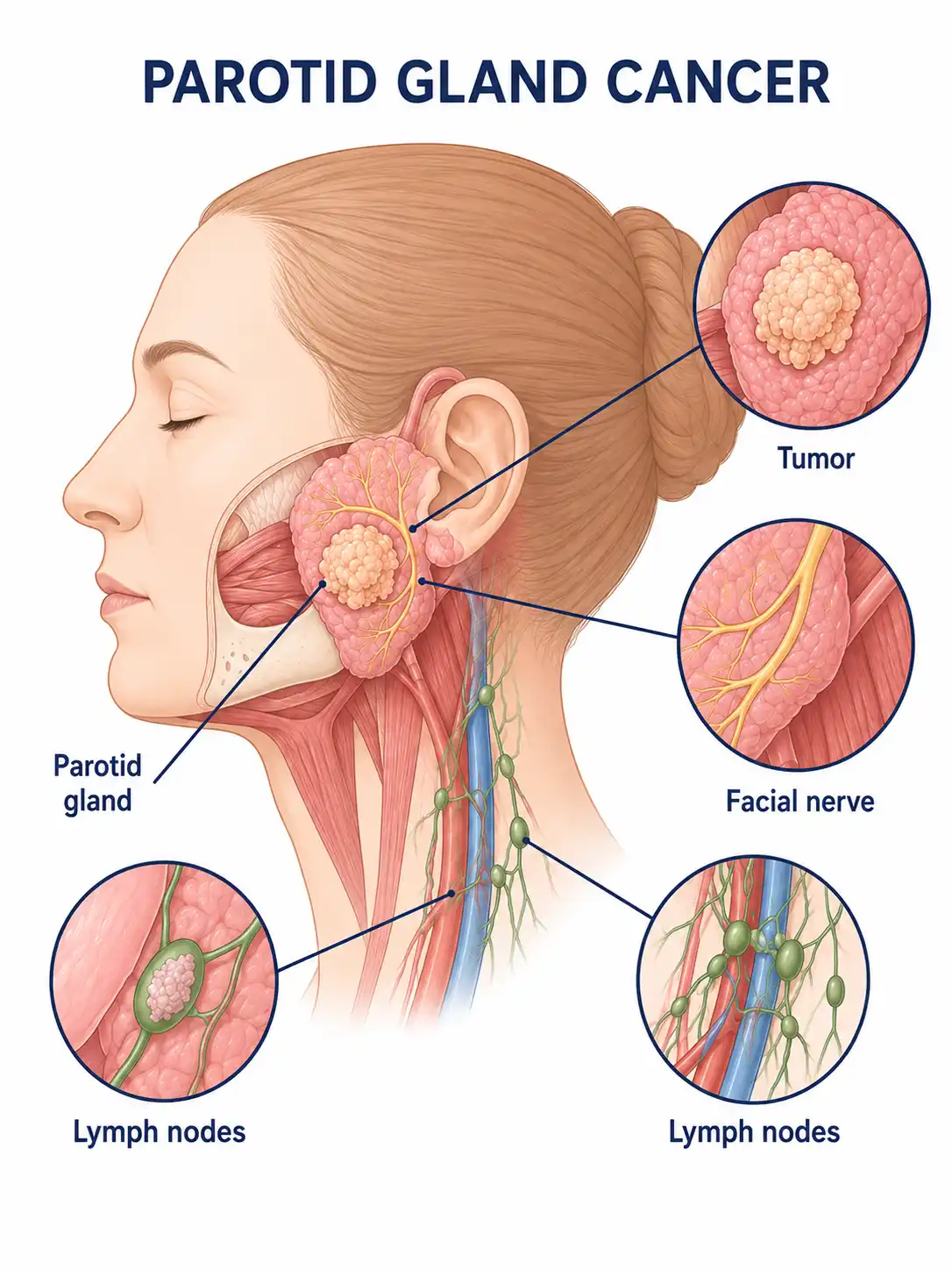
Parotid gland cancer is a tumor formed by malignant proliferation of parotid epithelial cells. The parotid glands are the largest pair of salivary glands, located in front of and below the ears, and secrete saliva to aid digestion.
The global situation regarding parotid gland cancer
Parotid gland cancer accounts for a small proportion of head and neck malignancies but is the most common salivary gland malignancy. It can occur at any age, and benign tumors outnumber malignant ones.
Consult a doctor regarding cancer-related issues
Anyone with a painless lump in front of or below the ear, facial numbness or asymmetry, restricted mouth opening, or facial nerve dysfunction should promptly consult an oral and maxillofacial or head and neck surgeon.
Main types of parotid gland cancer
1. Mucoepidermoid carcinoma
This is the most common parotid malignancy and is classified as well, moderately, or poorly differentiated. Well-differentiated tumors have a better prognosis, while poorly differentiated tumors are highly invasive.
2. Adenoid cystic carcinoma
It tends to grow along nerves and has a high local recurrence rate, but distant metastases occur relatively late, and long survival with the tumor is possible.
3. Acinic cell carcinoma
It is relatively well differentiated and slow-growing, with a relatively favorable prognosis. It is more common in middle-aged and older women and may spread to the lungs.
4. Malignant mixed tumor
It develops through malignant transformation of a benign pleomorphic adenoma, presenting as rapid growth of a long-standing lump over a short period. Prognosis depends on the degree of malignant transformation.
5. Squamous cell carcinoma
This relatively rare type is highly invasive and readily spreads early to cervical lymph nodes, with a relatively poor prognosis.
Typical symptoms and signs of parotid gland cancer
1. Preauricular lump
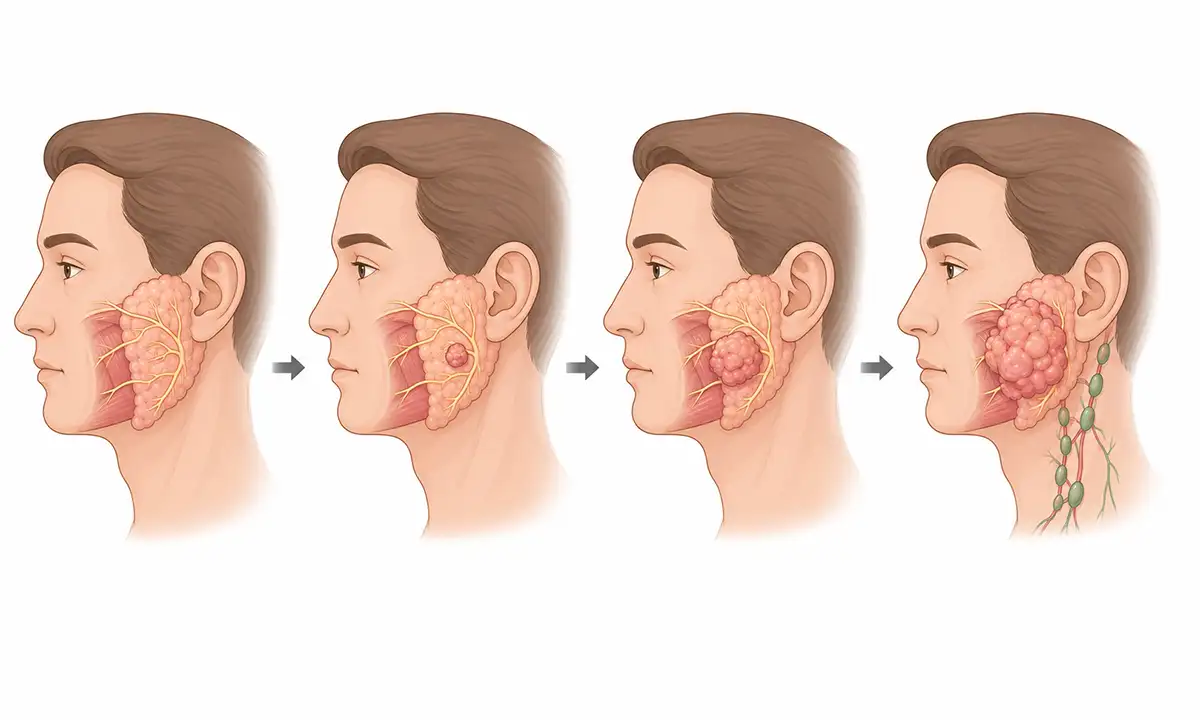
A painless, relatively hard lump with indistinct borders in the parotid region is the most common initial symptom. Benign tumors grow slowly, while malignant tumors grow faster.
2. Facial numbness
Invasion of sensory branches of the facial nerve or branches of the trigeminal nerve causes numbness or pain around the ear and cheek, an important warning sign of malignancy.
3. Facial nerve paralysis
Invasion of the main facial nerve trunk causes loss of forehead wrinkles, incomplete eye closure, and a deviated mouth corner on the affected side, indicating relatively advanced disease.
4. Restricted mouth opening
Invasion of the masseter muscle or temporomandibular joint can cause difficulty opening the mouth, affecting eating and oral hygiene.
5. Neck lump
Malignant tumors readily spread to cervical lymph nodes, producing palpable enlarged nodes that are hard and poorly mobile.
6. Pain symptoms
Benign parotid tumors are usually painless, while malignant tumors may cause persistent pain that worsens and radiates to the ear when nerves are invaded.
How is parotid gland cancer diagnosed
1. Palpation
The doctor assesses the lump's location, size, consistency, mobility, and borders by palpation to form an initial judgment of its nature.
2. Ultrasound
Ultrasound determines the relationship of a parotid mass to surrounding tissues, assesses whether it is cystic or solid, and guides needle biopsy.
3. Contrast-enhanced CT or MRI
CT or MRI shows tumor extent, its relationship to the facial nerve and surrounding tissues, and cervical lymph node metastasis.
4. Fine-needle aspiration biopsy
Ultrasound-guided fine-needle aspiration obtains cells for pathological examination, providing an initial assessment of whether the tumor is benign or malignant.
5. Excisional biopsy
Intraoperative rapid frozen-section examination establishes the pathological diagnosis and guides the surgical plan.
6. Chest CT scan
Chest CT excludes lung metastases and is an important part of routine preoperative staging.
What treatments are available for parotid gland cancer
1. Surgical treatment
Superficial or total parotidectomy is the main treatment. Meticulous dissection is needed to preserve the facial nerve, with neck dissection performed at the same time.
2. Radiation therapy
Postoperative adjuvant radiotherapy is suitable for high-grade tumors, positive margins, or lymph node metastasis and reduces local recurrence.
3. Chemotherapy
Chemotherapy is mainly used for advanced, recurrent, or distant metastatic disease as palliative treatment to control progression.
4. Facial nerve repair
After facial nerve damage or removal, nerve grafting or facial nerve anastomosis is needed to restore facial expression as much as possible.
5. Targeted therapy
Drugs directed at specific molecular targets have shown therapeutic potential in some salivary gland cancers and may be considered as a treatment option.
6. Follow-up monitoring
Long-term regular postoperative follow-up is needed to monitor local recurrence and distant metastasis, especially lung metastasis.
7. Functional exercises
Postoperative facial expression muscle exercises help improve facial nerve recovery and reduce lasting effects.
Conclusion
Parotid gland cancer mainly presents as a lump in front of or below the ear, and facial nerve preservation is central to surgical treatment. Prompt care, standardized surgery, and necessary adjuvant treatment can control the tumor while preserving facial function as much as possible.


