


What is esophageal cancer
Esophageal cancer arises from malignant proliferation of esophageal mucosal epithelial cells. The esophagus is a muscular tube connecting the pharynx to the stomach, mainly transporting food.
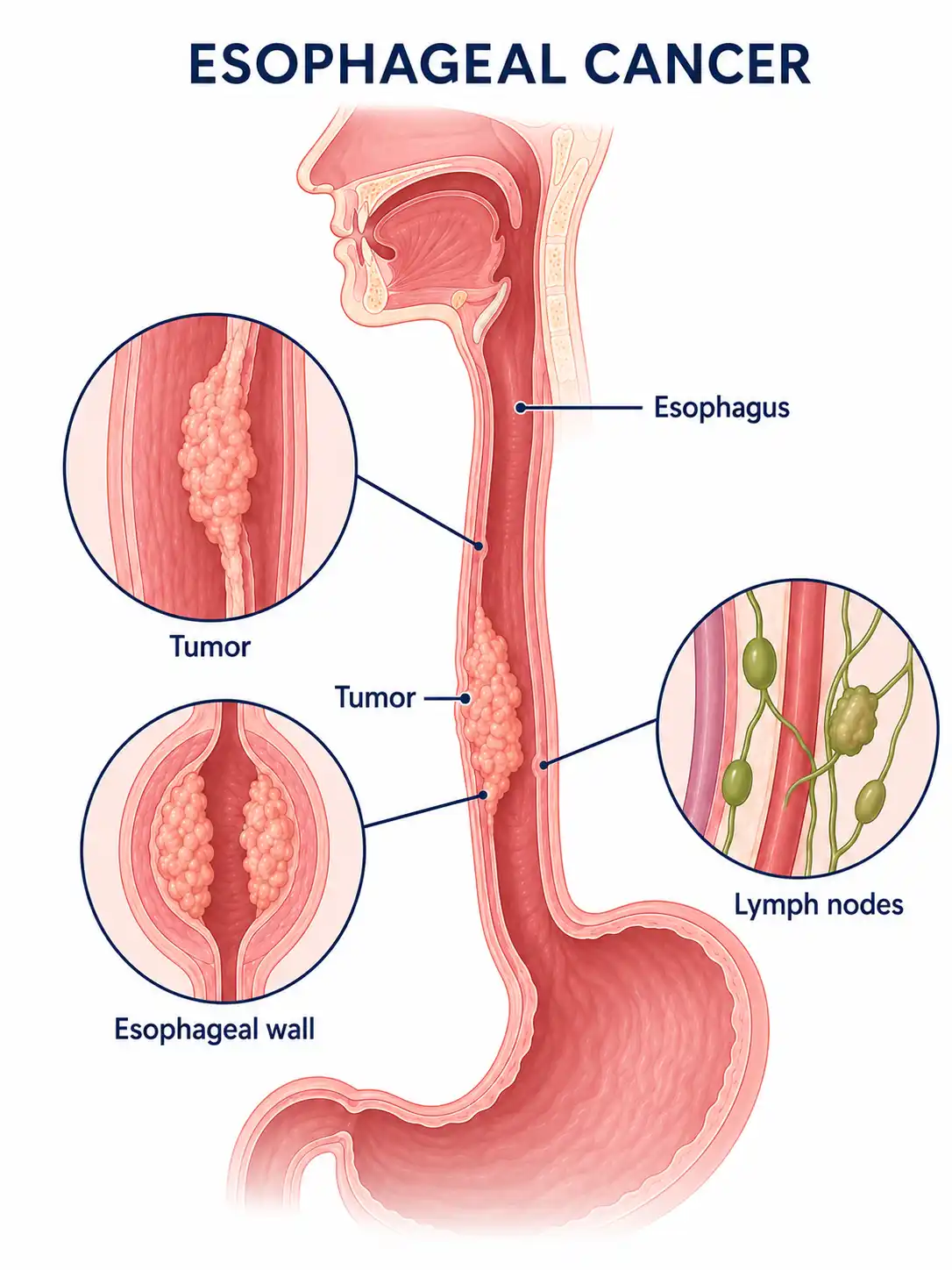
The global situation regarding esophageal cancer
Esophageal cancer contributes substantially to the global cancer burden and varies markedly by region. Rates are higher in parts of East and Central Asia and eastern and southern Africa. Tobacco, alcohol, and dietary practices influence risk.
Consult a doctor regarding cancer-related issues
Anyone with progressive difficulty swallowing, pain behind the breastbone, food regurgitation, or marked weight loss, especially long-term smokers and drinkers, should promptly consult a thoracic surgeon or gastroenterologist.
Main types of esophageal cancer
1. Squamous cell carcinoma
Squamous cell carcinoma predominates in many high-incidence regions, often affects the middle or upper esophagus, and is associated with tobacco, alcohol, and regular consumption of very hot beverages.
2. Types of adenocarcinoma
Its incidence has increased in recent years. It mainly affects the lower esophagus and gastric cardia and is associated with gastroesophageal reflux and malignant transformation of Barrett's esophagus.
3. Small-cell carcinoma
This uncommon neuroendocrine tumor grows rapidly and metastasizes early. It is highly malignant and usually requires combined treatment.
4. Undifferentiated carcinoma
This very rare tumor lacks pathological differentiation, is extremely aggressive, and has a very poor prognosis, requiring multidisciplinary treatment planning.
5. Mixed adenosquamous carcinoma
The tumor contains both adenocarcinoma and squamous carcinoma components. It is uncommon, and treatment must consider the biological characteristics of both.
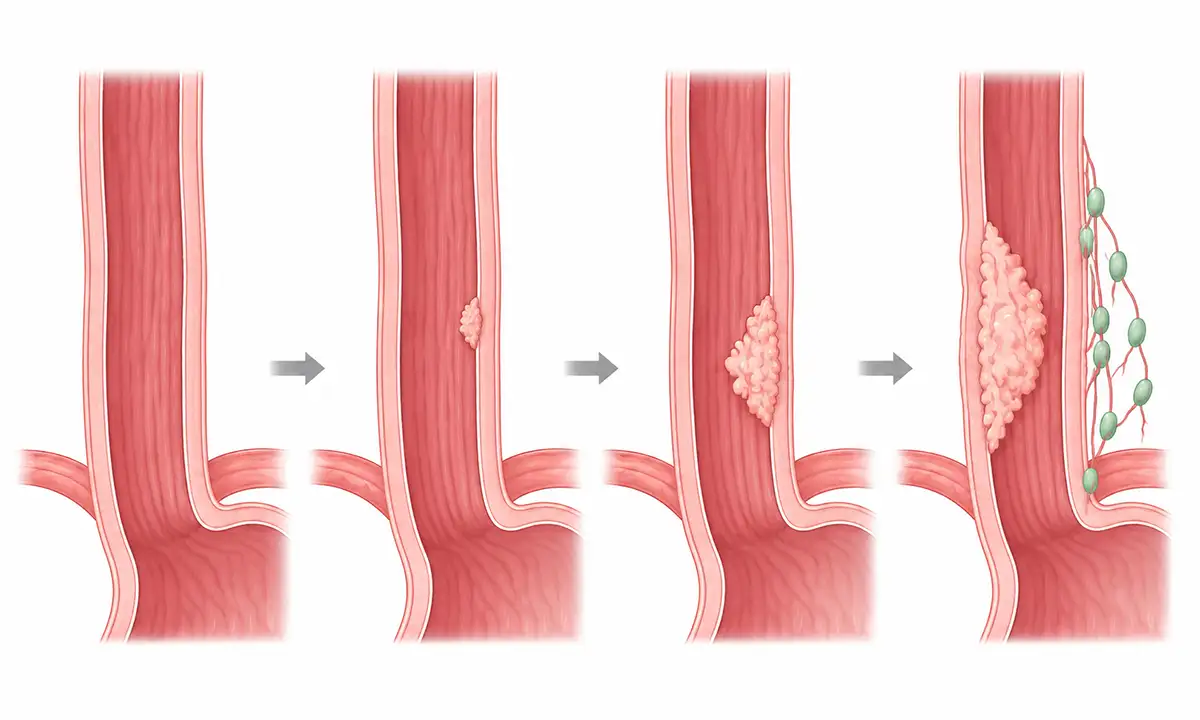
Typical symptoms and signs of esophageal cancer
1. Difficulty swallowing
Initially, dry or hard food feels stuck. Difficulty progressively worsens until even semisolid and liquid foods are hard to swallow.
2. Pain behind the breastbone
Burning, stabbing, or pulling pain behind the breastbone during or after swallowing may radiate to the shoulders and back. Persistent pain suggests invasion beyond the esophagus.
3. Food regurgitation
Esophageal narrowing retains food and mucus, which regurgitate into the mouth when lying down, sometimes with foul odor. Severe cases cause choking, coughing, and aspiration pneumonia.
4. Weight loss
Difficulty eating reduces nutrient intake, causing marked weight loss over a short period, fatigue, anemia, and other systemic wasting symptoms.
5. Hoarseness
Tumor invasion or metastatic nodes compressing the recurrent laryngeal nerve cause hoarseness, suggesting relatively advanced disease.
6. Enlarged cervical lymph nodes
Upper esophageal cancer readily spreads to supraclavicular nodes, producing palpable hard, poorly mobile enlarged neck nodes.
How is esophageal cancer diagnosed
1. Gastroscopy
Endoscopy is the first-choice diagnostic method, directly showing tumor location, shape, and extent and permitting biopsy of suspicious areas for pathological diagnosis.
2. Barium swallow
X-rays after swallowing barium show mucosal destruction, narrowing, and filling defects, providing an important assessment of disease extent and possible surgical removal.
3. Contrast-enhanced CT scan
Chest and abdominal CT assess invasion depth, relationships with surrounding organs, and mediastinal and abdominal nodal metastases.
4. Endoscopic ultrasonography
Endoscopic ultrasound clearly shows the layers and depth of esophageal wall invasion and nearby nodal metastases, supporting precise staging.
5. Esophageal exfoliative cytology
A mesh-covered balloon catheter rubs the esophageal mucosa to collect exfoliated cells and detect early cancer cells. This is suitable for population screening in high-incidence regions.
6. PET-CT scan
PET-CT detects distant metastases difficult to identify on conventional imaging, supporting comprehensive staging and treatment planning.
What treatments are available for esophageal cancer
1. Surgical treatment
Surgery is the main treatment, including esophagectomy and reconstruction using the stomach. Early-stage patients can achieve favorable long-term survival.
2. Radiation therapy
Radiotherapy can be used alone for inoperable early disease or as preoperative neoadjuvant or postoperative adjuvant treatment to reduce local recurrence.
3. Chemotherapy
Neoadjuvant chemotherapy shrinks tumors and increases surgical resection rates, while postoperative adjuvant chemotherapy reduces distant metastasis risk.
4. Concurrent chemoradiotherapy
Concurrent chemoradiotherapy is standard for inoperable locally advanced disease and a common neoadjuvant regimen for operable patients.
5. Immunotherapy
PD-1 immune checkpoint inhibitors combined with chemotherapy have become a first-line option for advanced esophageal cancer, significantly prolonging survival.
6. Targeted therapy
Antiangiogenic targeted drugs such as apatinib may be used as second- or later-line treatment in advanced disease to control progression.
7. Nutritional support
Nutrition support continues throughout treatment and includes enteral and parenteral nutrition. Improved nutritional status helps increase treatment tolerance and efficacy.
Conclusion
Early symptoms are subtle, and disease is often intermediate or advanced when difficulty swallowing appears. Improved dietary habits, regular high-risk screening, early detection, and standardized combined treatment help improve prognosis and quality of life.


