


Indications
1. Applicable conditions
• Lesions immediately adjacent to critical structures such as major blood vessels, bile ducts, pancreatic ducts, nerves, or airways, where thermal ablation or surgery poses a high risk of ductal injury
• Localized solid tumors in regions with dense ductal structures (e.g., liver, pancreas, renal hilum, pulmonary hilum) where lesion size and number meet ablation criteria.
• Patients unable to tolerate open surgery or at high risk for conventional thermal/cryo-ablation who require local intervention.
• Locally advanced tumors; using NanoKnife (IRE) first to shrink the lesion, thereby creating conditions for subsequent radiotherapy, chemotherapy, or systemic therapy.
• Postoperative patients with oligoresidual disease or local recurrence lesions located near critical structures, making repeat surgery technically difficult
2. Common indications
Primary liver cancer, liver metastases, locally advanced pancreatic cancer, hilar renal tumors, hilar and mediastinal lesions, peribiliary solid tumors, and localized pelvic tumors adjacent to major blood vessels.
Core Strengths
1. Non-thermal ablation mechanism; avoids heat-related injury
Unlike thermal ablation techniques such as radiofrequency, microwave, or cryoablation, this method does not rely on extreme heat or cold to destroy tissue; it avoids the "heat sink effect" and the risk of extensive thermal burns, and is unlikely to damage surrounding connective tissues or tubular structures.
2. Naturally preserves blood vessels, bile ducts, and nerve fibers
High-voltage electric pulses selectively disrupt tumor cell membranes while having minimal impact on fibrous connective tissues such as blood vessel walls, bile ducts, and nerves, allowing for safer margins when treating lesions adjacent to critical structures.
3. Suitable for lesions located in areas contraindicated for traditional ablation
For tumors located in close proximity to the portal vein, hepatic artery, common bile duct, or pancreatic duct—where maintaining a safe margin is difficult with conventional ablation—Nano-Knife technology enables complete coverage of the target area.
4. Minimally invasive puncture; smooth postoperative recovery
Electrode needles are placed via percutaneous puncture only, avoiding large surgical incisions;the procedure is performed under general anesthesia with muscle relaxation, and patients can get out of bed after a short period of postoperative monitoring.
5. Can be combined synergistically with various other treatments
Can be combined with TACE (transarterial chemoembolization), systemic targeted/immunotherapy, or radiotherapy to achieve downstaging, tumor reduction, and local lesion control, thereby optimizing the multidisciplinary comprehensive treatment strategy.
Technical features
1. MDT: Rigorous upfront case screening
Joint assessment by interventional radiologists, oncologists, radiologists, anesthesiologists, and surgeons; patient eligibility is screened against the domestic expert consensus on NanoKnife therapy, contraindications (such as cardiac pacemakers or severe arrhythmias) are ruled out, and the electrode placement plan is designed.
2. 3D needle placement planning using multimodal imaging
Contrast-enhanced CT/MRI is used to create 3D reconstructions of the lesion and surrounding structures (such as vessels or ducts); this allows for preoperative simulation of electrode spacing and electric field coverage, as well as real-time CT-guided, precise needle placement during the procedure.
3. Safety control via ECG-synchronized pulsing
The device is linked to ECG monitoring and delivers high-voltage pulses only during the ventricular refractory period to reduce the risk of arrhythmia; comprehensive muscle relaxation management is employed to prevent muscle contraction or displacement caused by electrical stimulation.
4. Standardized quality control throughout the entire perioperative process
Preoperative screening covers coagulation, cardiac function, and organ function; intraoperative monitoring tracks current, ECG, and blood pressure in real-time; and a CT scan is performed immediately after ablation to assess the electric field coverage area.
5. Stratified, long-term follow-up system
Scheduled contrast-enhanced imaging follow-ups at 1, 3, and 6 months post-procedure to assess lesion changes and simultaneously adjust the schedule of subsequent systemic therapies, such as targeted therapy or immunotherapy.
Technical definition
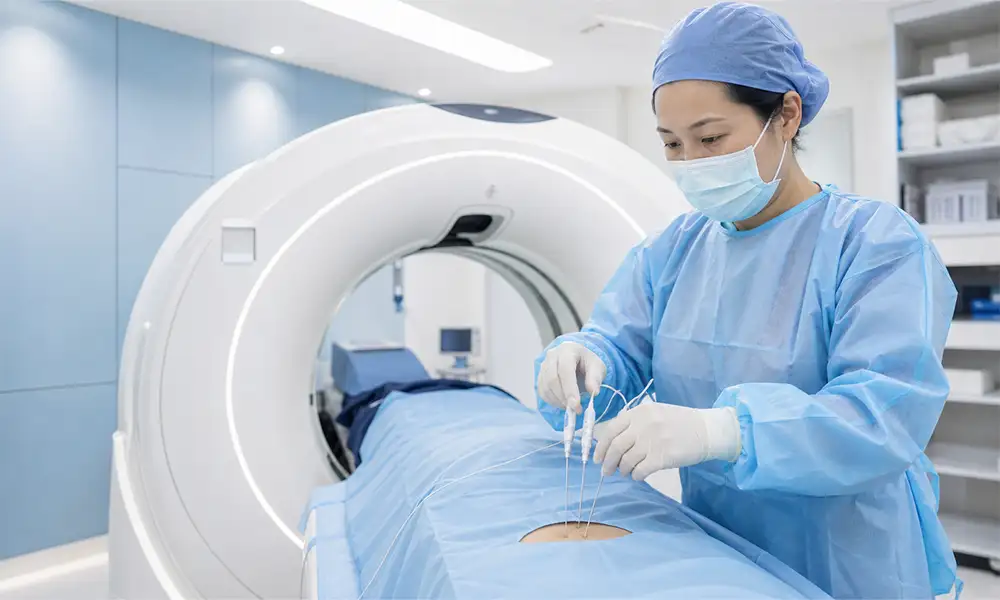
NanoKnife ablation, also known as irreversible electroporation (IRE), is a novel, image-guided, minimally invasive non-thermal ablation technique.Under real-time CT guidance and general anesthesia with muscle relaxation, multiple electrode needles are inserted to deliver microsecond-duration, high-voltage electrical pulses. These pulses create permanent nanopores in tumor cell membranes, inducing apoptosis (programmed cell death). Procedural protocols strictly adhere to domestic expert consensus on IRE for liver, pancreatic, and multi-site applications, with local intervention plans specifically designed for complex lesions adjacent to critical ducts.
Working principle/mechanism
1. Irreversible electroporation-induced cell death: A stable high-voltage electric field is established between electrodes; pulses breach the tumor cell membrane, creating irreparable nanopores. This disrupts cellular osmotic balance and triggers apoptosis, resulting in the inactivation of the targeted tumor.
2. Tissue-differentiated action: Structures such as blood vessel walls, bile ducts, and nerves are primarily composed of fibrous connective tissue; they tolerate electric fields well and are resistant to necrosis. In contrast, tumor epithelial cells are more sensitive to electric fields, allowing for selective intervention on the lesion.
3. No extensive heat accumulation: The ablation process generates only minimal local Joule heat; unlike thermal ablation, it does not cause high-temperature diffusion damage to surrounding ducts or vessels, making it suitable for areas with dense vascular and biliary networks.
Treatment process
1. Preoperative MDT comprehensive assessment: Complete contrast-enhanced CT/MRI, ECG, coagulation profiles, and liver/kidney function tests; screen for cardiac and anesthesia-related contraindications; and plan electrode placement points in 3D.
2. General anesthesia + neuromuscular blockade: Anesthesiologists administer general anesthesia combined with muscle relaxants to prevent body spasms or electrode displacement caused by pulse stimulation.
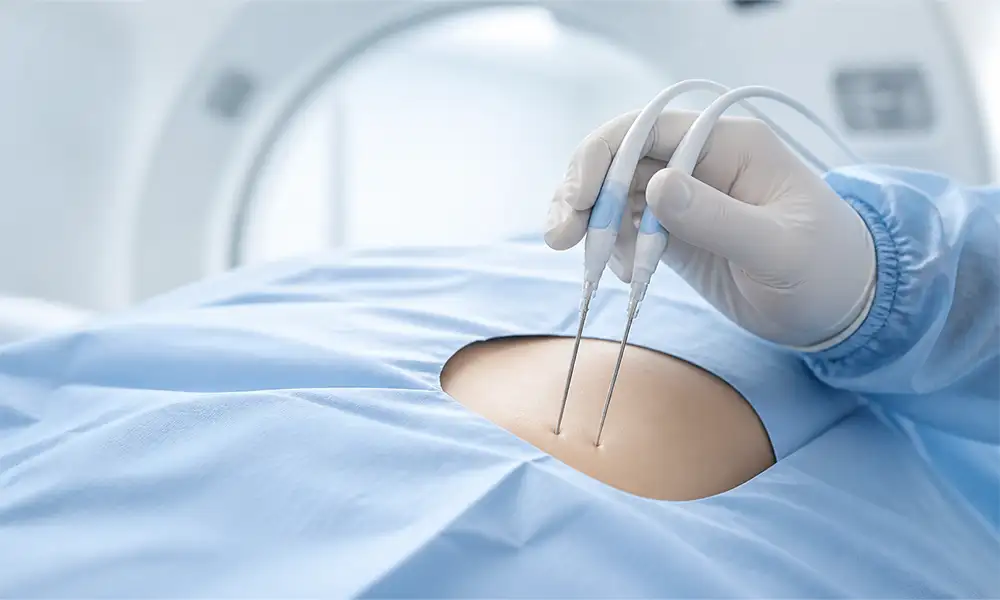
3. CT-guided precision needle placement: Electrode needle arrays are inserted according to a preoperative 3D plan, followed by scanning to verify electrode spacing and distances from blood vessels and bile ducts.
4. ECG-synchronized high-voltage pulsed ablation: Electrical pulses are delivered in synchronization with ECG signals across multiple cycles to cover the target area with an electric field;current and vital signs are monitored in real-time during the procedure.
5. Immediate postoperative imaging assessment: A CT scan is performed after ablation to determine if the electric field fully encompasses the tumor target area; electrodes are then withdrawn, and the needle tracts are managed.
6. Stratified follow-up and re-examination: Short-term monitoring of organ function; scheduled contrast-enhanced imaging to assess local lesion changes; subsequent comprehensive treatment plans formulated by the MDT.
Safety and Precautions
1. Strict screening for contraindications prior to the procedure.
Nano-Knife (Irreversible Electroporation) therapy is unsuitable for patients with implanted cardiac pacemakers, severe arrhythmias, severe coagulation disorders, active systemic infections, or an inability to tolerate general anesthesia with muscle relaxants.
2. Intraoperative multi-level ECG protection
Pulse output is synchronized with the ECG throughout the procedure; an anesthesia team is present with defibrillation equipment ready, and heart rate and blood pressure fluctuations are monitored in real time.
3. Short-term, transient post-operative reactions
Some patients may experience dull pain, mild swelling, or fatigue in the treated area. These are typically short-term stress reactions following ablation that gradually resolve with appropriate supportive care.
4. Standardized care for the puncture site
Apply a pressure dressing to the puncture site and keep it dry and clean; avoid significant twisting of the abdomen or chest and heavy lifting for 1–2 weeks.
5. Prompt medical consultation for abnormal symptoms
If symptoms such as persistent palpitations or chest tightness, severe abdominal pain, worsening jaundice, difficulty breathing, or persistent high fever occur, contact medical staff immediately for assessment.
6. Unified coordination of the comprehensive plan
NanoKnife serves solely as a local adjunctive intervention. Comprehensive treatment plans—combining interventional, targeted, and immunotherapies—are coordinated by a Multidisciplinary Team (MDT); patients must not unilaterally discontinue follow-up examinations or treatment.
FAQs
1. What is NanoKnife?
The medical term for NanoKnife is irreversible electroporation.It delivers high-voltage electrical pulses via multiple electrodes, causing irreversible micropores to form in tumor cell membranes and leading to cell death; it is a local ablation technique primarily based on a non-thermal mechanism.
2. How does Nano-Knife differ from radiofrequency, microwave, and cryoablation?
Radiofrequency (RF) and microwave ablation rely on high temperatures, while cryoablation relies on low temperatures; NanoKnife primarily uses electric fields to disrupt cell membranes.While it may offer advantages in preserving fibrous structures—such as blood vessels and bile ducts—this does not mean these structures are immune to damage.
3. Which lesions may be suitable for NanoKnife treatment?
May be considered for certain localized lesions situated near major blood vessels, bile ducts, pancreatic ducts, or other critical structures; common sites for research and clinical application include the pancreas and liver.Applicability depends on the extent of the lesion, feasibility of electrode placement, and the hospital's qualifications.
4. Why are general anesthesia and ECG synchronization usually required?
High-voltage electric pulses can cause significant muscle contractions, necessitating general anesthesia and muscle relaxation.As the electric current may also affect heart rhythm, treatment often requires ECG synchronization and continuous monitoring of vital signs.
5. Can treatment be performed if the patient has a pacemaker or cardiac arrhythmia?
Conditions such as cardiac pacemakers, implantable defibrillators, severe arrhythmias, or inability to tolerate general anesthesia may constitute contraindications or require special assessment.Patients should provide a complete cardiac history and details regarding implanted devices in advance.
6. Can NanoKnife therapy be repeated?
In cases of local residual disease or recurrence—provided organ function permits—repeat treatment may be considered, though the electrode trajectory requires re-planning.Post-operative outcomes are primarily assessed via contrast-enhanced CT or MRI; however, short-term inflammation and edema may affect image interpretation.


