


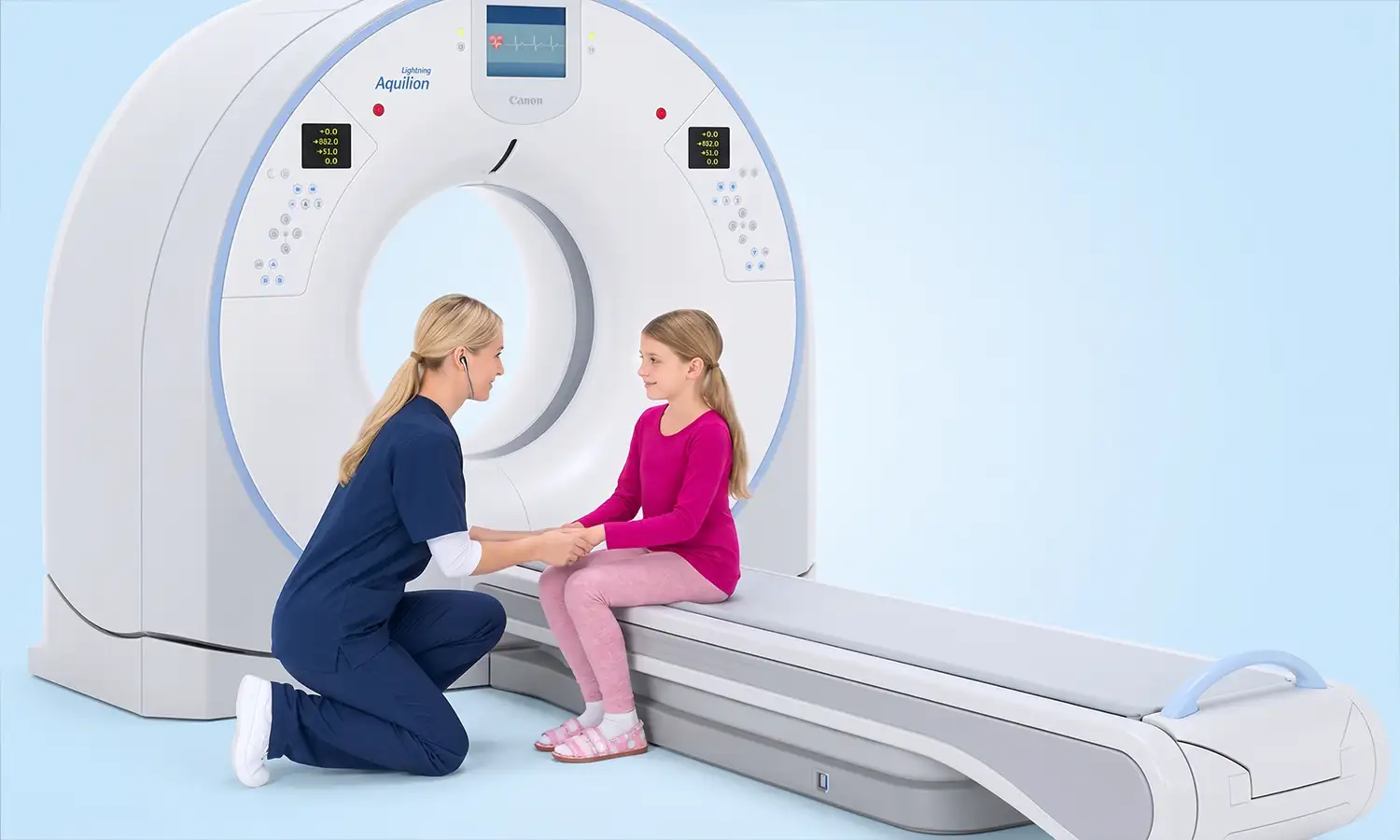
The Aquilion Lightning diagnostic-grade large-bore CT simulator is an advanced imaging system dedicated to precise positioning for oncological radiotherapy.Through its large-bore design, high-resolution CT imaging, and 4D dynamic scanning capabilities, it enables accurate tumor target delineation, organ motion assessment, and the formulation of radiotherapy plans, providing support for precise, safe, and personalized radiation therapy for patients with complex tumors such as lung cancer, liver cancer, and mediastinal tumors.
Core Technologies
What is the Aquilion Lightning diagnostic-grade wide-bore CT scanner?
Developed by Toshiba Medical (the predecessor to Canon Medical Systems), the Aquilion Lightning is a CT system designed specifically for precise patient positioning within the oncology radiotherapy workflow.Unlike standard diagnostic CT scanners, a radiotherapy simulation CT must not only capture high-definition anatomical images but also meet specialized requirements such as patient immobilization, tumor target localization, organ motion assessment, and radiotherapy treatment planning.Featuring a large-bore design, the Aquilion Lightning accommodates patients of various body sizes and complex immobilization devices, allowing CT simulation and positioning to be performed under conditions closely resembling the actual treatment setup.By integrating high-quality CT images with radiotherapy planning systems, clinicians can precisely define tumor target volumes (GTV/CTV/PTV), identify areas requiring protection (organs at risk), and determine beam angles and dose distributions, thereby achieving clear visualization, accurate localization, and precise treatment delivery.
1. Large-bore design
Conventional CT scanners often have small bores, which can be restrictive for certain patients or specific radiotherapy positioning requirements.The Aquilion Lightning features a large-bore gantry design that provides ample scanning space and accommodates specialized positioning devices, making it suitable for obese patients and complex radiotherapy setups.This large-bore design ensures high consistency between the simulation/positioning phase and the actual treatment, thereby enhancing the accuracy of radiotherapy delivery.
2. High-definition CT imaging technology
The core of precision radiotherapy lies in the ability to accurately identify the tumor's location and surrounding critical organs.The Aquilion Lightning system utilizes high-resolution CT imaging technology to clearly visualize tumor boundaries, vascular structures, bony structures, and surrounding normal tissues.These high-definition images assist radiation oncologists in precisely delineating target areas—minimizing the risk of missing the tumor and preventing unnecessary radiation exposure to normal tissues—thereby providing a reliable imaging basis for precision radiotherapy planning.
3. 4D-CT dynamic imaging technology
Thoracic and abdominal tumors shift position with the patient's breathing—for instance, lung cancer moves vertically during respiration, and the liver undergoes displacement due to diaphragmatic movement.Using 4D CT technology, the Aquilion Lightning system acquires dynamic images across multiple respiratory cycles to record tumor motion trajectories.Physicians can then formulate more precise radiotherapy plans based on the tumor's range of motion, respiratory cycle variations, and organ movement patterns.
4. Radiotherapy simulation and localization technology
Serving as a radiotherapy simulation CT scanner, the Aquilion Lightning is a crucial link connecting patient positioning, CT simulation scanning, target volume delineation, treatment planning, and the delivery of precise therapy.By replicating the patient's posture and immobilization setup used during actual treatment, it enables physicians to plan the optimal irradiation strategy in advance.It integrates with 3D Conformal Radiation Therapy (3D-CRT), Intensity-Modulated Radiation Therapy (IMRT), and Stereotactic Body Radiation Therapy (SBRT) to further enhance treatment precision.
Scope of Indications
The Aquilion Lightning diagnostic-grade large-bore CT simulator is primarily used in the field of precision radiotherapy for oncology.
1. Major clinical applications
Field Primary Applications
Lung tumors; radiotherapy localization for lung cancer, respiratory-gated radiotherapy
Hepatobiliary and pancreatic tumors; precision localization for liver and pancreatic cancers
Head and Neck Tumors Nasopharyngeal carcinoma, radiotherapy planning for head and neck tumors
Mediastinal tumors; localization of complex thoracic tumors
Bone and soft tissue tumors: Bone metastases, precise irradiation of localized tumors
2. Suitable patient population
● Tumor patients requiring precision radiotherapy
Includes primary malignant tumors, locally recurrent tumors, and metastatic lesions.
● Patients with tumors whose location shifts significantly with respiration
For patients with conditions such as lung or liver cancer, 4D CT can assess the range of tumor motion, helping doctors formulate personalized radiotherapy strategies.
● Patients requiring high-precision target area control
For patients with small tumors located near vital organs—where the preservation of normal tissue is critical—large-bore simulation CT provides support for highly precise tumor localization.
Core Strengths
Comparison Dimension Standard Diagnostic CT Aquilion Lightning Large-Bore Simulation CT
Primary Uses: Disease diagnosis; precise localization for radiotherapy
Scan space Standard aperture Large-bore design; supports complex patient positioning
Imaging Purpose Disease detection Target volume delineation and treatment planning
Dynamic assessment Conventional static imaging 4D-CT assessment of respiratory motion
Radiotherapy compatibility: No dedicated positioning function; supports radiotherapy simulation and localization.
Clinical Value: Provides diagnostic evidence; guides the implementation of precision therapy
Standard diagnostic CT
Standard diagnostic CT is primarily used for disease screening and clinical diagnosis; it provides a basis for assessing disease by visualizing the location, size, and morphology of lesions. However, as it is designed for routine examinations, its scanning space and positioning capabilities often fail to meet the complex requirements of radiotherapy.It cannot adequately assess tumor displacement caused by respiration and lacks specific functions for radiotherapy target delineation and treatment planning.
Aquilion Lightning Large-Bore Simulation CT
Designed specifically for radiotherapy positioning, the Aquilion Lightning Large-Bore Simulation CT provides high-precision imaging support for accurate radiation therapy.Compared to standard CT scanners, its large-bore design accommodates complex patient positioning and the use of immobilization devices, thereby improving patient comfort and the efficiency of treatment preparation.The system supports 4D-CT dynamic assessment technology, allowing for the observation of tumor position changes due to respiratory motion, which assists physicians in more accurate target volume delineation and treatment planning.Furthermore, its image acquisition capabilities go beyond lesion detection to facilitate radiotherapy simulation and precise treatment delivery, providing a reliable imaging foundation for radiation therapy.
FAQ
1. Why is CT simulation localization required before radiotherapy?
Simulation CT localization is used to acquire the imaging data required for radiotherapy planning. It helps physicians determine the treatment position, delineate the tumor target area and surrounding critical organs, and design the subsequent radiation delivery plan.It is a crucial step in the radiotherapy preparation process but does not involve the actual delivery of radiation therapy.
2. What is the function of the large-bore design?
The large gantry opening facilitates scanning for patients using immobilization masks, vacuum cushions, or other radiotherapy positioning devices, while also providing more space for patients with larger body sizes or those requiring special positioning.Specific positioning methods are determined based on the treatment site and planning requirements.
3. Why must the same posture be maintained during simulation/localization as during the actual treatment?
Radiotherapy plans are developed based on images obtained during the simulation (positioning) phase; therefore, the positioning posture must be as stable and reproducible as possible.Staff will use appropriate immobilization devices and mark positioning details to ensure the posture can be accurately replicated for every subsequent treatment session.
4. Is a contrast agent injection required for the simulation CT scan?
In some cases, contrast-enhanced scanning may be required to clearly distinguish between tumors, blood vessels, and normal tissues, although many localization procedures do not require contrast agents.Patients with a history of adverse reactions to contrast agents, renal dysfunction, or thyroid disease should disclose this information in advance.
5. How do I schedule an Aquilion Lightning CT simulation/localization scan?
Simulation CT localization is typically ordered by a radiation oncologist following an assessment.When scheduling the appointment, please have your pathology reports, recent imaging studies, and records of previous treatments ready. Follow instructions regarding preparations such as fasting, bladder filling, or breathing exercises. Please inform the staff in advance if you are unable to maintain the required position or are experiencing significant pain.