


What is nasopharyngeal cancer
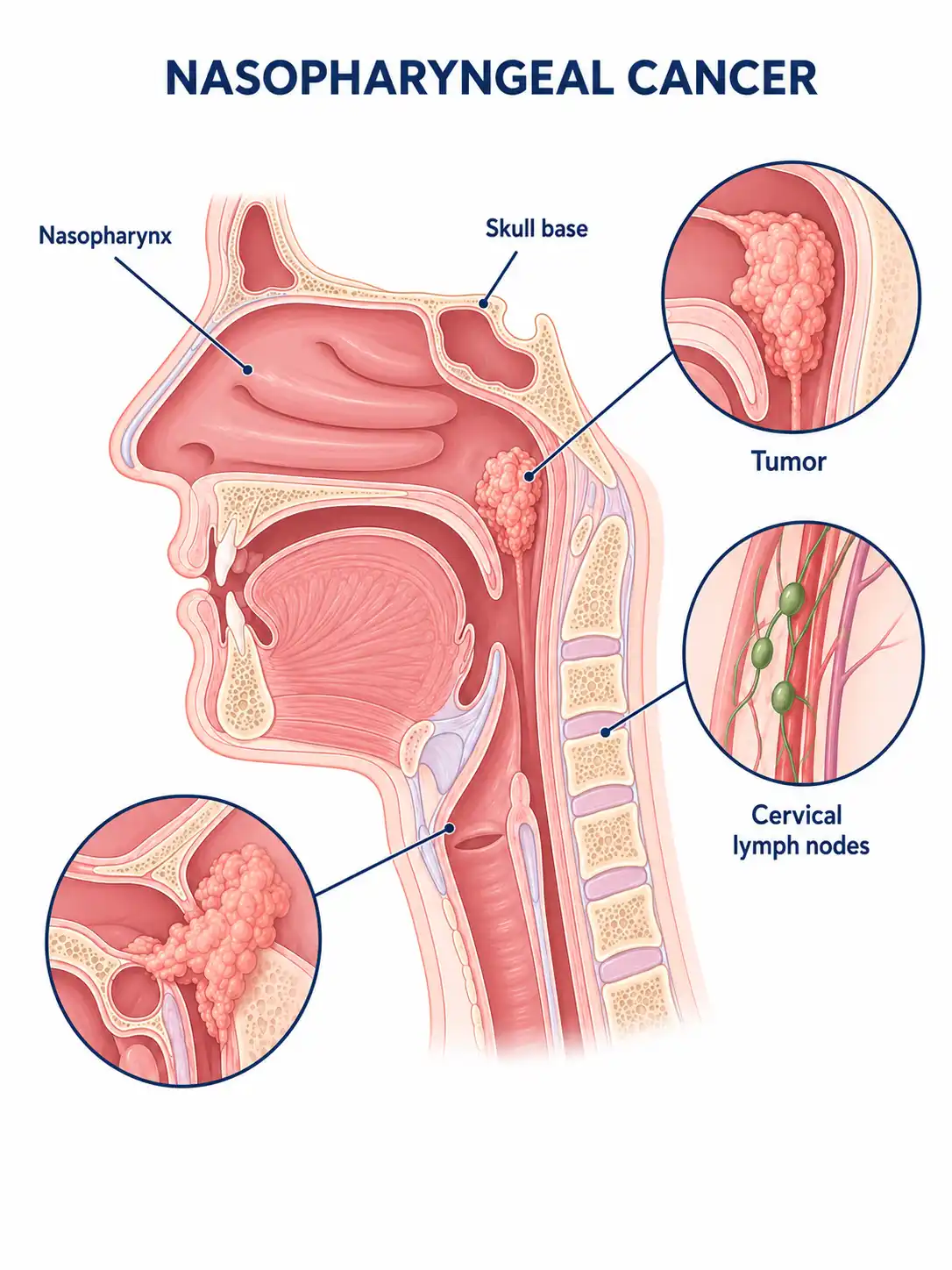
Nasopharyngeal cancer is a tumor formed by malignant proliferation of nasopharyngeal mucosal epithelial cells. Located behind the nasal cavity and below the skull base, the nasopharynx is a crossroads for breathing and swallowing.
The global situation regarding nasopharyngeal cancer
Nasopharyngeal cancer is uncommon worldwide but geographically concentrated. Rates are higher in Southeast Asia, North Africa, the Middle East, and some Arctic populations, but low in most Western regions. The burden is associated with Epstein-Barr virus infection, genetics, and dietary or environmental factors.
Consult a doctor regarding cancer-related issues
Anyone experiencing blood-stained postnasal secretions, unilateral nasal obstruction, tinnitus or ear fullness, a painless neck lump, or double vision should promptly consult an ENT or head and neck oncology specialist, especially residents of southern coastal regions.
Main types of nasopharyngeal cancer
1. Keratinizing squamous cell carcinoma
It has distinct pathological features, including keratin pearl formation, and is not closely associated with Epstein-Barr virus. It accounts for a small proportion of nasopharyngeal cancers and is somewhat less radiosensitive.
2. Nonkeratinizing squamous cell carcinoma
The most common pathological type, it is closely associated with Epstein-Barr virus infection, is poorly differentiated and highly radiosensitive, and responds well to treatment.
3. Undifferentiated carcinoma
The cancer cells lack differentiation features and form nests or cords. This type has the closest association with Epstein-Barr virus and is relatively sensitive to both radiotherapy and chemotherapy.
4. Basaloid squamous cell carcinoma
This relatively rare type has distinctive pathological morphology, is highly invasive, and readily spreads to lymph nodes early, requiring aggressive multimodal treatment.
5. Nasopharyngeal adenocarcinoma
Arising from minor salivary glands or the surface epithelium of the nasopharynx, it is extremely rare. Its biological behavior differs from squamous cell carcinoma, and treatment strategies also differ.
Typical symptoms and signs of nasopharyngeal cancer
1. Blood-stained postnasal secretions
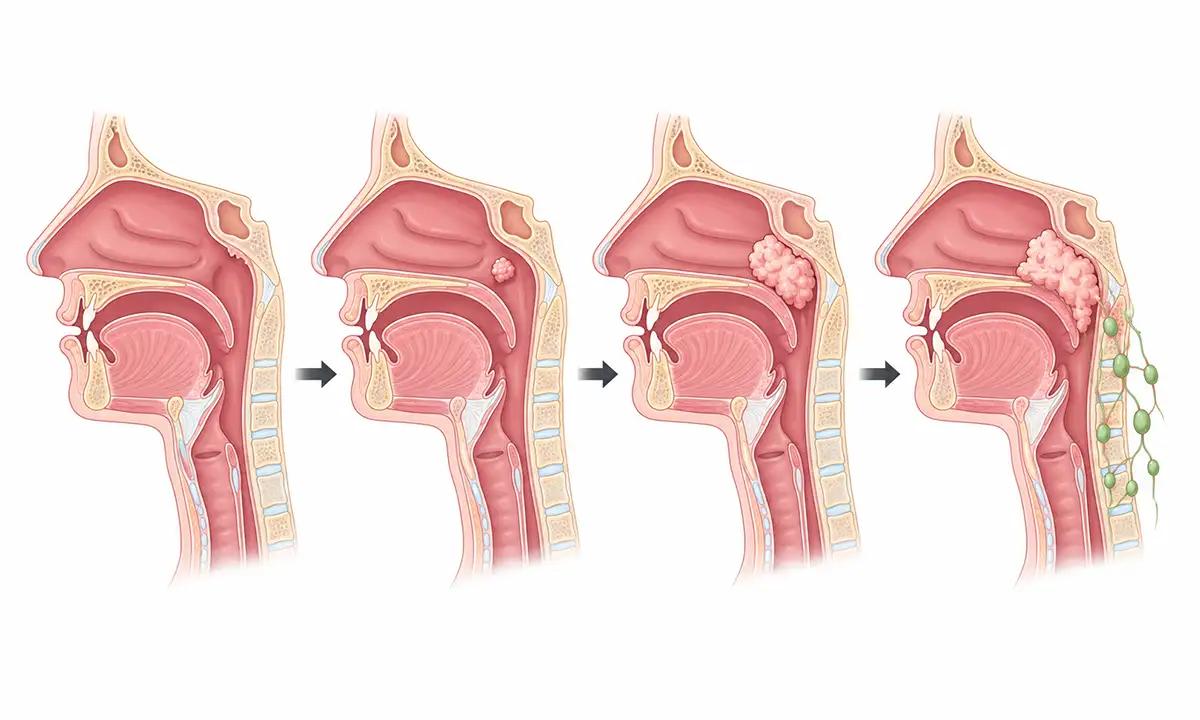
Blood streaks in nasal secretions drawn back into the throat on waking are a typical early manifestation of nasopharyngeal cancer. Initially, the small amount of bleeding is easily overlooked; persistent symptoms warrant close attention.
2. Unilateral nasal obstruction
A tumor blocking the posterior nasal aperture causes progressive unilateral nasal obstruction, sometimes with a runny nose and reduced sense of smell. Unlike rhinitis, symptoms worsen persistently and do not respond to medication.
3. Tinnitus and ear fullness
Compression of the pharyngeal opening of the Eustachian tube impairs middle ear ventilation, causing unilateral tinnitus, ear fullness, and hearing loss, resembling otitis media with effusion.
4. Neck lump
Nasopharyngeal cancer readily spreads to cervical lymph nodes. A painless upper neck lump is often the first symptom; it tends to be firm, poorly mobile, and fast-growing.
5. Headache
Upward invasion of the skull base and cranial nerves causes persistent headaches, usually in the temporal or occipital region. Pain becomes increasingly severe and unbearable in advanced disease.
6. Cranial nerve symptoms
Skull base invasion may cause facial numbness, double vision, impaired eye movements, and hoarseness due to cranial nerve involvement, indicating advanced disease.
How is nasopharyngeal cancer diagnosed
1. Nasopharyngoscopy
Indirect or electronic nasopharyngoscopy allows direct observation of the nasopharyngeal mucosa to identify abnormalities such as raised lesions, ulcers, or cauliflower-like growths.
2. Epstein-Barr virus serology
VCA-IgA and EA-IgA antibody levels are measured. Positive results suggest active Epstein-Barr virus infection and provide an important means of screening and supporting diagnosis of nasopharyngeal cancer.
3. Nasopharyngeal biopsy
Suspicious tissue is sampled under direct nasopharyngoscopic visualization for pathological examination. This is the gold standard for diagnosing nasopharyngeal cancer and determines the pathological type.
4. Contrast-enhanced MRI scan
MRI offers high soft-tissue resolution, clearly showing tumor extent, skull base bone destruction, and intracranial invasion. It is the preferred imaging method for staging.
5. Neck ultrasound
Ultrasound assesses the size, shape, number, and blood flow of cervical lymph nodes and guides needle biopsy to confirm metastasis.
6. PET-CT scan
Whole-body PET-CT can detect distant metastases that conventional imaging may miss, helping achieve accurate staging and develop a comprehensive treatment plan.
What treatments are available for nasopharyngeal cancer
1. Radiotherapy
Radiotherapy is the first-line treatment for nasopharyngeal cancer. Intensity-modulated radiotherapy precisely targets the tumor while protecting surrounding normal tissue; radiotherapy alone can achieve good outcomes in early-stage patients.
2. Concurrent chemoradiotherapy
Concurrent chemoradiotherapy with cisplatin is the standard regimen for locally advanced disease and significantly improves local control and survival.
3. Chemotherapy
Induction chemotherapy can shrink tumors and eliminate micrometastases, while adjuvant chemotherapy can reduce the risk of distant metastasis. Platinum and taxane drugs are commonly used.
4. Targeted therapy
Anti-EGFR monoclonal antibodies such as nimotuzumab can improve outcomes when combined with radiotherapy and are suitable for locally advanced disease.
5. Immunotherapy
PD-1 inhibitors such as camrelizumab and toripalimab have been approved for recurrent or metastatic nasopharyngeal cancer.
6. Surgery
Surgery is mainly used for local recurrence or residual cervical lymph nodes after radiotherapy, including salvage nasopharyngeal surgery and neck dissection.
7. Nutritional support
Nutritional support and oral hygiene should be strengthened during radiotherapy. If swallowing becomes difficult, nasogastric feeding or gastrostomy can ensure adequate nutrition.
Conclusion
Nasopharyngeal cancer is closely associated with Epstein-Barr virus infection and shows marked geographic clustering. Improving cancer awareness, seeking prompt care for symptoms such as blood-stained postnasal secretions, and receiving standardized multimodal treatment centered on radiotherapy can help achieve good long-term survival.


