


Indications
1. Applicable conditions
• Patients unsuitable for surgery or seeking minimally invasive options: Elderly patients, those with compromised cardiopulmonary function or multiple underlying conditions who cannot tolerate open resection; involves only a puncture procedure with a shorter postoperative recovery period.
• Lesions adjacent to major blood vessels, nerves, or vital organs, where surgical resection carries high risk and maximal preservation of organ function is required
• Local residual or recurrent lesions following radiotherapy, chemotherapy, or external beam radiation; can serve as a supplementary local intervention.
• Patients with intermediate-to-advanced stage tumors; intervention targeting lesions with a high local tumor burden—in addition to systemic therapy—to alleviate symptoms and optimize the comprehensive treatment strategy.
2. Common indications
Covers local control of solid tumors across multiple body systems: prostate cancer; lung cancer and thoracic tumors (including select pulmonary metastases and chest wall/mediastinal lesions); abdominal tumors such as liver cancer, liver metastases, pancreatic cancer, and cholangiocarcinoma; head, neck, and facial tumors (e.g., nasopharyngeal and oral-maxillofacial lesions); intraorbital tumors; brain tumors; bone and soft tissue tumors; paraspinal and vertebral lesions; pelvic tumors and recurrences (including gynecologic tumor-related lesions); and renal and adrenal tumors.
Core Strengths
1. High-dose irradiation within the tumor; low radiation exposure to normal tissues
Iodine-125 seeds have an effective radiation range of approximately 7 cm, with the dosage decaying rapidly as distance increases.By placing the miniature radiation source directly inside the tumor, the lesion receives a high radiation dose; meanwhile, the rapid attenuation of the radiation significantly reduces exposure to surrounding organs and blood vessels, resulting in better overall tolerability.
2. Unaffected by the thermal effects of blood flow; suitable for highly vascularized lesions
It is not a thermal ablation technique; its efficacy is not diminished by the dissipation of energy via tumor blood flow. It allows for conformal source placement that adapts to irregular tumor shapes, making it suitable for lesions with rich blood supply or complex anatomical structures.
3. Long-acting, continuous irradiation covering the tumor proliferation cycle
Iodine-125 seeds have a half-life of approximately 54 days and an effective duration of about 180 days; they continuously deliver low-dose radiation to tumor cells across various stages of division, thereby suppressing lesion proliferation over the long term.
4. Sealed radioactive source; stable safety profile
The seeds feature a fully sealed titanium alloy shell (approximately 0.8 × 5 mm) with excellent biocompatibility, allowing for long-term retention in the body and significantly reducing the risk of radioactive source leakage.
5. Local reinforcement regimen for recurrent or advanced tumors
For lesions that are unresectable or have reached the limit for external radiotherapy dosage, supplemental local radiation can be administered to alleviate lesion-related discomfort; this can be combined with interventional, targeted, or immunotherapies to create a comprehensive treatment plan.
Technical features
1. TPS: 3D customized dose planning
Prior to the procedure, a 3D tumor model is reconstructed using CT imagery. The TPS (Treatment Planning System) automatically calculates the number of seeds, puncture trajectories, and distribution density, designing a conformal dose plan tailored to the tumor's shape that balances lesion coverage with the protection of surrounding organs.
2. Real-time intraoperative dose verification and flexible optimization of seed implantation
Synchronous scanning is performed during the implantation process to evaluate seed distribution. If insufficient local dose coverage is detected, additional seeds are implanted along a safe puncture path to optimize the dose distribution in the target area, thereby establishing a closed-loop quality control process comprising "pre-operative planning, intra-operative execution, and intra-operative verification."
3. MDT (Multidisciplinary Team) integrated diagnosis and treatment
Joint consultations involving oncology, radiology, radiotherapy, and interventional radiology are conducted for every patient. Seed implantation is strategically combined with systemic therapy, ablation, and external beam radiotherapy to balance local lesion control with systemic disease management, while simultaneously planning long-term follow-up.
Technical definition
Iodine-125 seed implantation is a standardized interstitial brachytherapy technique. It utilizes real-time CT or ultrasound imaging guidance and a 3D treatment planning system (TPS) to design the dosage. Sealed Iodine-125 radiation sources are deployed into the tumor lesion and areas of infiltration via minimally invasive percutaneous puncture. It achieves local tumor control through sustained, low-dose local radiation and represents a key branch of comprehensive, minimally invasive treatment for solid tumors. The procedure is performed in accordance with established domestic expert consensus guidelines on seed implantation.
Working principle/mechanism
Iodine-125 seeds continuously emit low-energy gamma rays (energy approx. 27–35 keV), with an effective radiation range (5–0 cm) confined to the immediate vicinity of the lesion.On one hand, the radiation directly damages the DNA strands of tumor cells, blocking cell division and proliferation; on the other hand, it ionizes water molecules within the tissue to generate reactive free radicals, further exacerbating damage to the tumor cells.
The seeds continuously emit radiation, acting on tumor cells throughout their proliferation cycles over the long term; meanwhile, the radiation dose attenuates rapidly with distance, minimizing radiation impact on blood vessels, nerves, and organs surrounding the lesion.
Treatment process
1. Image acquisition and target area localization
Perform a comprehensive contrast-enhanced CT scan to determine the tumor's size, shape, and spatial relationship with surrounding critical tissues, thereby providing the necessary data for 3D dose planning.
2. TPS: 3D pre-operative treatment planning
The system delineates the tumor target area and sets the appropriate prescription dose; it automatically calculates puncture paths, needle distribution, and the number and spacing of seeds to optimize dose conformity.
3. Image-guided positioning and puncture
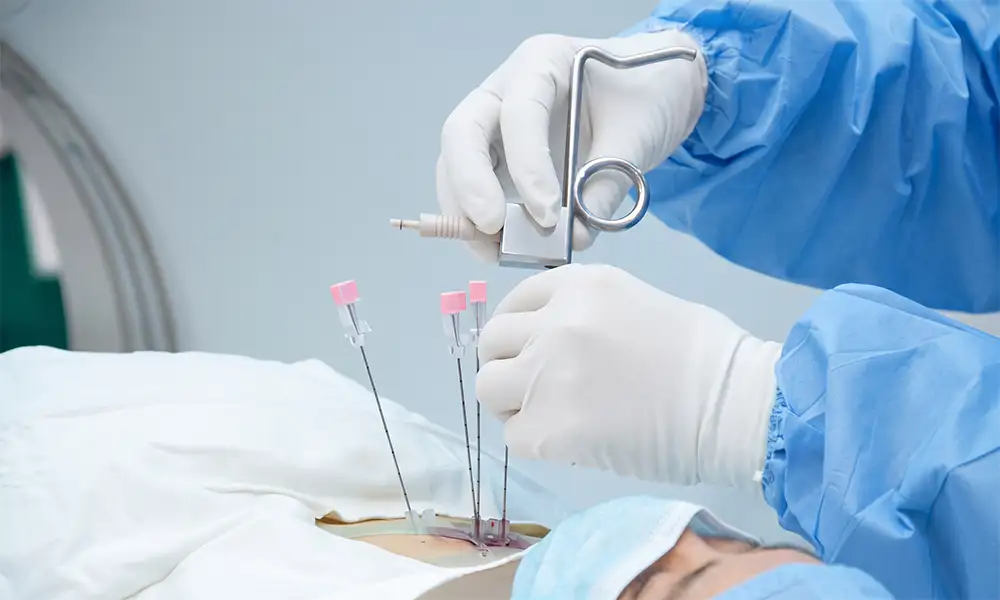
Real-time CT scanning is used to pinpoint the puncture site on the body surface; following local anesthesia, a puncture needle is guided along a pre-planned path into the tumor.
4. Implantation of particles at designated points according to the plan
Radioactive seeds are deployed in layers along each needle track to progressively complete the source distribution across the entire lesion, adhering to the preoperative 3D dose plan.
5. Intraoperative real-time dose verification and supplementary placement
After implantation, a scan is performed to reconstruct the seed distribution and assess dose coverage in the target area; if areas of dose deficiency are identified, additional seeds can be safely implanted.
6. Wound management and short-term postoperative observation
Withdraw the puncture instrument; disinfect the puncture site and apply a pressure dressing; keep the patient hospitalized to monitor vital signs and check for bleeding at the puncture site.
7. Periodic imaging follow-up and assessment
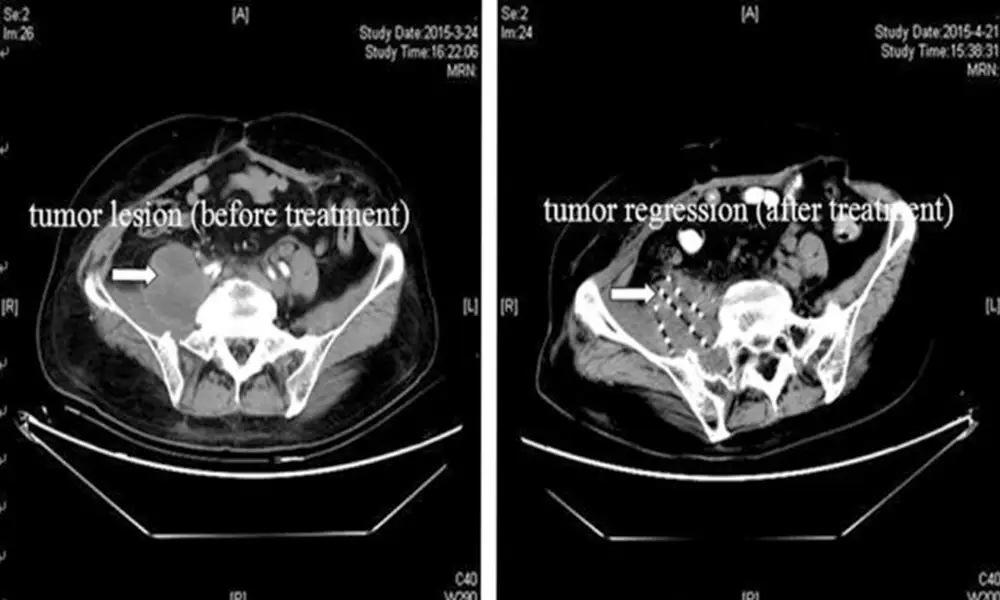
Postoperative CT follow-up to assess seed distribution and lesion changes; simultaneous provision of radiation safety education and dynamic adjustment of the subsequent comprehensive treatment schedule.
Safety and Precautions
1. Standardized radiation protection management
Strictly adhere to the three key protective principles—distance, time, and crowd avoidance—throughout the process to minimize unnecessary close-range, prolonged contact with the area where seeds were implanted; follow medical advice regarding the duration of contact during daily caregiving or home interactions.
2. Contact control for special populations
Pregnant women, infants, and breastfeeding family members should minimize close, prolonged physical contact; specific protective guidelines will be provided individually by medical staff.
3. Puncture site care and activity restrictions
In the short term after the procedure, avoid strenuous running or jumping, heavy lifting, and significant torso twisting to prevent bleeding, swelling, or pain at the puncture site; keep the puncture site clean and dry, and seek follow-up care promptly if oozing, redness, swelling, or heat occurs.
4. Scheduled follow-up assessments
Ensures completion of follow-up CT and imaging scans as ordered; verifies seed positioning and local changes in the lesion; conducts dose assessments as needed;and adjusts the subsequent comprehensive intervention plan.
5. Combined treatment coordinated by the MDT (Multidisciplinary Team)
Seed implantation can be combined with interventional therapy, targeted therapy, immunotherapy, and external beam radiotherapy. Treatment intervals, the sequence of therapies, and follow-up schedules are determined by a multidisciplinary team; patients must not unilaterally interrupt follow-ups or alter the treatment plan.
FAQs
1. What is Iodine-125 seed implantation?How does it differ from conventional radiotherapy?
Iodine-125 seed implantation is a form of brachytherapy (internal radiotherapy). Physicians place sealed, miniature radiation sources inside or near the tumor, allowing radiation to act continuously on the local area over a period of time;in contrast, conventional external beam radiotherapy involves directing radiation at the lesion from an external device.
2. Which patients might be suitable for radioactive seed implantation?
May be considered for certain localized solid tumors, post-surgical or post-radiotherapy recurrences, and patients unsuitable for surgery due to lesion location or physical condition.Suitability assessment includes pathological type, lesion extent, prior radiation doses, puncture trajectory, and safety margins relative to surrounding organs.
3. How are the seeds implanted?What type of anesthesia is required?
Preoperative planning involves using imaging (such as CT) and treatment planning systems to determine the number, placement, and dosage of radioactive seeds, which are then implanted via puncture needles under image guidance.Local anesthesia, sedation, or general anesthesia may be used, depending on the lesion's location and the procedure's complexity.
4. Do the implanted seeds need to be removed?
Permanently implanted Iodine-125 seeds generally do not require removal, as their radioactivity decays over time.Although the seeds are hermetically sealed, their position and dose distribution must still be monitored via scheduled follow-ups;any abnormalities should be managed by a professional medical team.
5. Will the body emit radiation after treatment?
The radioactive particles continuously emit low-energy radiation over a period of time; therefore, hospital guidelines regarding distance and duration of contact must be followed.In particular, before prolonged close contact with pregnant women, infants, or young children, specific protective requirements should be confirmed with radiotherapy or nuclear medicine personnel.
6. How soon can the treatment efficacy be evaluated?
Changes in the lesion are typically assessed via follow-up contrast-enhanced CT, MRI, or other imaging studies; the timing of re-examination depends on the specific disease type and treatment regimen.In the short term, the lesion may exhibit edema or necrotic changes; therefore, treatment efficacy cannot be judged solely based on volumetric changes observed in a single imaging scan.


