


Indications
1. Applicable conditions
• Patients with hematologic malignancies whose disease has progressed or recurred following interventions such as conventional chemotherapy or targeted therapy.
• Patients deemed suitable for cellular immunotherapy following multidisciplinary assessment, with no severe, uncontrolled underlying medical conditions
• Patients meeting enrollment criteria who wish to explore novel treatment modalities and control tumor burden through immune intervention.
2. Common indications
• Relapsed/refractory B-cell acute lymphoblastic leukemia
• Relapsed/refractory diffuse large B-cell lymphoma
• Relapsed/refractory mantle cell lymphoma
• Other B-cell-derived hematologic malignancies within the scope of approved indications.
Core Strengths
1. Derived from autologous cells; superior compatibility
Prepared using the patient's own T-lymphocytes, thereby reducing risks associated with the rejection of exogenous cells.
2. Targeted gene modification for tumor recognition
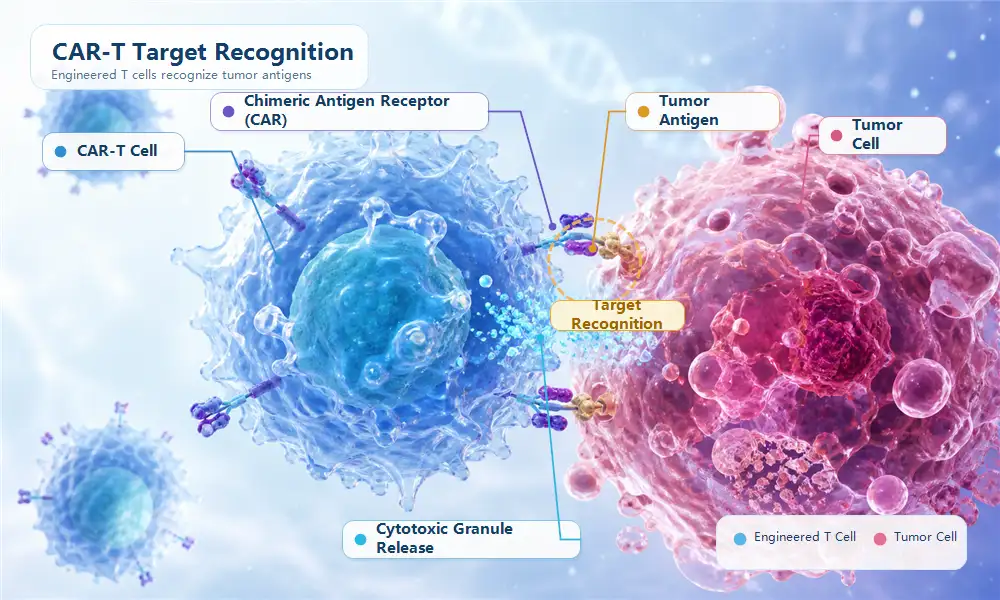
Employs genetic engineering to equip T cells with targeting receptors, enabling them to specifically recognize tumor cells and exert targeted anti-tumor effects.
3. Long-lasting effect of living cells
The engineered CAR-T cells can persist in the body for an extended period, continuously tracking and acting upon tumor cells.
4. Expanding treatment options for patients with relapsed or refractory disease
Provides a novel treatment pathway for relapsed or refractory hematologic malignancies that have shown limited response to various standard regimens.
5. Can be integrated into a comprehensive treatment system
Following MDT assessment, it can be appropriately combined with modalities such as chemotherapy and supportive care to optimize the overall treatment plan.
Technical features
Fosun Health has established a standardized clinical diagnosis and treatment system for CAR-T therapy, strictly adhering to domestic consensus and guidelines regarding clinical CAR-T applications.
The clinical team comprises experts in hematology-oncology, cell therapy, and critical care medicine, conducting regular multidisciplinary team (MDT) consultations.Pre-treatment, patients undergo systematic assessment of tumor status, organ function, and immune status to determine suitability for CAR-T therapy. Throughout the treatment process, key indicators are closely monitored to promptly identify and manage adverse reactions. Post-treatment, a long-term follow-up mechanism is established to continuously assess disease progression and dynamically plan subsequent supportive care.
Strictly implement quality control across the entire process, standardizing the management of the full chain—including cell collection, pretreatment, cell reinfusion, and monitoring for adverse reactions—to ensure a standardized treatment workflow.
Technical definition
CAR-T cell therapy (Chimeric Antigen Receptor T-cell therapy) is a form of personalized cellular immunotherapy.It involves collecting T-lymphocytes from the patient's peripheral blood and genetically modifying them *ex vivo* to express chimeric antigen receptors (CARs). After expansion and preparation, the CAR-T cells are infused back into the patient, enabling the modified immune cells to target and attack tumor cells. It is a key component of comprehensive treatment for hematologic malignancies, with clinical procedures following domestic expert consensus on CAR-T therapy.
Working principle/mechanism
1. Cell collection: Collecting the patient's own peripheral blood to isolate and obtain T lymphocytes
2. Ex vivo genetic modification: modifying T-cells using gene vectors to express CAR (Chimeric Antigen Receptor), thereby enabling immune cells to recognize tumor-specific antigens;
3. In vitro expansion: Modified CAR-T cells are cultured and expanded in the laboratory to reach the quantity required for treatment.
4. Mechanism of intravenous reinfusion: Upon reinfusion into the body, CAR-T cells precisely identify tumor cells bearing the corresponding target, activate immune-mediated killing mechanisms, and inhibit tumor cell proliferation.

Treatment process
1. Comprehensive preoperative screening and assessment: Complete imaging, bone marrow examinations, organ function tests, and immune-related assays; the MDT team makes a comprehensive determination regarding suitability for CAR-T therapy.
2. Lymphocyte collection (apheresis): Peripheral blood lymphocytes are collected from the patient using a blood cell separator and sent to the laboratory for CAR-T cell preparation.
3. Pre-treatment chemotherapy: administration of pre-treatment according to protocol prior to cell infusion to create a suitable environment for CAR-T cell proliferation in vivo
4. CAR-T cell intravenous infusion: The prepared CAR-T cells are infused back into the patient's body according to standard protocols.
5. Close in-hospital monitoring: Continuous monitoring of vital signs and inflammatory markers during hospitalization following reinfusion;timely monitoring and management of associated adverse reactions.
6. Long-term stratified follow-up: Follow-up examinations at standardized intervals after discharge to assess tumor burden and immune status, and to formulate subsequent supportive care plans.
Safety and Precautions
1. Rigorous preoperative MDT (Multidisciplinary Team) assessment is the foundation of safety.
Comprehensively assess tumor burden, organ reserve function, and prior treatment history to screen suitable patients and predict the risk of adverse reactions.
2. Strict in-hospital monitoring required during the reinfusion phase
The weeks following cell reinfusion represent a period of high risk for adverse reactions; hospitalization for monitoring is required to facilitate timely intervention.
3. Focus on two types of typical adverse reactions
Some patients may experience cytokine release syndrome or immune effector cell-associated neurotoxicity syndrome, manifesting as symptoms such as fever, fatigue, or headache.Please inform the medical team immediately if you experience any discomfort.
4. Infection risk prevention and control
Immune levels may fluctuate for a period following treatment; patients should take precautions in daily life, such as avoiding exposure to cold and contact with infected individuals, and seek medical attention promptly if a fever develops.
5. Standardized, scheduled follow-up
Do not arbitrarily skip follow-up examinations; disease status and immune reconstitution must be continuously assessed during the follow-up period.
6. Comprehensive treatment plan unified by the multidisciplinary team
Chemotherapy and supportive care regimens administered before and after CAR-T therapy are coordinated by the Multidisciplinary Team (MDT);please do not adjust medications on your own.
FAQs
1. What is CAR-T cell therapy?
CAR-T is a type of cellular immunotherapy.Physicians collect T-cells from the patient, genetically modify and expand them *ex vivo* to enable recognition of specific tumor markers, and then infuse the cells back into the patient.
2. Which hematologic malignancies might be suitable for CAR-T therapy?
Currently, various CAR-T products have been approved for specific types and treatment stages of B-cell lymphoma, B-cell acute lymphoblastic leukemia, multiple myeloma, etc. Patients must meet the specific pathological, prior treatment, and physical condition criteria outlined in the product's prescribing information.
3. Can CAR-T therapy only treat hematologic malignancies?
No longer.In 2026, China approved Suricioleucel for eligible patients with advanced gastric or gastroesophageal junction adenocarcinoma that is CLDN18.2-positive and HER2-negative, and has progressed after at least two lines of therapy; however, this does not mean that all gastric cancers or other solid tumors are suitable for CAR-T therapy.
4. How long does the process take from cell collection to infusion?
Treatment typically involves eligibility assessment, apheresis, cell preparation, necessary bridging therapy, lymphodepleting pre-conditioning, cell reinfusion, and inpatient monitoring.Cell preparation generally requires a specific timeframe, depending on the product, production schedule, and the patient's condition.
5. What are the major risks associated with CAR-T therapy?
Key risks include cytokine release syndrome (CRS), immune effector cell-associated neurotoxicity syndrome (ICANS), infection, cytopenia, and hypogammaglobulinemia.Report any fever, hypotension, difficulty breathing, or abnormalities in consciousness or speech to medical staff immediately.
6. How long is the hospital stay after the procedure?What precautions should be taken after discharge?
The duration of hospitalization and monitoring depends on the specific product used, hospital protocols, and the patient's response; it cannot be standardized to a fixed number of weeks.After discharge, patients must remain within a reasonable distance of the treatment center for timely follow-up visits to monitor blood counts and immune status, and must strictly adhere to medical advice regarding infection prevention, medication regimens, and vaccination schedules.


