


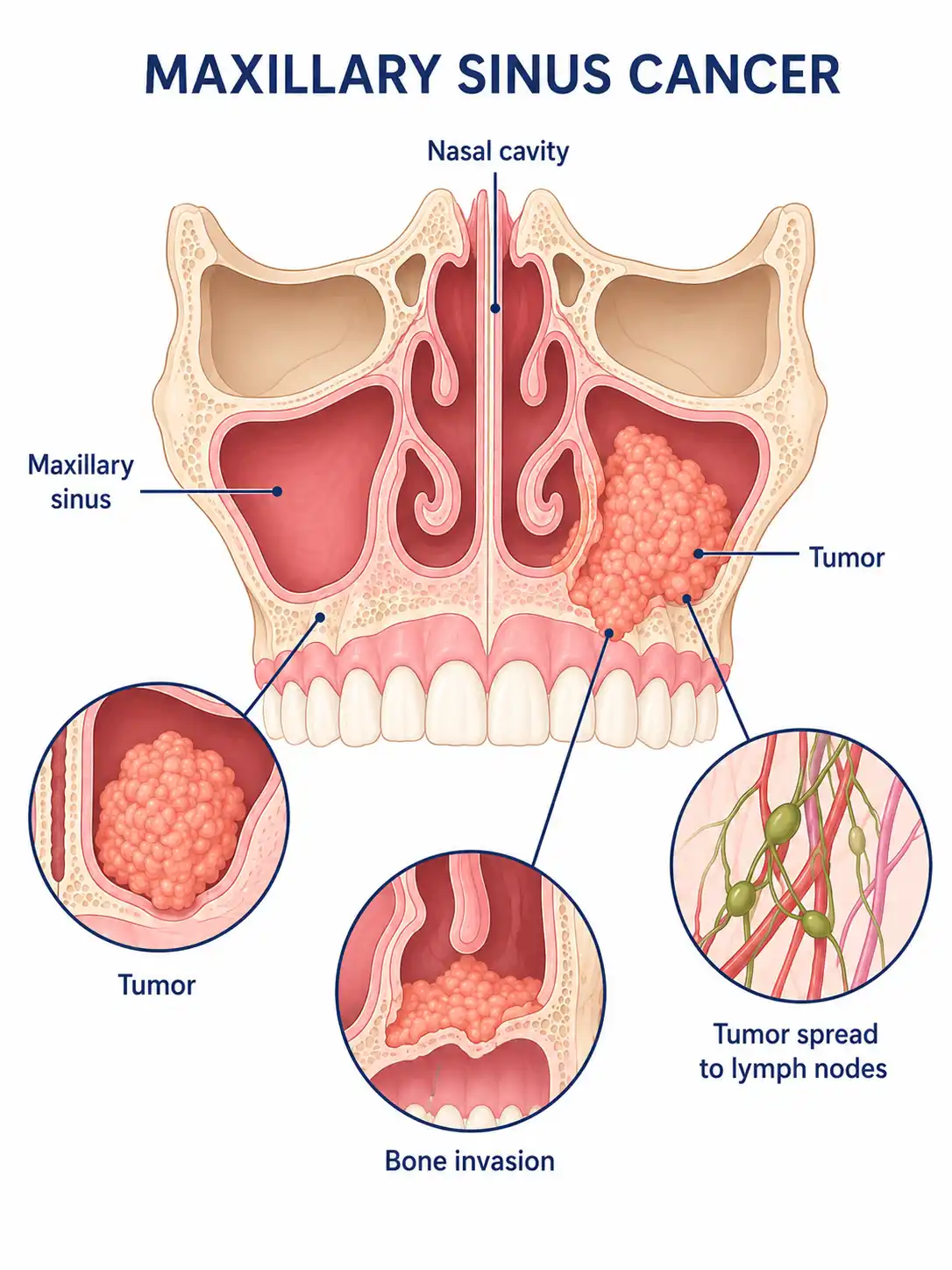
Maxillary Sinus Cancer Overview
Maxillary sinus cancer is a tumor formed by malignant proliferation of epithelial cells in the maxillary sinus mucosa. The maxillary sinuses lie below the orbits on either side of the nasal cavity and are the largest paranasal sinuses.
The global situation regarding maxillary sinus cancer
Maxillary sinus cancer accounts for a small proportion of head and neck malignancies but is the most common paranasal sinus malignancy. It is more common in men and usually occurs at ages 50-70.
Consult a doctor regarding cancer-related issues
Anyone with persistent unilateral nasal obstruction, bloody nasal discharge, facial swelling or numbness, toothache, loose teeth, or double vision should promptly consult an ENT or head and neck surgeon.
Main types of maxillary sinus cancer
1. Squamous cell carcinoma
This is the most common pathological type of maxillary sinus cancer, accounting for most cases. Its biological behavior and treatment response resemble those of other head and neck squamous cell carcinomas.
2. Types of adenocarcinoma
Arising from glands in the maxillary sinus mucosa, this relatively rare type can be low-grade or high-grade. High-grade adenocarcinoma is highly invasive and has a poorer prognosis.
3. Adenoid cystic carcinoma
It arises from minor salivary glands and tends to grow along nerves. Local recurrence is common, but distant metastasis occurs relatively late.
4. Undifferentiated carcinoma
It is extremely poorly differentiated and grows rapidly, with extensive infiltration and metastasis possible early. Treatment outcomes are poor and prognosis is extremely unfavorable.
5. Osteosarcoma types
These extremely rare tumors arise from maxillary sinus bone tissue and include chondrosarcoma and osteosarcoma. Surgical resection is the main treatment.
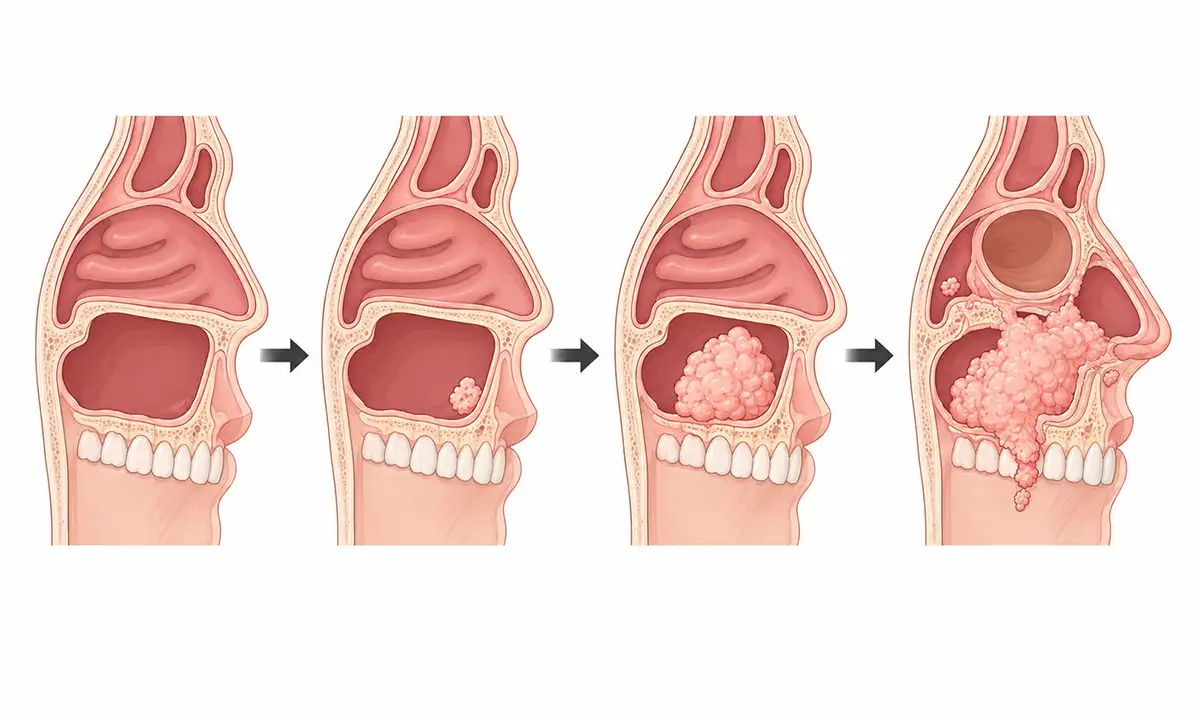
Typical symptoms and signs of maxillary sinus cancer
1. Unilateral nasal obstruction
Tumor obstruction of the maxillary sinus opening causes progressive unilateral nasal obstruction, often with purulent bloody nasal discharge. It resembles chronic sinusitis and is easily overlooked.
2. Facial swelling
Tumor invasion beyond the sinus wall causes cheek swelling and prominence, potentially leading to facial deformity in severe cases. A hard, fixed mass may be palpable.
3. Toothache and loose teeth
Downward invasion of the alveolar bone causes toothache, tooth loosening, or even tooth loss. A persistently unhealed extraction wound is an important warning sign.
4. Facial numbness
Invasion of the infraorbital nerve causes numbness of the cheek and upper lip, an important sign of tumor spread along nerves.
5. Eye symptoms
Upward invasion of the orbit can cause eye protrusion, double vision, excessive tearing, and reduced vision, indicating relatively advanced disease.
6. Difficulty opening the mouth
Posterolateral invasion of the pterygopalatine and infratemporal fossae can involve the medial pterygoid muscle, restricting mouth opening and affecting eating and speech.
How is maxillary sinus cancer diagnosed
1. Nasal endoscopy
Nasal endoscopy examines the middle meatus and posterior nasal aperture for medial displacement of the lateral nasal wall, new growths, or abnormal secretions, and guides biopsy sampling.
2. Sinus CT scan
CT is the preferred imaging method for assessing maxillary sinus cancer, showing sinus wall bone destruction, tumor extent, and surrounding tissue involvement.
3. Contrast-enhanced MRI
MRI provides high soft-tissue resolution, clearly showing the tumor's relationship to the orbit, skull base, and pterygopalatine fossa and helping with accurate staging.
4. Pathological biopsy
Lesion tissue obtained by nasal endoscopy or needle biopsy through the nasal vestibule is submitted for pathological examination, the gold standard for diagnosing maxillary sinus cancer.
5. Chest CT scan
Chest CT is used to rule out pulmonary metastasis and is an essential component of routine preoperative staging examinations.
6. Whole-body bone scan
Bone scanning assesses whether bone metastases are present and should be considered when bone pain occurs.
What treatments are available for maxillary sinus cancer
1. Surgical treatment
Maxillectomy is the main treatment for maxillary sinus cancer. Partial or total resection is selected according to tumor extent, with orbital exenteration when necessary.
2. Radiation therapy
Preoperative radiotherapy can shrink the tumor and improve resectability. Postoperative adjuvant radiotherapy reduces local recurrence risk, while radiotherapy alone is suitable for patients unable to undergo surgery.
3. Chemotherapy
Chemotherapy may be used as preoperative neoadjuvant or postoperative adjuvant treatment, or for palliation in advanced and recurrent disease.
4. Concurrent chemoradiotherapy
Concurrent chemoradiotherapy is suitable for unresectable locally advanced disease or as adjuvant treatment for high-risk postoperative patients.
5. Targeted therapy
Anti-EGFR targeted drugs have shown efficacy in some head and neck squamous cell carcinomas and may be considered according to individual circumstances.
6. Repair and reconstruction
Prosthetic rehabilitation or free-flap reconstruction is needed after maxillectomy to restore facial appearance and oral function.
7. Comprehensive treatment
A multidisciplinary team developing a comprehensive plan combining surgery, radiotherapy, and chemotherapy is key to improving treatment outcomes.
Conclusion
Early symptoms of maxillary sinus cancer resemble sinusitis and are easily overlooked, so most cases are intermediate or advanced at diagnosis. Greater awareness, prompt care for unilateral nasal obstruction with facial swelling, and multimodal treatment centered on surgery can improve prognosis.


