


Penile cancer is a tumor resulting from the malignant transformation of epithelial cells in the penile skin and mucosa; it is relatively rare, accounting for less than 1% of malignant tumors in men.The vast majority of cases are squamous cell carcinoma; redundant foreskin, phimosis, and HPV infection are the primary risk factors.
Global prevalence of penile cancer by country
Penile cancer is relatively rare in Western countries but has a higher incidence in parts of Asia, Africa, and South America.It predominantly affects men aged 50–70.Redundant foreskin and phimosis, which lead to the accumulation of smegma, are significant risk factors;circumcision in infancy or early childhood can significantly reduce the risk.HPV-16 and HPV-18 infections are associated with approximately 40%–50% of penile cancer cases.
Penile cancer: staging and symptoms
1.Early symptoms of penile cancer
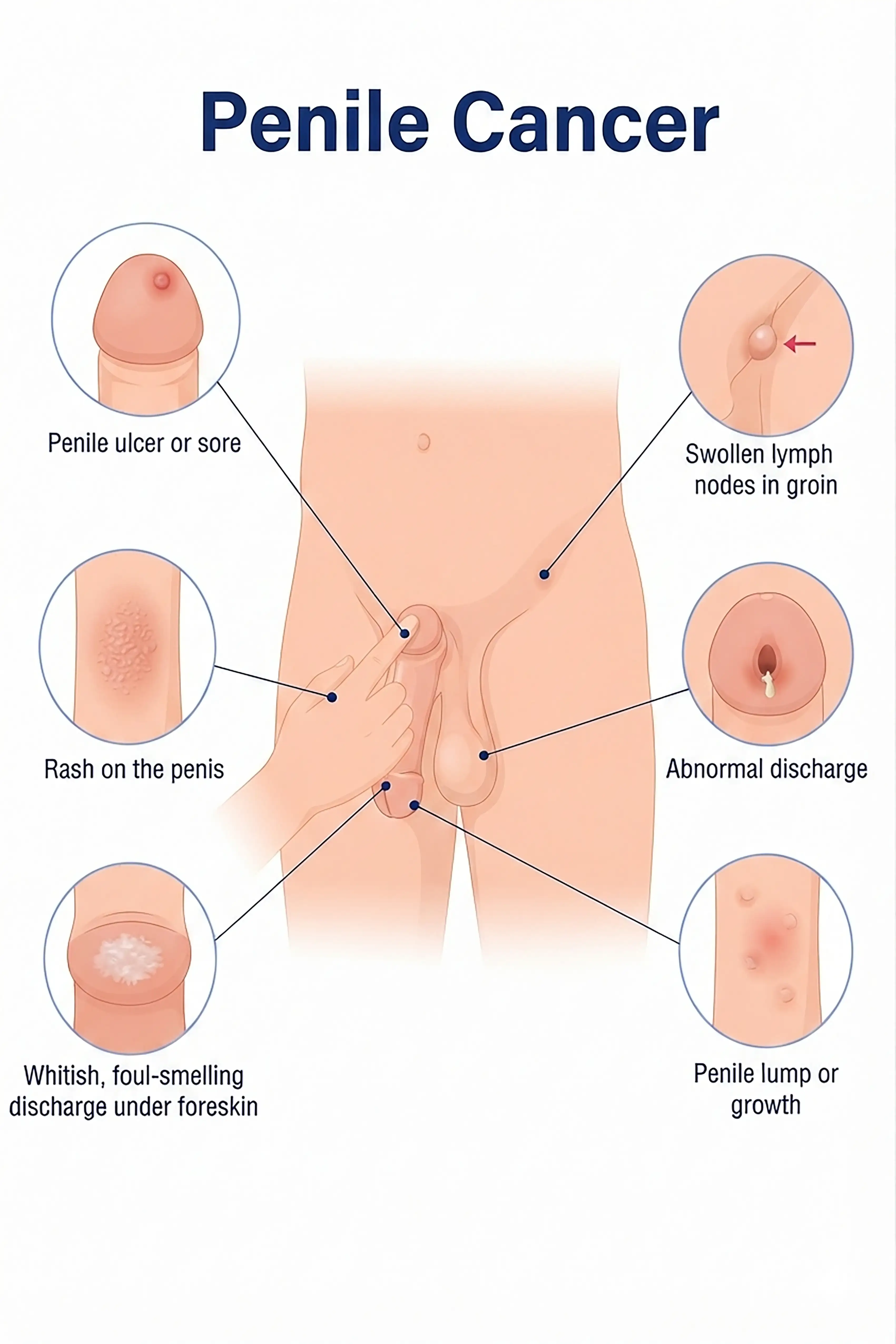
Erythema, papules, white patches, or induration appear under the foreskin, accompanied by itching and mild discomfort; early detection is difficult due to the concealed location.
2.Intermediate-stage symptoms of penile cancer
An ulcer or cauliflower-like mass appears on the glans penis or inner foreskin, accompanied by foul-smelling discharge, bleeding, and pain; retraction of the foreskin is difficult.
3.Symptoms of advanced penile cancer
The tumor invades the majority of the penile shaft and the urethra, resulting in difficulty urinating, persistent severe pain, inguinal lymphadenopathy, and distant metastasis.
When to Seek Medical Attention
Early signs of penile cancer include red patches, ulcers, lumps, and abnormal discharge on the glans penis.Please consult a doctor via the "Chat with Doctor" feature to facilitate early detection.During the online consultation, the doctor will ask about the condition of your foreskin and your symptoms, and provide guidance on undergoing a local biopsy.
Staging of penile cancer
Stage 0 penile cancer
Cancer cells are confined to the penile epithelium; this is classified as carcinoma in situ (e.g., Paget's disease or erythroplasia of Queyrat), presenting as erythematous or leukoplakic skin lesions.
Stage I penile cancer
The tumor is confined to the glans penis and foreskin, measures less than 2 cm in diameter, and shows no lymph node metastasis.
Stage II penile cancer
The tumor measures 2–5 cm in diameter or invades the penile shaft, accompanied by regional lymph node enlargement.
Stage III penile cancer
Tumor diameter >5 cm or extensive invasion of the penile shaft, with fixed inguinal lymph node metastasis.
Stage IV penile cancer
Difficulty urinating and systemic wasting occur when the tumor invades adjacent organs or metastasizes to distant sites.

Detailed Symptoms of Penile Cancer
1.Appearance of penile erythema
Early signs include the appearance of well-defined erythematous (red) or white patches on the glans penis or inner foreskin, with a rough surface and associated mild itching and burning sensations.
2.Non-healing ulcer
An ulcer or area of erosion appears on the glans penis; the edges are raised and irregular, the lesion fails to heal over a long period, it bleeds easily upon contact, and is accompanied by foul-smelling discharge.
3.Cauliflower-like tumor
The tumor exhibits exophytic cauliflower-like or papillary growth with a rough, uneven surface and friable texture; it bleeds and undergoes necrosis easily upon contact.
4.Increased smegma
Patients with redundant foreskin or phimosis exhibit a marked increase in smegma—a white or yellowish-white substance with a foul odor—which causes chronic irritation and can induce malignant transformation.
5.Localized pain
Tumor invasion of nerves or concurrent infection causes localized pain that worsens during urination; in severe cases, it can affect walking, sitting, and lying down.
6.Hemorrhage and exudation observed
Ulceration of the tumor surface leads to easy bleeding and the presence of bloody or seropurulent discharge that stains underwear.
7.Difficulty urinating
Tumor invasion of the urethral meatus causes obstructed urination, a narrowed or deflected urinary stream, and—in severe cases—urinary retention.
8.Inguinal swelling/enlargement
Penile cancer tends to metastasize to the inguinal lymph nodes, presenting as a hard, painless, and progressively enlarging inguinal mass.
9.Difficulty retracting foreskin
In patients with phimosis, the inability to retract the foreskin hinders visual inspection and cleaning, leading to concealed symptoms and delayed diagnosis.
Conclusion
Penile cancer is relatively rare;maintaining local hygiene and undergoing circumcision can effectively prevent it.Surgical treatment yields good results when the cancer is detected early.


