


What is penile cancer
Penile cancer is a tumor resulting from the malignant proliferation of squamous epithelial cells on the penis.The penis consists of three parts—the root, the body, and the glans—and is covered by squamous epithelium; tumors most commonly occur on the glans and the foreskin.
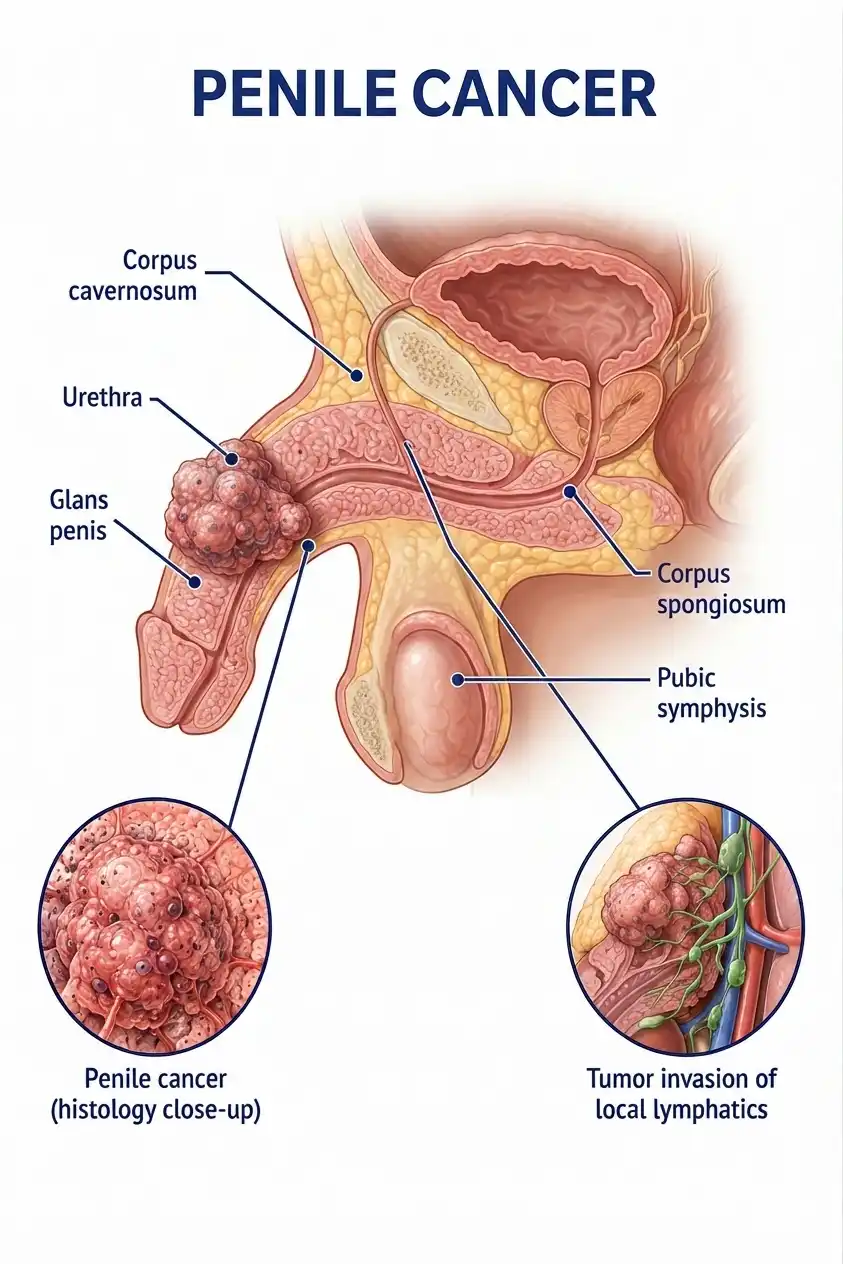
Global situation of penile cancer
Penile cancer is rare worldwide, but its incidence varies considerably by region, with a relatively higher burden in some low- and middle-income countries. It occurs mainly in middle-aged and older men. Persistent HPV infection, phimosis or poor foreskin hygiene, smoking, and immunosuppression are associated with an increased risk.
Consult a doctor regarding cancer-related issues
Patients presenting with ulcers, masses, or abnormal discharge on the glans penis or foreskin, or an inability to retract the foreskin, should promptly consult a urologist or andrologist.
Main types of penile cancer
1. Squamous cell carcinoma
The most common type, accounting for approximately 95% of penile cancers; it predominantly arises on the glans penis and the coronal sulcus.
2. Basaloid carcinoma
A subtype of squamous cell carcinoma composed of basaloid cells; it is associated with a relatively favorable prognosis.
3. Verrucous carcinoma
An exophytic, low-grade malignant tumor with a cauliflower-like appearance; it has a relatively good prognosis but is prone to local recurrence.
4. Adenocarcinoma
Originates from the glands of the penis or periurethral glands; relatively rare.
5. Melanoma
A malignant tumor originating from penile melanocytes; extremely rare, with a poor prognosis.
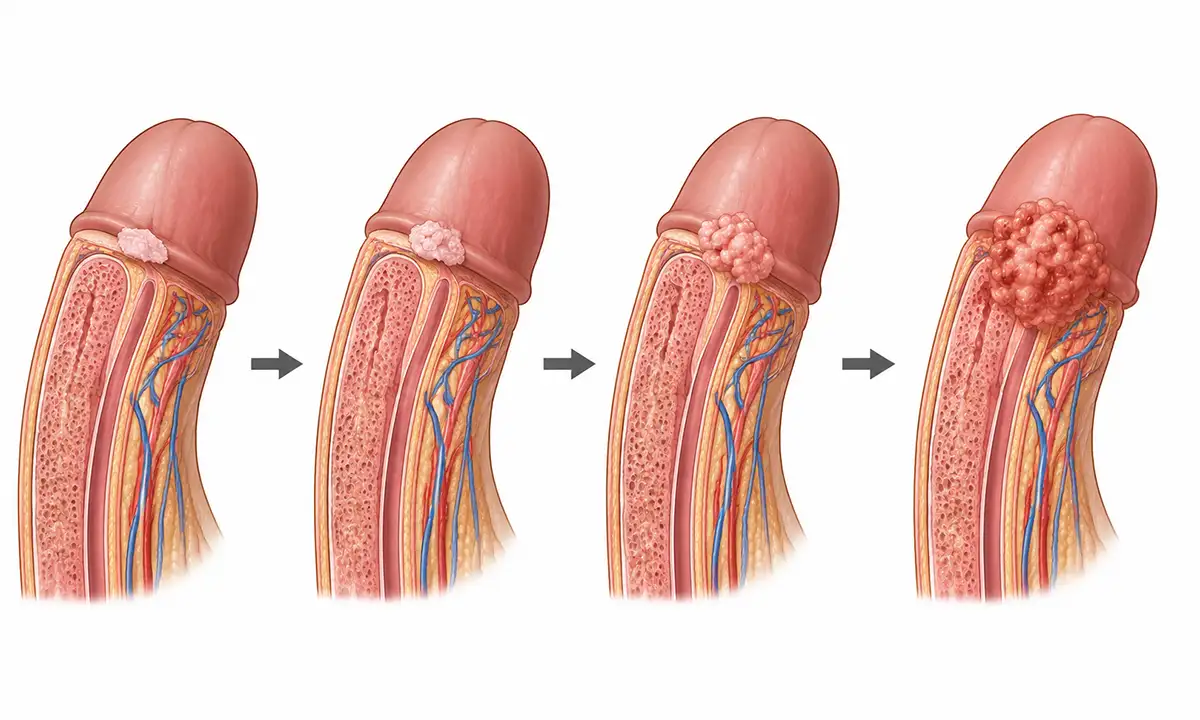
Typical symptoms and signs of penile cancer
1. Ulcer
A persistent, non-healing ulcer appears on the glans penis or foreskin; the edges are raised, the base is uneven, and it bleeds easily upon contact.
2. Mass/Lump
Nodules or masses appear on the glans penis, coronal sulcus, or inner foreskin; they are firm in texture and may present with a cauliflower-like appearance.
3. Abnormal discharge
Foul-smelling purulent or bloody discharge appears under the foreskin, associated with tumor necrosis and infection.
4. Inability to retract the foreskin
Tumor infiltration causes narrowing of the preputial orifice, preventing the foreskin from being retracted to expose the glans penis.
5. Pain
Persistent pain occurs when the tumor invades nerves or is complicated by infection.
6. Inguinal mass
Enlarged inguinal lymph nodes that are hard in texture and have poor mobility suggest possible lymph node metastasis.
Diagnostic methods for penile cancer
1. Physical examination
Carefully examine the glans penis, coronal sulcus, inner foreskin, and penile shaft to assess the tumor's location, size, and extent of invasion.
2. Biopsy pathology
Pathological examination of tissue from the suspected lesion is the gold standard for definitive diagnosis; the pathological type and degree of differentiation must be determined.
3. Pelvic MRI
MRI enables the assessment of tumor invasion depth, involvement of the cavernous bodies, and the status of inguinal lymph node metastasis.
4. HPV testing
Detecting HPV infection status; a subset of penile squamous cell carcinomas is associated with HPV type 16 infection.
5. Chest CT scan
Chest CT is used to rule out pulmonary metastasis and serves as a routine preoperative staging examination.
6. Ultrasound examination
Ultrasound of the groin can evaluate the size, morphology, and internal structure of lymph nodes.
Treatment Methods for Penile Cancer
1. Penis-sparing surgery
For small, early-stage tumors, local excision, laser excision, or Mohs surgery may be performed to preserve penile function and appearance as much as possible.
2. Partial penectomy
Excision of the tumor with a 2-cm surrounding safety margin; negative margins must be ensured, while preserving some penile function postoperatively.
3. Total penectomy
For patients with large tumors or tumors invading the corpus cavernosum, total penectomy is required, followed by the creation of a perineal urethrostomy.
4. Inguinal lymph node dissection
Patients with clinically positive lymph nodes or those at high risk require inguinal lymph node dissection; sentinel lymph node biopsy can help guide the extent of the surgery.
5. Chemotherapy
Platinum-based chemotherapy regimens are used for patients with advanced disease or lymph node metastasis.
6. Radiotherapy
For organ-sparing treatment of early-stage tumors, or as postoperative adjuvant therapy to reduce recurrence rates.
7. Circumcision
For patients with redundant foreskin accompanied by early-stage lesions, circumcision serves as both a treatment and a preventive measure.
8. Follow-up monitoring
Postoperative follow-up involving regular examination of the penile stump and inguinal lymph nodes is crucial to monitor for local recurrence and metastasis.
Conclusion
Penile cancer is a relatively rare malignant tumor of the male reproductive system, associated with HPV infection and a long foreskin.With early detection, organ-sparing surgery, and necessary adjuvant therapy, the prognosis is favorable.


