


Vulvar cancer is a tumor arising from the malignant transformation of epithelial cells in the vulvar skin and mucosa; squamous cell carcinoma is the most common type, accounting for approximately 90% of cases.It is most frequently seen in postmenopausal older women, with common symptoms including vulvar itching, lumps, and ulcers.
Global incidence of vulvar cancer
Vulvar cancer accounts for 3%–5% of malignant tumors of the female reproductive tract and is relatively rare.It predominantly affects older women over the age of 65. HPV infection and vulvar intraepithelial neoplasia are major risk factors.In recent years, the incidence rate among younger women has risen.Early symptoms are distinct but often overlooked, leading to diagnosis at an advanced stage.
Symptoms associated with vulvar cancer stages
1.Early symptoms of vulvar cancer
Persistent itching, hypopigmentation or white patches, and localized nodules or small ulcers appear on the vulvar skin; symptoms are mild but long-lasting, making them easily mistaken for common skin diseases.
2Symptoms of intermediate-stage vulvar cancer
A distinct mass or cauliflower-like growth appears on the vulva, accompanied by pain, bleeding, and foul-smelling discharge; enlarged lymph nodes are palpable in the groin.
3.Symptoms of advanced vulvar cancer
Extensive tumor invasion of the urethra, vagina, and anus, presenting with difficulty in urination and defecation, severe pain, lower extremity edema, and symptoms of distant metastasis.
When to Seek Medical Attention
Early signs of vulvar cancer include persistent itching of the vulva, changes in skin color, lumps, and ulcers.Please consult a doctor via "Chat with a Doctor" for early detection.During the online consultation, the doctor will ask about your symptoms and their duration, and guide you through the process of a gynecological examination and biopsy.
Staging of vulvar cancer
Stage 0 vulvar cancer
Cancer cells are confined to the vulvar epidermis; this is classified as carcinoma in situ. It manifests as vulvar leukoplakia or erythroplakia, accompanied by significant itching.
Stage I vulvar cancer
Tumor diameter <2 cm, confined to the vulva, no lymph node metastasis; may present with itching and small nodules.
Stage II vulvar cancer
Tumor diameter >2 cm or invasion of adjacent structures but still confined to the vulva; presents with pain and bleeding.
Stage III vulvar cancer
The tumor invades the vagina, urethra, or anus, accompanied by inguinal lymph node metastasis, causing difficulty with urination and defecation.
Stage IV vulvar cancer
Tumor extensively invades pelvic bones or causes distant metastasis, resulting in persistent severe pain and systemic wasting.

Detailed Symptoms of Vulvar Cancer
1.Persistent vulvar itching
The most common and earliest symptom is persistent vulvar itching that is refractory to treatment; symptoms worsen after scratching, severely affecting sleep and quality of life.
2.Change in skin color
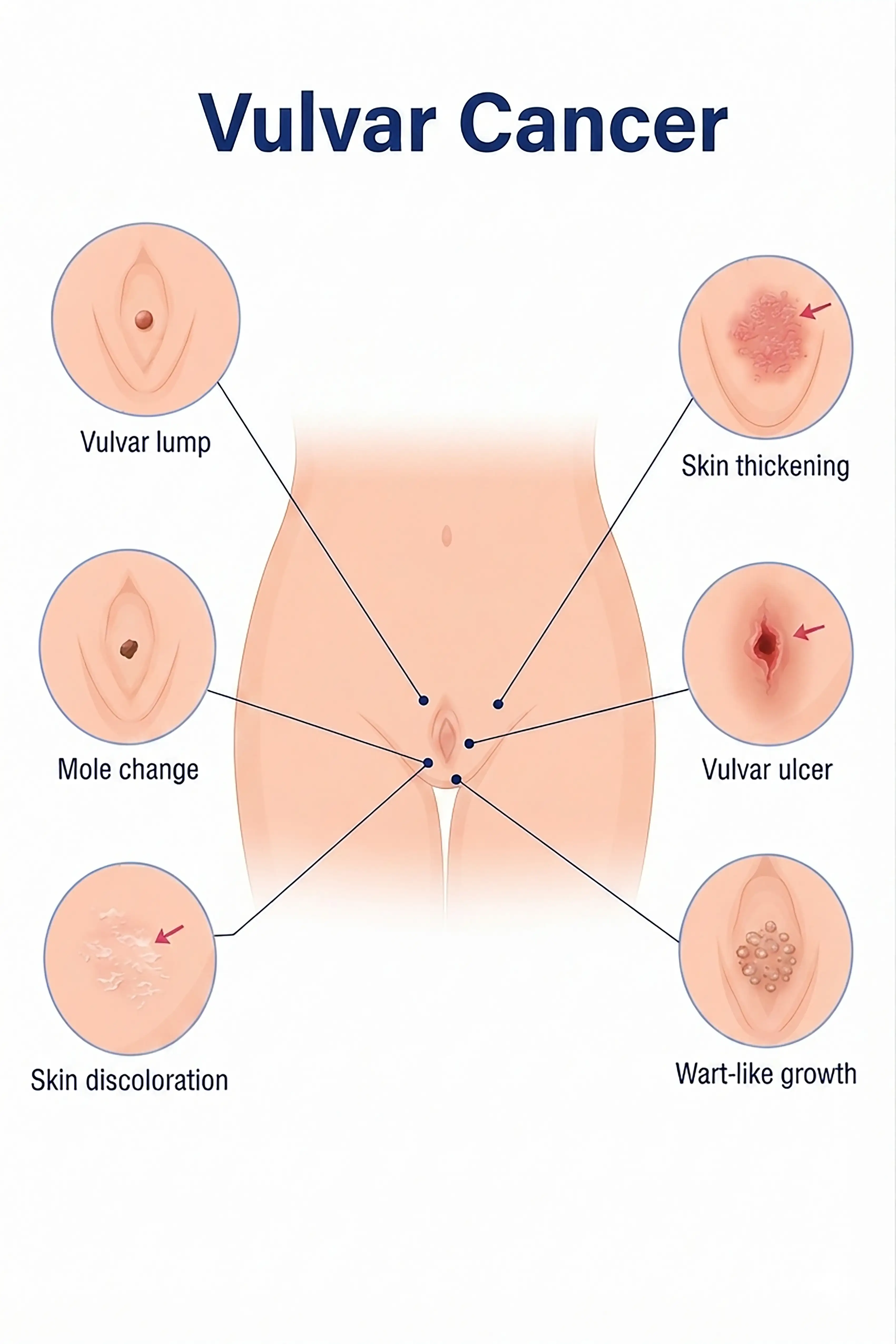
White, red, or brown patches appear on the vulvar skin, with localized thickening or thinning, and have clear boundaries with the surrounding normal skin.
3.Presence of vulvar mass
A nodular, cauliflower-like, or papillary mass appears on the vulva; the surface may be smooth or rough, the texture is firm, and it bleeds easily upon contact.
4.Non-healing ulcer
An ulcer or area of erosion appears on the vulva, characterized by raised, irregular edges and an uneven base; it fails to heal over a long period and is accompanied by pain.
5.Burning pain
Tumor invasion of nerves or concurrent infection causes persistent pain and a burning sensation in the vulva, which worsens during walking and physical activity.
6.Increased secretions
Tumor necrosis complicated by infection leads to increased vaginal discharge that is purulent or bloody and has a foul odor.
7.Inguinal lymphadenopathy
Vulvar cancer tends to metastasize to the inguinal lymph nodes, presenting as a hard, painless, and progressively enlarging inguinal mass.
8.Presence of difficulty urinating
Tumor invasion of the urethral meatus causes painful urination, urinary frequency, and difficulty urinating; severe cases may present with hematuria.
9.Abnormal bleeding
Ulceration of the tumor surface causes irregular vaginal bleeding or contact bleeding; the flow is scant but persistent.
Conclusion
Early symptoms of vulvar cancer are distinct but often overlooked.Older women experiencing persistent vulvar itching and unexplained lumps should seek medical attention promptly.HPV vaccination and regular gynecological check-ups help with prevention.


