


Global prevalence: Acoustic neuroma is a common benign intracranial tumor worldwide; it is most frequently seen in adults, grows slowly, and has a relatively good prognosis.
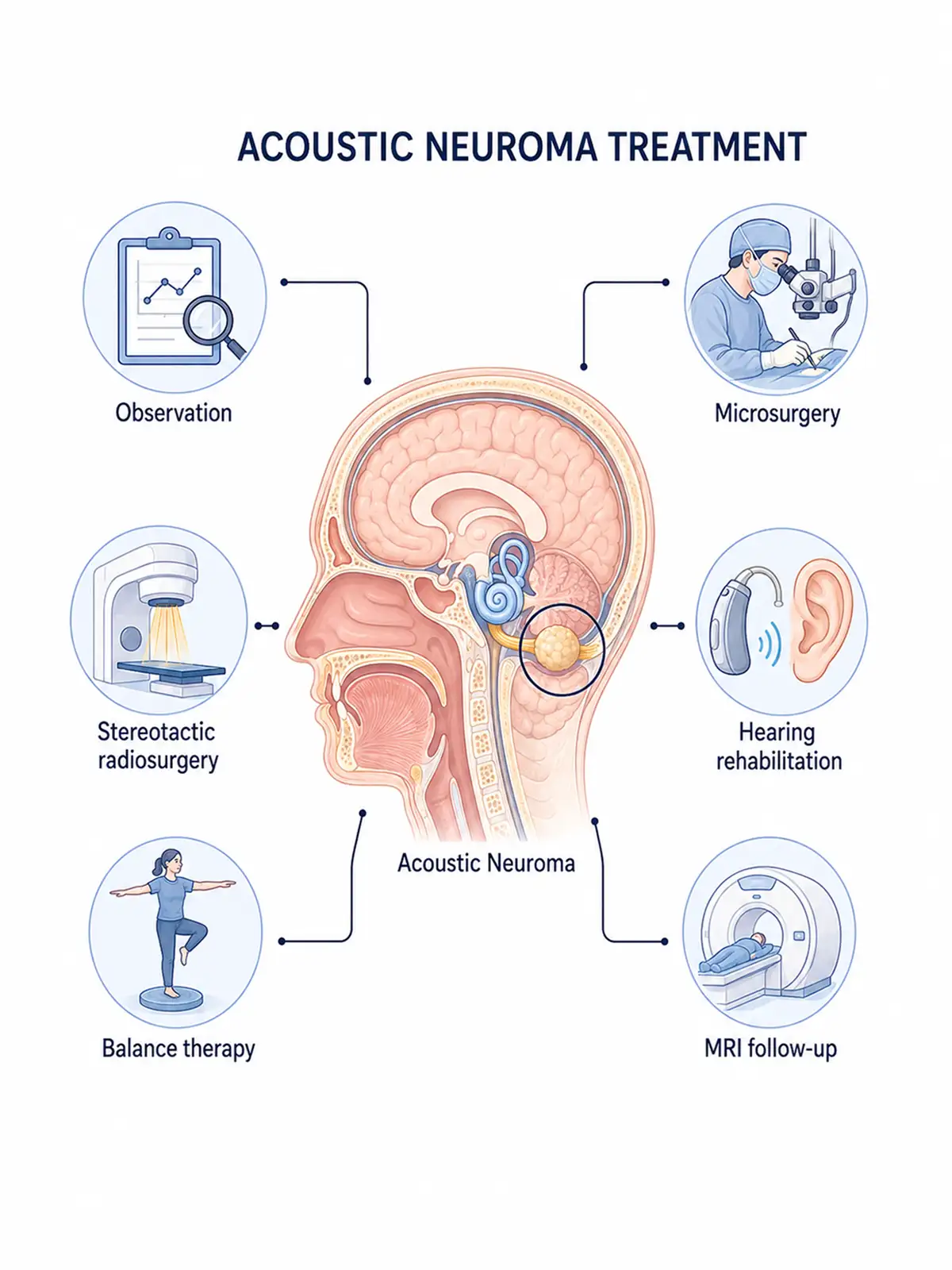
Staged treatment for acoustic neuroma
Early treatment (involving a localized, smaller tumor with a favorable response)
consisting of surgical resection combined with adjuvant therapy—can effectively control tumor progression while preserving facial nerve function.
Advanced-stage treatment (addressing severe compression, alleviating symptoms, and prolonging survival)
primarily employs systemic therapies such as radiotherapy to relieve symptoms of brainstem compression and maximize patient survival time.
Consequences of delayed early treatment: Failure to receive timely, standardized treatment in the early stages allows the tumor to continue enlarging and compressing the brainstem and surrounding nerves; missing the optimal window for intervention leads to a worsening of the condition.
Why choose Fosun Health for acoustic neuroma treatment
Leveraging its hospitals' platforms—including M6 CyberKnife, VitalBeam, ENT/skull base surgery, neurosurgery, audiology, and MRI assessment—Fosun Health facilitates multidisciplinary consultations involving relevant specialists.The team selects the appropriate approach—active surveillance, precision radiotherapy, or microsurgery—by comprehensively evaluating tumor size, growth rate, brainstem compression, pre-treatment hearing status, age, and patient preferences.
For small- to medium-sized lesions, CyberKnife (M6 model) treatment can be evaluated, offering a non-invasive (non-craniotomy) option for some patients; for larger lesions or those adjacent to the brainstem or cochlea, microsurgery or fractionated radiotherapy may be selected.Through precise manipulation and dose optimization, the brainstem, facial nerve, cochlea, and normal brain tissue are protected as much as possible to reduce the risk of adverse reactions affecting facial nerve function, hearing, and balance.
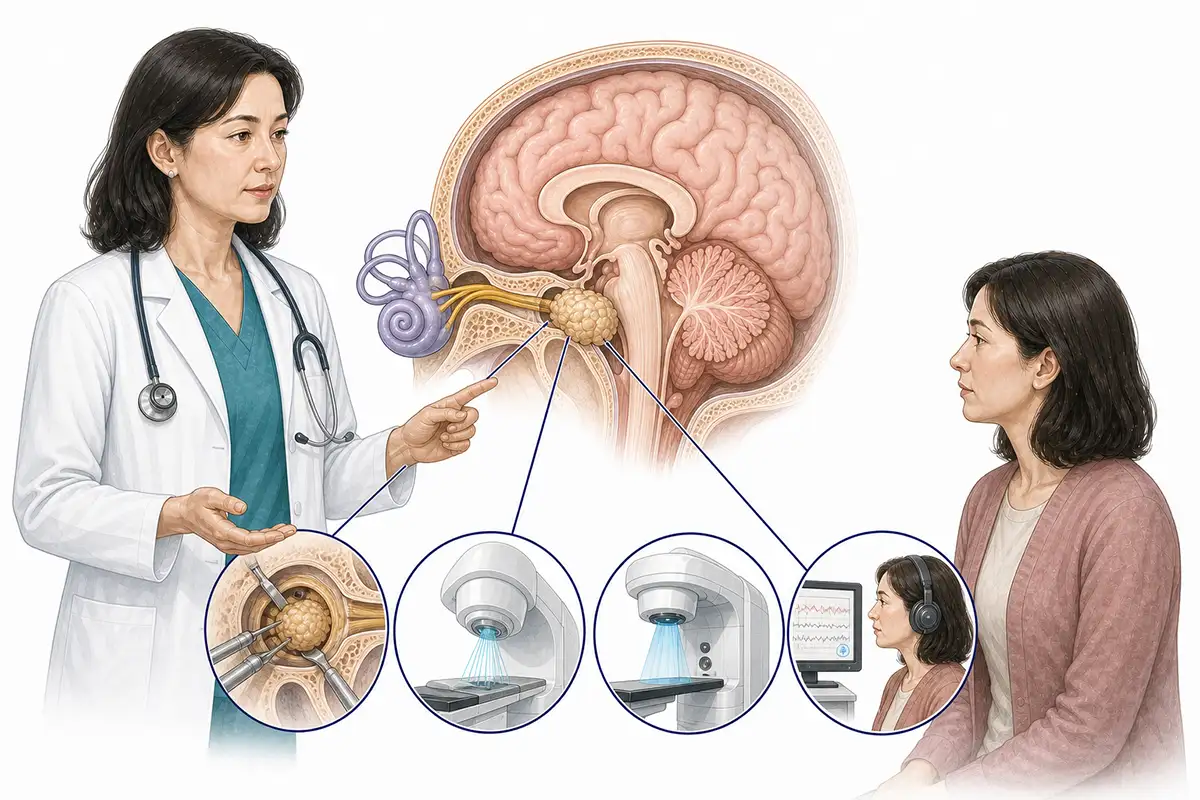
Treatment methods for acoustic neuroma
1.M6 CyberKnife treatment
Indicated for small- to medium-sized acoustic neuromas that are growing or symptomatic but do not require immediate surgical decompression, as well as for small residual or recurrent lesions following surgery.
Treatment advantages:
① Targeting internal auditory canal lesions: Adapted for target areas in the cerebellopontine angle and internal auditory canal.
② Protect brainstem: Reduce radiation dose to the adjacent brainstem and normal cerebellum.
③ Protection of the facial and auditory nerves: Control radiation doses to the cochlea, facial nerve, and trigeminal nerve.
④ No craniotomy required: Offers an alternative for patients at high surgical risk.
2.VitalBeam precision radiotherapy
Suitable for acoustic neuromas where the volume or morphology is unsuitable for CyberKnife hypofractionated therapy, or where the tumor is adjacent to the brainstem or cochlea, necessitating fractionation to reduce the single-fraction dose.
Treatment advantages:
① Suitable for large or irregular lesions: Controls the single-fraction dose through fractionated therapy.
② Protect brainstem: Lower the risk of high-dose radiation exposure to the brainstem.
③ Preservation of residual hearing: Optimize dose distribution based on the location of the cochlea.
④ Suitable for postoperative residual disease: Covers local lesions that cannot be safely resected.
3.Microsurgical acoustic neuroma resection
Indicated for patients with large tumors that significantly compress the brainstem, cause hydrocephalus, or require rapid decompression.
4.Active surveillance and hearing follow-up
For patients with small, asymptomatic lesions or those of advanced age with comorbidities, periodic MRI, hearing tests, and vestibular function assessments may be conducted.
5.Hearing rehabilitation
Improves hearing via assistive devices such as hearing aids or cochlear implants, providing functional rehabilitation for patients with postoperative hearing impairment.
6.Facial nerve function preservation
Employing intraoperative nerve monitoring to protect facial nerve function minimizes the risk of postoperative facial paralysis, thereby helping to improve overall therapeutic outcomes.
Post-treatment care
Protect hearing and keep the face warm; maintain a regular daily routine; attend scheduled follow-up appointments; and actively cooperate with subsequent treatments.
Post-treatment examinations
After treatment, regular cranial MRI scans, hearing tests, and facial nerve function assessments are required to detect changes in the condition in a timely manner.
Conclusion
Although acoustic neuromas are benign, the risks they pose cannot be ignored. The key to treatment lies in early detection, diagnosis, and intervention, as well as selecting an appropriate treatment plan and adhering to follow-up care.


