


Soft tissue tumors originate from soft tissues (muscle, fat, blood vessels, nerves, tendons, etc.) and can be benign or malignant.Soft tissue sarcomas often initially present as painless masses; deep-seated tumors are difficult to detect in the early stages.
Global prevalence of soft tissue tumors
Soft tissue sarcoma is a rare cancer comprising over 50 subtypes that can arise anywhere in the body. It most commonly affects the arms, legs, and abdomen.Tumors in the head, neck, and extremities are relatively superficial and easier to detect, whereas sarcomas in the trunk—particularly the retroperitoneum—are deep-seated and often large by the time of diagnosis.The most common presentation is a painless mass, with more than 50% of cases occurring in the extremities.
Symptoms associated with soft tissue tumor stages
1.Early symptoms of soft tissue tumors
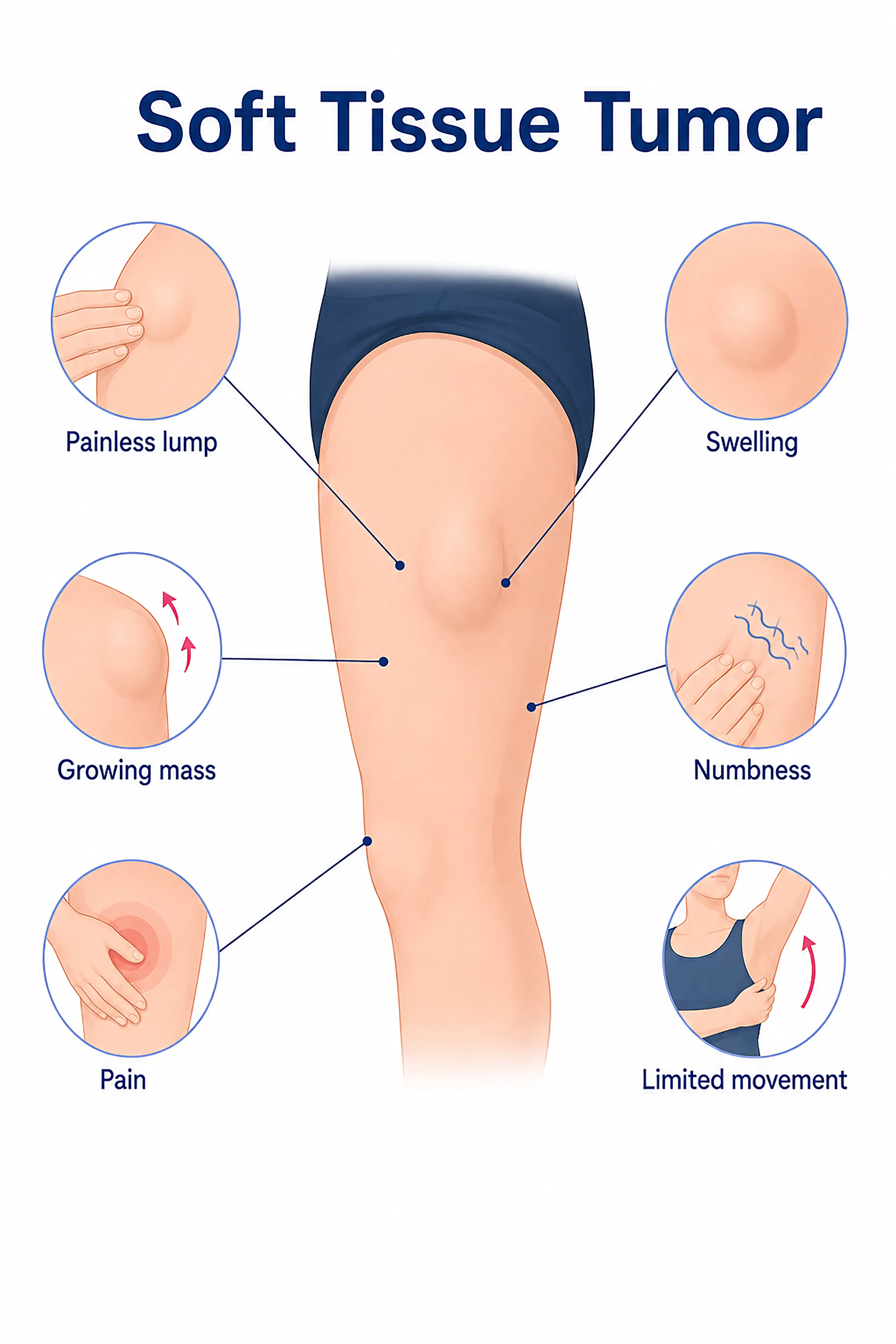
Small tumors are often asymptomatic, especially those located deep within the body.Superficial tumors may present as palpable, painless, slow-growing small nodules that are easily mistaken for lipomas or cysts.
2.Intermediate-stage symptoms of soft tissue tumors
The mass gradually enlarges, causing localized pain or a sensation of pressure; nerve compression leads to numbness or tingling, vascular compression causes limb swelling, and tumors near joints impair mobility.
3.Symptoms of advanced soft tissue tumor
Tumor extensively invades surrounding tissues and metastasizes to the lungs; symptoms include persistent severe pain, limb dysfunction, severe emaciation, and dyspnea.
When to Seek Medical Attention
Early signs of soft tissue tumors include the discovery of a painless lump, gradual enlargement of the lump, and localized pain.Please consult a doctor via "Chat with a Doctor" for early detection.During the online consultation, the doctor will ask about changes in the lump and guide you through ultrasound or MRI examinations.
Staging of soft tissue tumors
Soft tissue tumor: Stage 0
This staging system is not applicable to soft tissue tumors.Soft tissue sarcomas are staged using the TNM staging system, based on tumor size, depth, grade, and distant metastasis.
Soft tissue tumor: Stage I
Small (<5 cm), low-grade tumors confined to the primary site; they typically present as small, painless masses.
Soft tissue tumor: Stage II
Tumor is larger than 5 cm, deeply located, or high-grade, presenting with localized pain and symptoms of compression.
Soft tissue tumor: Stage III
The tumor extensively invades surrounding tissues and involves regional lymph node metastasis, accompanied by significant pain and functional impairment.
Soft tissue tumor: Stage IV
The tumor undergoes distant metastasis—most commonly to the lungs—presenting with cough, hemoptysis, and dyspnea.

Detailed symptoms of soft tissue tumors
1.Presence of a painless mass
The most common initial symptom presents as a gradually enlarging, painless mass that is relatively hard, has ill-defined borders, is adherent to surrounding tissues, and exhibits poor mobility.
2.Localized pain
Local pain—which may be dull or sharp—occurs when the enlarging tumor compresses nerves or muscles; pain at rest and nocturnal pain may develop in advanced stages.
3.Limb swelling
Compression of veins or lymphatic vessels by the tumor causes swelling in the distal limbs, accompanied by a sensation of heaviness and skin tightness.
4.Numbness and tingling
Tumor compression of peripheral nerves causes numbness, tingling, or sensory loss in the affected area; severe cases may present with muscle weakness.
5.Limited mobility
Tumors located around joints can cause limited range of motion, deformity, and functional impairment, affecting normal walking and physical activity.
6.Abdominal symptoms present
Retroperitoneal sarcoma can cause symptoms such as abdominal distension and pain, nausea, vomiting, intestinal obstruction, and ureteral obstruction; it is difficult to detect in the early stages.
7Weight loss
Due to tumor-induced wasting, patients in the advanced stage experience weight loss accompanied by fatigue and loss of appetite.
8.Presence of pulmonary symptoms
Lung metastases, presenting as persistent coughing, chest pain, and difficulty breathing, are the most common site of distant metastasis for soft tissue sarcoma.
9.Skin changes
Superficial tumors can cause localized skin elevation, redness, and increased temperature; in advanced stages, they may break down to form ulcers.
Conclusion
Early symptoms of soft tissue sarcoma are often inconspicuous; medical attention should be sought promptly if an unexplained mass is discovered.Complete surgical resection is the primary treatment, while adjuvant radiotherapy and chemotherapy can reduce the risk of recurrence.


