


Soft tissue sarcomas are tumors resulting from the malignant proliferation of mesenchymal cells.Mesenchymal tissues include fat, muscle, blood vessels, lymphatic vessels, synovium, and nerve sheaths; these tumors can arise anywhere in the body, most commonly in the extremities and the retroperitoneum.
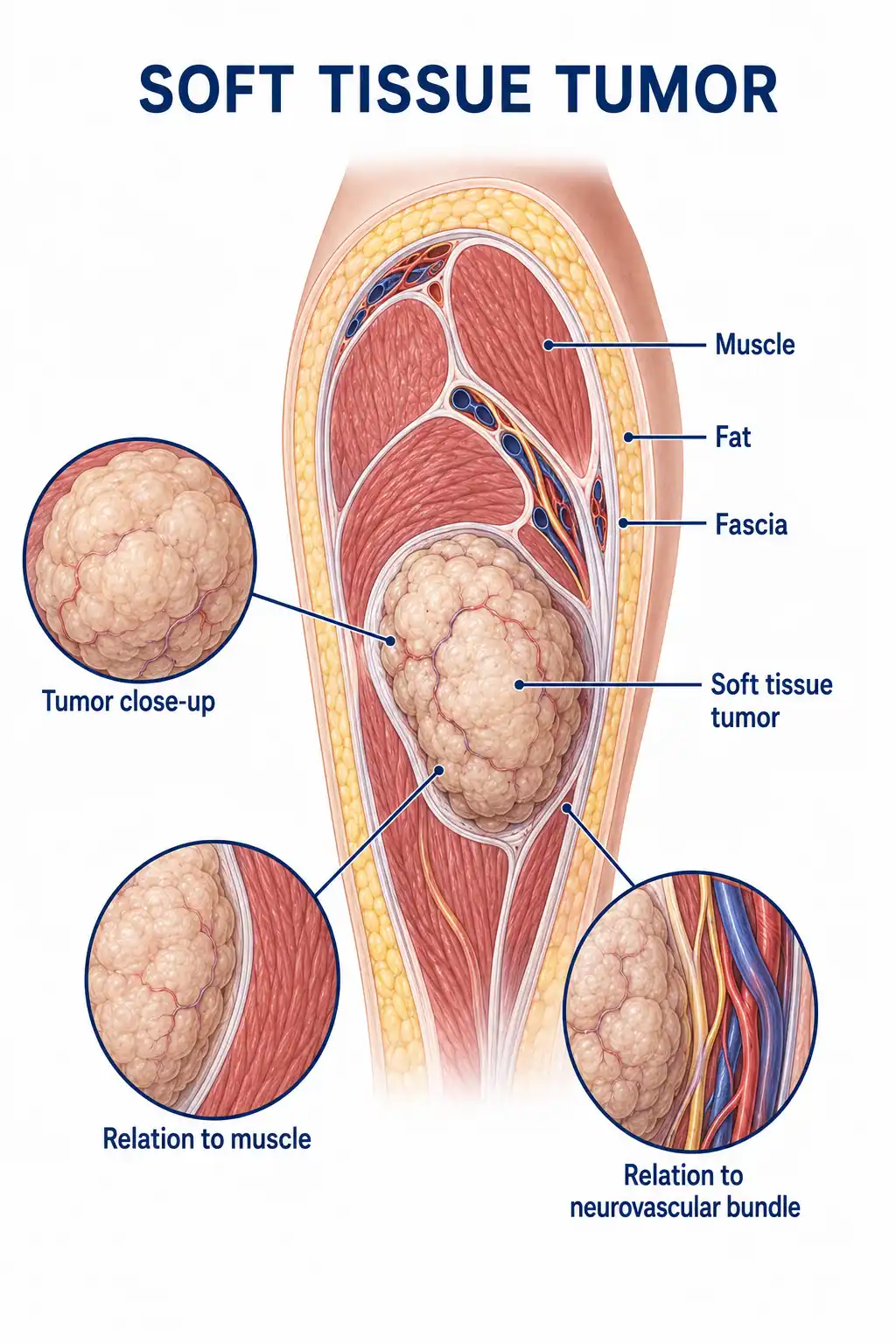
Global overview of soft tissue tumors
Soft tissue sarcomas account for approximately 1% of adult malignancies and about 15% of pediatric malignancies.There are over 100 histological types, with common examples including liposarcoma, leiomyosarcoma, and synovial sarcoma;they most frequently affect individuals aged 40 to 60.
Consult a doctor regarding cancer-related issues
Patients presenting with a painless, gradually enlarging soft-tissue mass—or a mass that grows rapidly over a short period or is accompanied by pain or symptoms of compression—should promptly consult a specialist in orthopedic oncology or surgical oncology.
Main types of soft tissue tumors
1. Liposarcoma
One of the most common types of soft tissue sarcoma;it typically occurs in the deep tissues of the extremities and the retroperitoneum and is classified into subtypes such as well-differentiated, dedifferentiated, myxoid, and pleomorphic.
2. Leiomyosarcoma
Originates in smooth muscle cells; commonly occurs in the uterus and retroperitoneum, but can also appear in the extremities. Highly malignant.
3. Synovial sarcoma
It typically occurs near the joints of the extremities, is unrelated to synovial tissue, is most common in adolescents and young adults, and is prone to metastasis.
4. Gastrointestinal stromal tumor
Originates from gastrointestinal interstitial cells of Cajal; associated with KIT or PDGFRA gene mutations; responds well to targeted therapy.
5. Ewing sarcoma
It commonly affects children and adolescents, is classified as a small round cell tumor, and is sensitive to radiotherapy and chemotherapy.
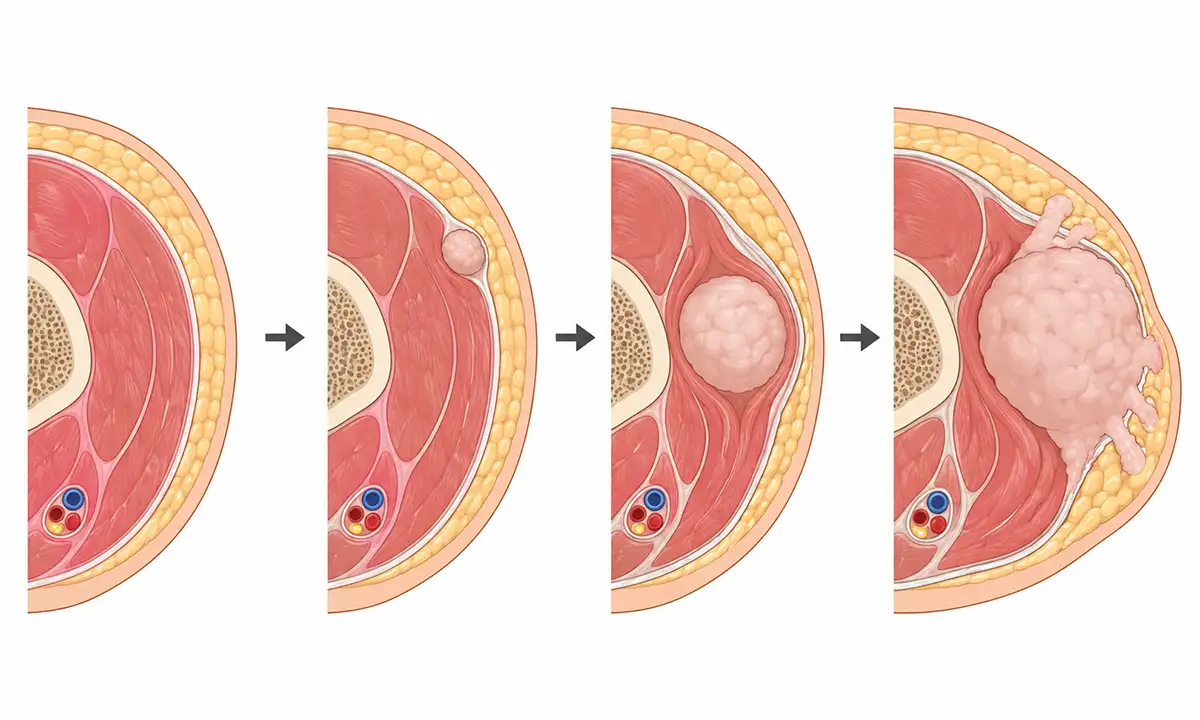
Typical symptoms and signs of soft tissue tumors
1. Painless mass
The most common initial symptom is a painless, gradually enlarging mass that is hard in texture, has ill-defined borders, and exhibits poor mobility.
2. Pain
As the tumor enlarges and invades surrounding nerves or tissues, persistent pain develops, which worsens at night.
3. Compression symptoms
Tumor compression of surrounding blood vessels, nerves, or organs leads to corresponding symptoms, such as limb numbness, edema, or gastrointestinal obstruction.
4. Functional impairment
Tumors located near joints can cause restricted joint mobility, while abdominal tumors can cause abdominal distension and pain.
5. Weight loss
Patients in the advanced stage exhibit systemic symptoms such as weight loss and fatigue.
6. Distant metastasis
Soft tissue sarcomas most frequently metastasize to the lungs, causing symptoms such as cough, chest pain, and dyspnea.
Diagnostic methods for soft tissue tumors
1. Imaging examination
MRI is the preferred method for assessing the extent of soft-tissue sarcomas, as it reveals the relationship between the tumor and surrounding muscles, blood vessels, and nerves.
2. CT scan
Chest CT is used to assess pulmonary metastasis, while abdominal CT is used to assess retroperitoneal tumors.
3. Biopsy pathology
Pathological examination of tumor tissue obtained via needle or incisional biopsy is the gold standard for definitive diagnosis; the pathological type and grade must be determined.
4. Molecular testing
Detection of specific gene fusions, mutations, and amplifications to help clarify the diagnosis and guide targeted therapy.
5. PET-CT
Whole-body PET-CT assesses tumor metabolic activity and distant metastasis, aiding in staging.
6. Immunohistochemistry
Immunohistochemical staining aids in differentiating between various types of soft tissue sarcoma and clarifying the pathological diagnosis.
Treatment methods for soft tissue tumors
1. Wide resection
Wide resection is the primary treatment for soft tissue sarcoma; adequate safety margins must be ensured, and involved muscles and bones should be resected when necessary.
2. Limb-salvage surgery
Preserve limb function to the greatest extent possible while ensuring negative surgical margins, utilizing reconstruction with prosthetic materials or autologous tissue.
3. Radiotherapy
Preoperative or postoperative adjuvant radiotherapy reduces the rate of local recurrence and is the standard adjuvant treatment for high-grade tumors.
4. Chemotherapy
Anthracycline-based chemotherapy may be used for high-grade and metastatic soft tissue sarcomas.
5. Targeted therapy
Drugs targeting specific molecular markers include imatinib for gastrointestinal stromal tumors (GIST) and pazopanib for advanced soft-tissue sarcoma.
6. Immunotherapy
Immune checkpoint inhibitors have demonstrated some efficacy in certain types of soft tissue sarcoma.
7. Retroperitoneal tumors
Surgery for retroperitoneal soft tissue sarcoma is technically challenging and often requires multi-organ resection; postoperative adjuvant radiotherapy can reduce the recurrence rate.
8. Follow-up monitoring
Postoperative follow-up involving regular imaging is crucial to monitor for local recurrence and pulmonary metastasis.
Conclusion
Soft tissue sarcomas are a group of malignant tumors of mesenchymal origin with complex classifications; they primarily present as painless masses.A combination of wide surgical resection and adjuvant therapy helps improve patient prognosis.


