


Prostate cancer is a tumor resulting from the malignant transformation of prostatic acinar epithelial cells and is one of the most common malignancies in men.It often presents no obvious symptoms in the early stages; as the disease progresses, symptoms such as urinary dysfunction and bone pain may appear.
Global prevalence of prostate cancer
Prostate cancer is the second most common malignancy among men worldwide; incidence rates are highest in Europe and the United States, while in my country, the incidence is rising year by year.It predominantly affects men over the age of 65. Approximately 95% of cases are adenocarcinomas.The 5-year survival rate for early-stage prostate cancer is nearly 100%, whereas the prognosis is poor for advanced cases with metastasis.Prostate-specific antigen (PSA) screening aids in early detection.
Symptoms associated with prostate cancer stages
1.Early symptoms of prostate cancer
Tumor confined to the prostate; usually asymptomatic, though some patients may experience mild urinary hesitancy or frequency; often detected due to elevated PSA or abnormal DRE findings during a physical examination.
2.Intermediate-stage symptoms of prostate cancer
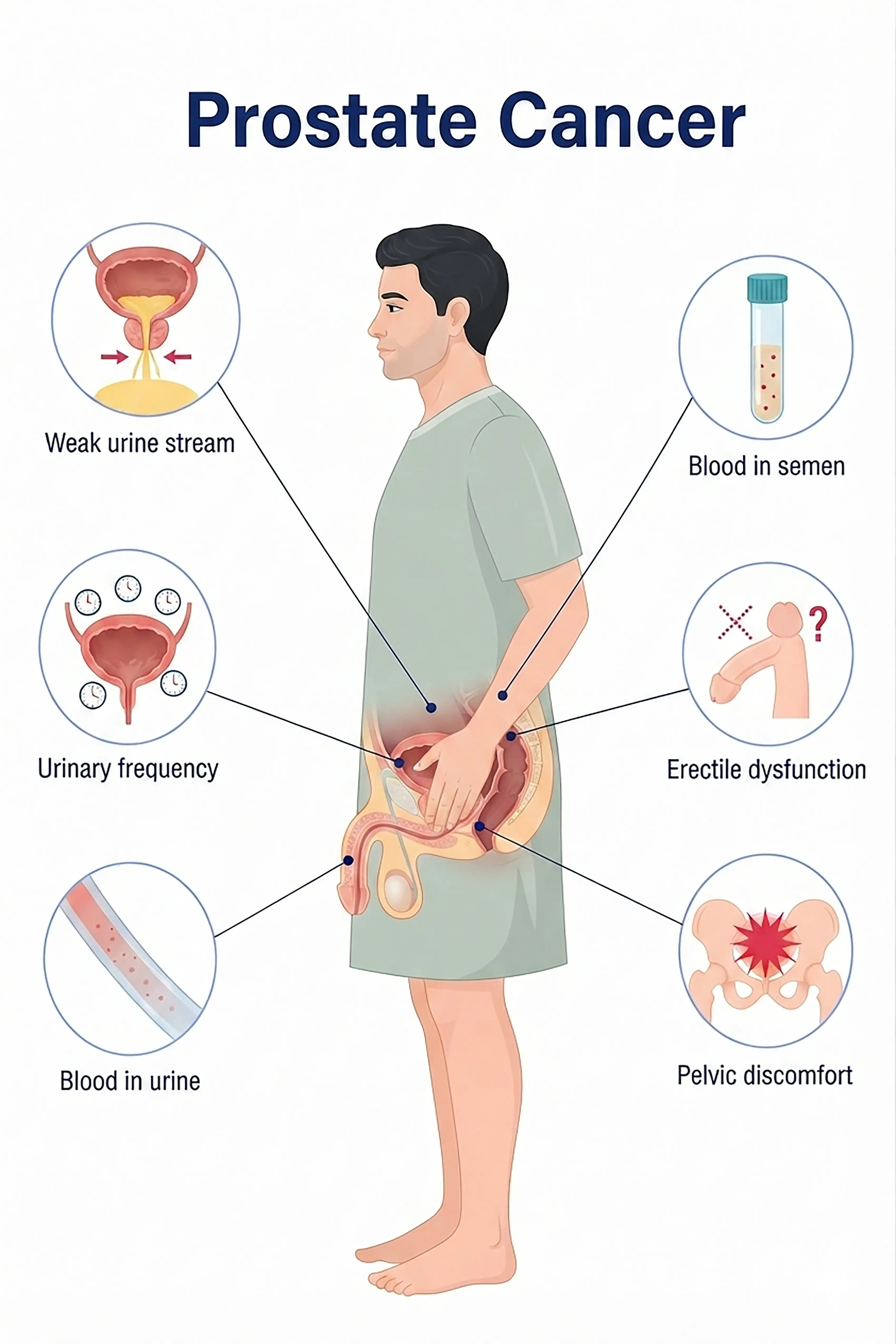
Symptoms include progressive difficulty urinating, urinary frequency and urgency, a weak urinary stream, nocturia (frequent nighttime urination), hematuria (blood in urine), and hemospermia (blood in semen); a hard nodule on the prostate may be palpable during a digital rectal examination.
3.Symptoms of advanced prostate cancer
Extensive tumor metastasis; bone metastases cause persistent bone pain and pathological fractures, spinal cord compression leads to lower-limb paralysis, and lymph node metastasis causes lower-limb edema.
When to Seek Medical Attention
Early signs of prostate cancer include difficulty urinating, urinary frequency and urgency, blood in the urine, and bone pain.Please consult a doctor via the "Chat with a Doctor" feature for early detection.During the online consultation, the doctor will ask about your urinary symptoms and family history, and guide you through PSA testing and a digital rectal exam.
Staging of prostate cancer
Stage 0 prostate cancer
Cancer cells are confined to the prostatic ductal epithelium; this is classified as carcinoma in situ. It is often asymptomatic and is usually detected incidentally during PSA screening.
Stage I prostate cancer
Tumor confined to the prostate; small in volume; digital rectal examination (DRE) may be normal; PSA is mildly elevated.
Stage II prostate cancer
The tumor remains confined to the prostate but is large in volume or involves both lobes; a hard nodule can be palpated during a digital rectal examination.
Stage III prostate cancer
Tumor breaches the prostatic capsule and invades adjacent tissues; symptoms include significant voiding dysfunction and hematuria.
Stage IV prostate cancer
The tumor metastasizes to the bones, lymph nodes, and lungs, presenting with bone pain, lower-extremity edema, and systemic wasting.

Detailed Symptoms of Prostate Cancer
1.Difficulty urinating
Tumor enlargement compresses the urethra, causing progressive difficulty in urination; symptoms include a thinning urinary stream, reduced projection distance, straining to void, urinary dribbling, and a sensation of incomplete emptying.
2.Urinary frequency and urgency
Tumor irritation or compression of the bladder neck leads to urinary frequency and urgency, particularly increased nocturia; severe cases may present with urge incontinence.
3.Hematuria and hemospermia
Tumor invasion of the urethra or seminal vesicles causes hematuria or hemospermia, with semen appearing pink or dark red.
4.Bone pain and fractures
Prostate cancer most commonly metastasizes to the bones—particularly the spine and pelvis—causing persistent bone pain and pathological fractures.
5.Lower limb weakness
Spinal metastases compressing the spinal cord cause numbness, weakness, and difficulty walking in the lower limbs;severe cases can lead to paraplegia.
6.Lower extremity edema
Pelvic lymph node metastasis compresses lymphatic vessels or obstructs venous return, causing lower limb edema that is most pronounced in the distal extremities.
7.Rectal obstruction
Posterior invasion of the rectum by the tumor causes rectal irritation symptoms such as difficulty defecating, tenesmus, and bloody stools.
8.Anemia and emaciation
Due to chronic blood loss and tumor-induced wasting, patients in the advanced stage exhibit systemic manifestations such as anemia, fatigue, and weight loss.
9.Elevated PSA
Elevated prostate-specific antigen (PSA) is the most important laboratory indicator for prostate cancer; a significant rise in PSA suggests a possibility of prostate cancer.
Conclusion
Early-stage prostate cancer is often asymptomatic; PSA screening is a crucial method for early detection.Older men should undergo regular PSA testing and digital rectal examinations (DRE).Early treatment leads to a good prognosis.


