


Lung cancer is the malignant tumor with the highest incidence and mortality rates globally.Approximately 85% of cases are associated with smoking.Non-small cell lung cancer (NSCLC) accounts for 80%–85% of cases, while small cell lung cancer (SCLC) accounts for 15%–20%.Early diagnosis is crucial for improving the five-year survival rate.
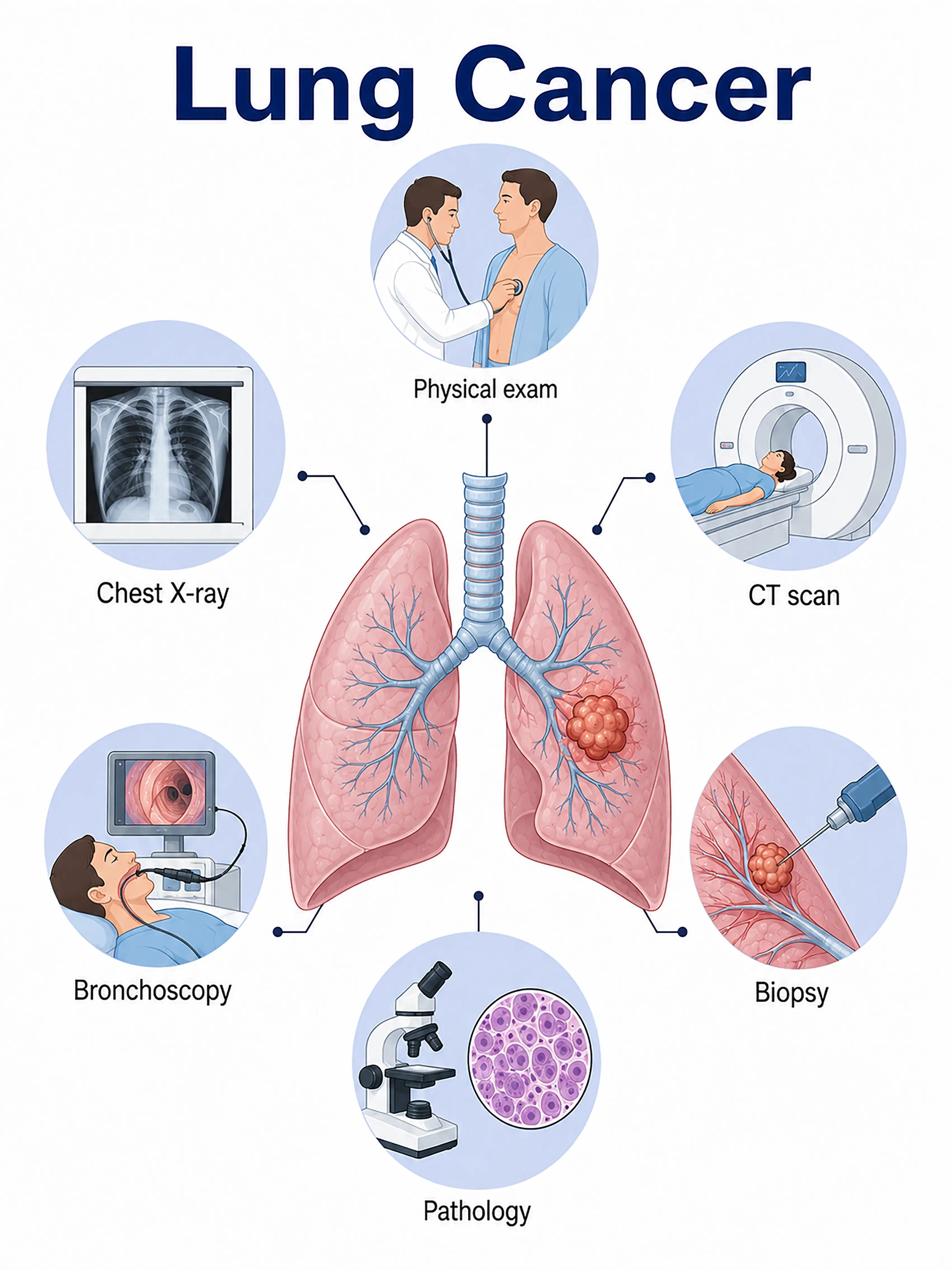
Diagnosis and staging of lung cancer
1.Early diagnosis of lung cancer
Small tumors, usually located in the lung periphery, are often asymptomatic.Pulmonary nodules detected via low-dose CT screening are assessed for malignancy risk based on size, morphology, and density (solid or ground-glass).
2.Diagnosis of mid-stage lung cancer
Presentation includes symptoms such as cough and hemoptysis.Chest CT reveals a mass characterized by lobulation, spiculation, or pleural retraction; tissue samples for pathological examination are obtained via bronchoscopy or CT-guided percutaneous lung biopsy.
3.Diagnosis of advanced lung cancer
Extensive tumor invasion or distant metastasis to the brain, bones, liver, and adrenal glands.Whole-body PET-CT and brain MRI assess the extent of metastasis; multiple biopsies clarify the pathological type and molecular subtype.
Without timely diagnosis, approximately 70% of patients are already in the advanced stage when diagnosed, losing the opportunity for surgery;the five-year survival rate is less than 20%.
When to Seek Medical Attention
Early signs of lung cancer include persistent coughing, blood-streaked sputum, chest pain, and difficulty breathing.Please consult a doctor via the "Chat with a Doctor" feature for early detection.During the online consultation, the doctor will ask about your smoking history and symptoms, and advise you on undergoing a chest CT scan.
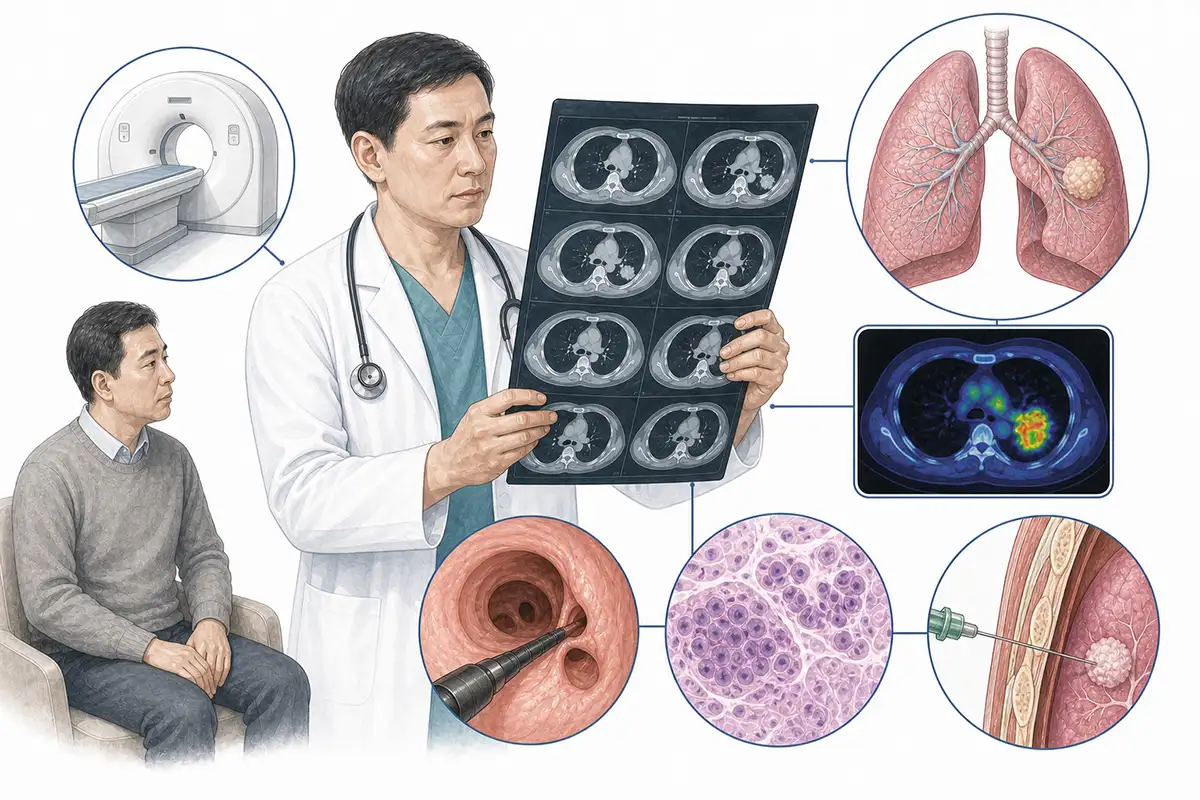
Basis for lung cancer diagnosis
1.Low-dose CT screening
Low-dose spiral CT is the preferred method for lung cancer screening and can reduce lung cancer mortality by 20%; annual screening is recommended for heavy smokers aged 55–80.
2.Chest CT scan
Contrast-enhanced CT evaluates the size, morphology, density, and location of pulmonary nodules and detects mediastinal lymph node metastasis; it is a core imaging examination for the diagnosis and staging of lung cancer.
3.Bronchoscopy
Uses bronchoscopy to visualize airway lesions and obtains tissue or cytologic samples through a combination of biopsy, brushing, and lavage; the preferred diagnostic method for central-type lung cancer.
4.Percutaneous lung needle biopsy
CT-guided transthoracic needle biopsy of a pulmonary lesion is the preferred invasive diagnostic procedure for confirming peripheral lung cancer.
5.Tumor marker test
Test for markers such as CEA, CYFRA21-1, NSE, and Pro-GRP to assist in pathological classification, monitoring of treatment efficacy, and surveillance for recurrence.
6.Endobronchial ultrasound (EBUS) biopsy
EBUS-TBNA utilizes ultrasound guidance for real-time needle aspiration of mediastinal and hilar lymph nodes to determine metastatic status, offering high safety and accuracy.
7.Whole-body PET-CT assessment
Whole-body PET-CT assesses distant metastasis and is valuable for staging and treatment planning, as it can detect metastatic lesions invisible on conventional CT.
8.Thoracoscopy
For cases where specimens cannot be obtained via bronchoscopy or percutaneous puncture, diagnosis may be achieved through thoracoscopic lesion resection, with concurrent pleural biopsy.
9.Molecular genetic testing
Test for driver gene mutations such as EGFR, ALK, ROS1, and KRAS to guide the selection of targeted therapies; this is a mandatory test for advanced non-small cell lung cancer.
Daily Self-Check
Heavy smokers over the age of 55 should undergo annual low-dose CT screening.Seek immediate medical attention if you experience a persistent cough, blood-streaked sputum, or chest pain.Quitting smoking is the most effective measure for preventing lung cancer.
Conclusion
Early diagnosis is key to improving survival rates for lung cancer.Low-dose CT screening can significantly reduce mortality in high-risk populations, while bronchoscopy and needle biopsy are the primary methods for definitive diagnosis.


