


Global disease prevalence: Kidney cancer is a common malignant tumor of the urinary system worldwide, with higher incidence rates in developed countries and regions; it affects more men than women.
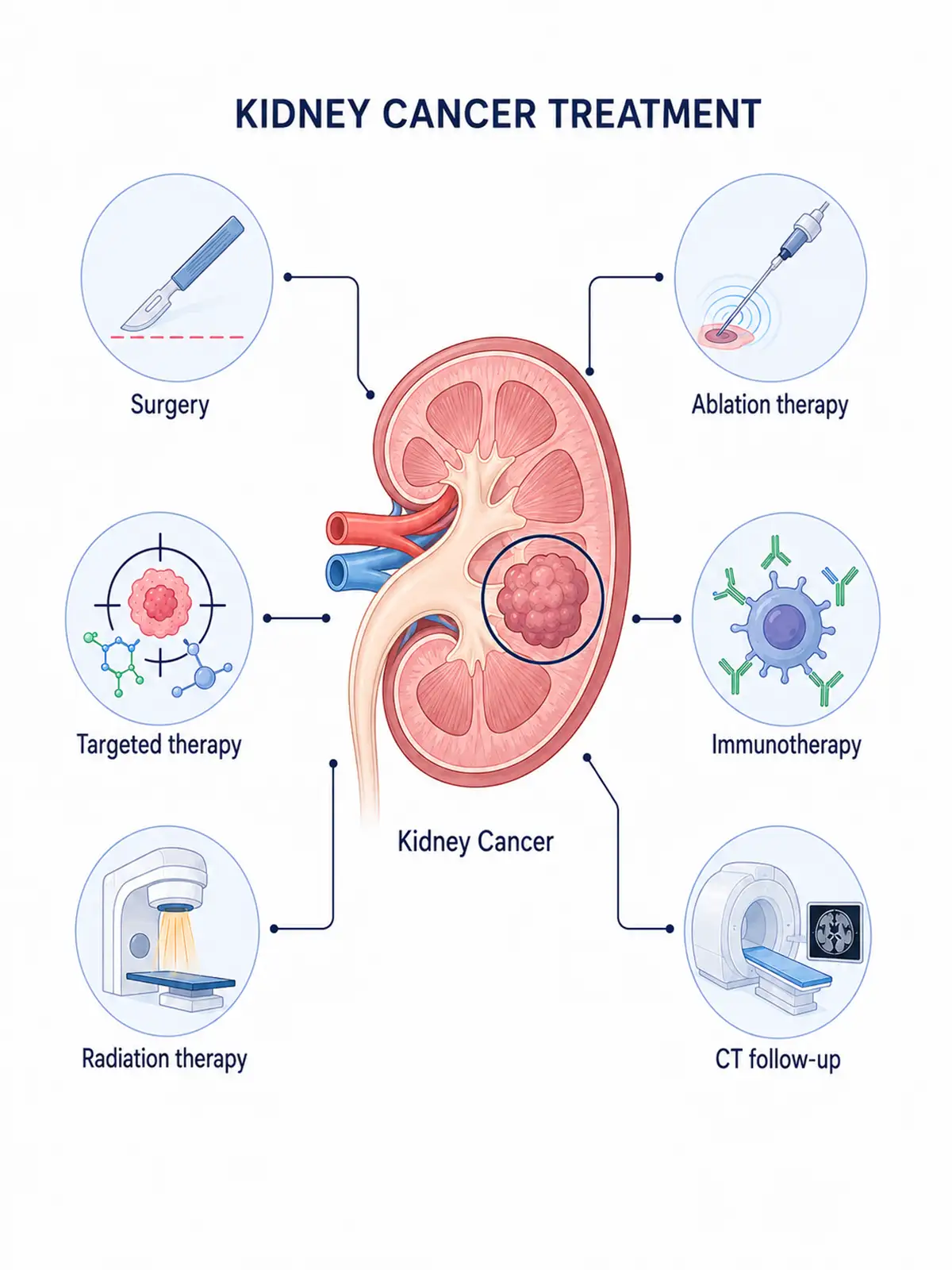
Treatment based on renal cancer stage
Early treatment (involving a localized, small tumor with a favorable response)
specifically surgical resection combined with adjuvant therapy—can effectively control tumor progression, and the patient's prognosis is relatively good.
Intermediate-stage treatment (addressing local spread, inhibiting growth, and delaying progression)
employs a comprehensive approach—combining surgery with targeted therapy—to control further tumor spread and slow the rate of disease deterioration.
Treatment for advanced-stage disease (involving distant metastasis, symptom relief, and survival prolongation)
primarily relies on systemic therapies such as targeted therapy and immunotherapy to alleviate clinical symptoms and extend patient survival as much as possible.
Consequences of failing to receive timely treatment in the early stage: If standardized treatment is not administered promptly in the early stage, the tumor will continue to grow and spread/metastasize to surrounding tissues and distant organs, resulting in a missed opportunity for optimal intervention and a worsening of the condition.
Why choose Fosun Health for kidney cancer treatment
Fosun Health’s renal cancer diagnosis and treatment services are managed by the specialized center for urologic oncology. The program operates under the guidance of Professor Huang Jian—a renowned Chinese urology expert and Chairman of the Urology Branch of the Chinese Medical Association—and is led by Zheng Bin, Director of Urology at Foshan Fosun Chancheng Hospital. The team has extensive experience in da Vinci robot-assisted partial nephrectomy and comprehensive treatment for advanced renal cancer.Leveraging a global medical network, patients have access to cutting-edge international treatments such as da Vinci robot-assisted partial nephrectomy, minimally invasive laparoscopic surgery, CyberKnife precision radiotherapy, targeted therapy, and immunotherapy.
The fourth-generation da Vinci Xi surgical robot offers a 10–15x magnified high-definition 3D view, a 540°-rotating simulated wrist with 0.1 mm precision, and a tremor-filtering system, enabling tumor resection while preserving over 90% of functional nephrons.For elderly patients or those unable to tolerate surgery for small renal tumors (<4 cm), minimally invasive treatments such as radiofrequency ablation, microwave ablation, and cryoablation are available.
Fosun Health continues to introduce innovative technologies for treating renal cancer.Foshan Fosun Chancheng Hospital is equipped with Foshan’s first sixth-generation CyberKnife M6 system, which achieves a precision of 0.1 mm.HLX18, a nivolumab biosimilar independently developed by Fosun Pharma, has received clinical trial approval from both the US FDA and China’s NMPA.Through a combination of precision kidney-sparing surgery, stereotactic radiotherapy, and targeted immunotherapy, the hospital provides personalized, comprehensive treatment for patients with renal cancer at different stages.
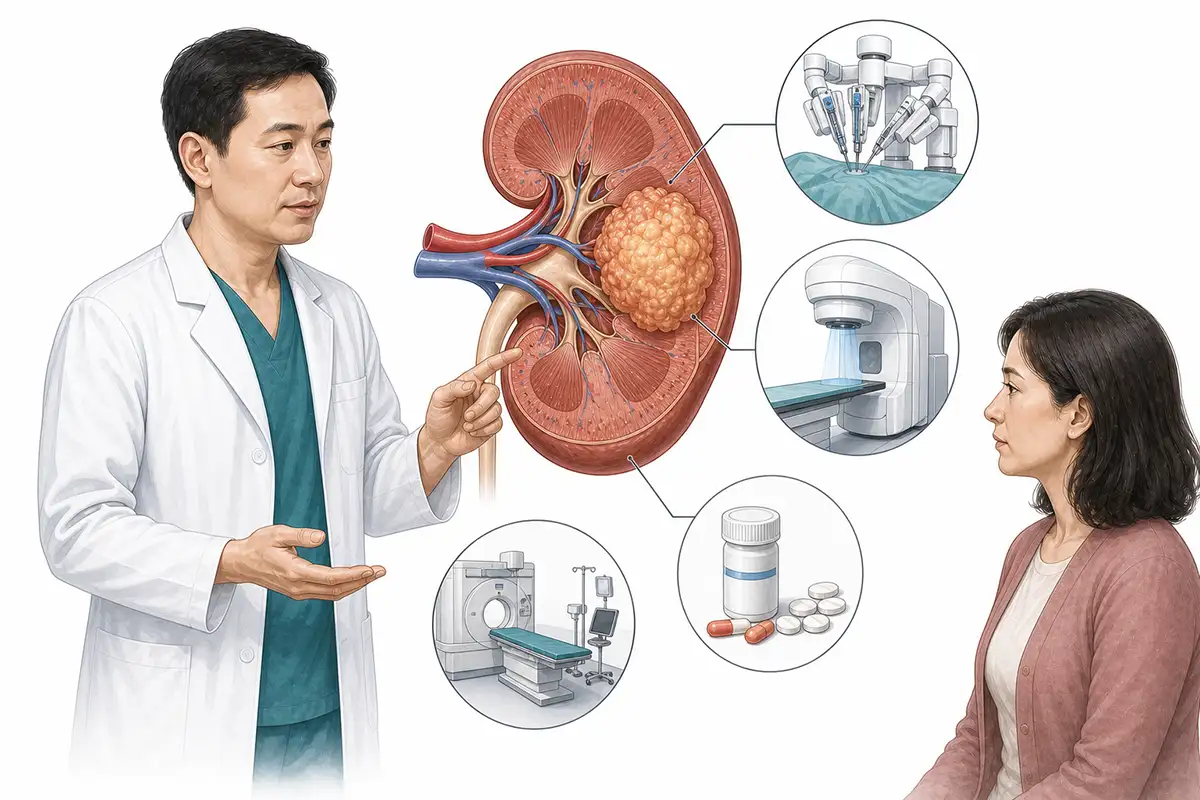
Renal Cancer Treatment Methods
1.Da Vinci robot-assisted surgery for renal cancer
For patients with localized renal cancer eligible for minimally invasive surgery, procedures such as da Vinci robot-assisted partial nephrectomy or other appropriate renal cancer surgeries may be performed, depending on tumor size, location, and renal anatomy.
Treatment advantages:
① Minimally invasive procedure: Precise surgical operations performed using a robotic-assisted system, reducing the trauma associated with traditional open surgery.
② Precise anatomical visualization: Magnified surgical field facilitates the identification of anatomical relationships between the tumor and surrounding normal tissues.
③ Kidney-sparing option: For patients suitable for partial nephrectomy, normal renal tissue can be preserved as much as possible while removing the tumor.
④ Personalized surgery: Select a surgical approach based on tumor location and size, renal function, and the patient's overall condition.
2.CyberKnife precision radiotherapy
For selected patients with localized renal cell carcinoma who are unsuitable for surgery or at high surgical risk, CyberKnife stereotactic radiotherapy may be considered based on tumor size, location, and the status of adjacent organs.
Treatment advantages:
① Precise localization: Formulate an individualized radiotherapy plan based on the tumor's location and morphology.
② Non-invasive treatment: No traditional surgical incision required.
③ Dose concentration: Concentrates the radiation dose on the tumor region while minimizing exposure to surrounding normal tissues.
④ Applicable to specific patients: Can provide a local treatment option for some patients unsuitable for surgery.
3.VitalBeam linear accelerator precision radiotherapy
Utilizing the VitalBeam linear accelerator platform, precise radiotherapy—such as stereotactic body radiotherapy (SBRT)—can be administered to eligible renal tumors.
Treatment advantages:
① Precision irradiation: Formulate a radiotherapy plan based on tumor location and motion characteristics.
② Dose optimization: Improves target area coverage through dose distribution optimization.
③ Protects normal tissues: Minimizes radiation exposure to the kidneys and surrounding vital organs as much as possible.
④ Local treatment option: Suitable for select patients who are not candidates for surgery.
4.Cryoablation for renal cancer
For certain small, favorably located renal tumors with high surgical risk, image-guided cryoablation may be employed, utilizing low temperatures to create an ice ball that destroys the tumor tissue.
Treatment advantages:
① Minimally invasive treatment: Treatment is typically performed via percutaneous puncture, resulting in relatively minimal trauma.
② Preservation of renal function: For suitable cases, the impact on normal renal tissue can be minimized.
③ Precise localization: Image guidance facilitates accurate tumor localization and control of the ablation zone.
④ Applicable to high-risk patients: Can provide a local treatment option for some elderly patients or those at high surgical risk.
5.Renal artery interventional embolization
For selected patients unable to undergo radical surgery who present with tumor hemorrhage or require symptom palliation, renal artery interventional embolization may be employed depending on the clinical condition.
Treatment advantages:
① Block blood supply: Reduces tumor blood flow by embolizing the tumor's feeding arteries.
② Hemorrhage control: Can be used to stop or reduce bleeding in patients with tumor-related hemorrhage.
③ Minimally invasive interventional procedure: Treatment performed via an endovascular approach.
④ Palliative treatment: Can be used for symptom control in some patients who are ineligible for surgery.
6.Targeted therapy
Precision targeting of specific molecular targets such as VEGF offers good efficacy and manageable side effects, making it suitable for patients with intermediate-to-advanced renal cancer.
7.Chemotherapy
Systemic elimination of potential cancer cells using anti-cancer drugs to effectively control the rate of tumor progression; commonly used for patients with advanced renal cancer.
8.Comprehensive therapy
Formulate an individualized comprehensive treatment plan based on the patient's specific condition, combining modalities such as surgery, targeted therapy, and immunotherapy to enhance therapeutic efficacy.
9.Supportive care
Approaches such as nutritional support, psychological counseling, and symptom management can comprehensively improve the patient's physical condition and quality of life.
Post-treatment care
Maintain a regular daily routine and a low-salt diet; avoid excessive fatigue; attend scheduled follow-up appointments and actively cooperate with subsequent treatment as advised.
Post-treatment examinations
Regular abdominal CT scans, renal function testing, and follow-up tumor marker testing are required after treatment to detect changes in the condition in a timely manner.
Conclusion
Renal cancer poses a serious threat; successful treatment hinges on early detection, diagnosis, and intervention, as well as selecting an appropriate treatment plan and adhering to follow-up care to improve quality of life.


