


Renal cancer is a common malignant tumor of the urinary system worldwide, accounting for 80%–90% of malignant renal tumors.It predominantly affects individuals aged 60–70, with a higher incidence in men than in women.Smoking, obesity, and hypertension are major risk factors.Clear cell carcinoma is the most common pathological subtype.
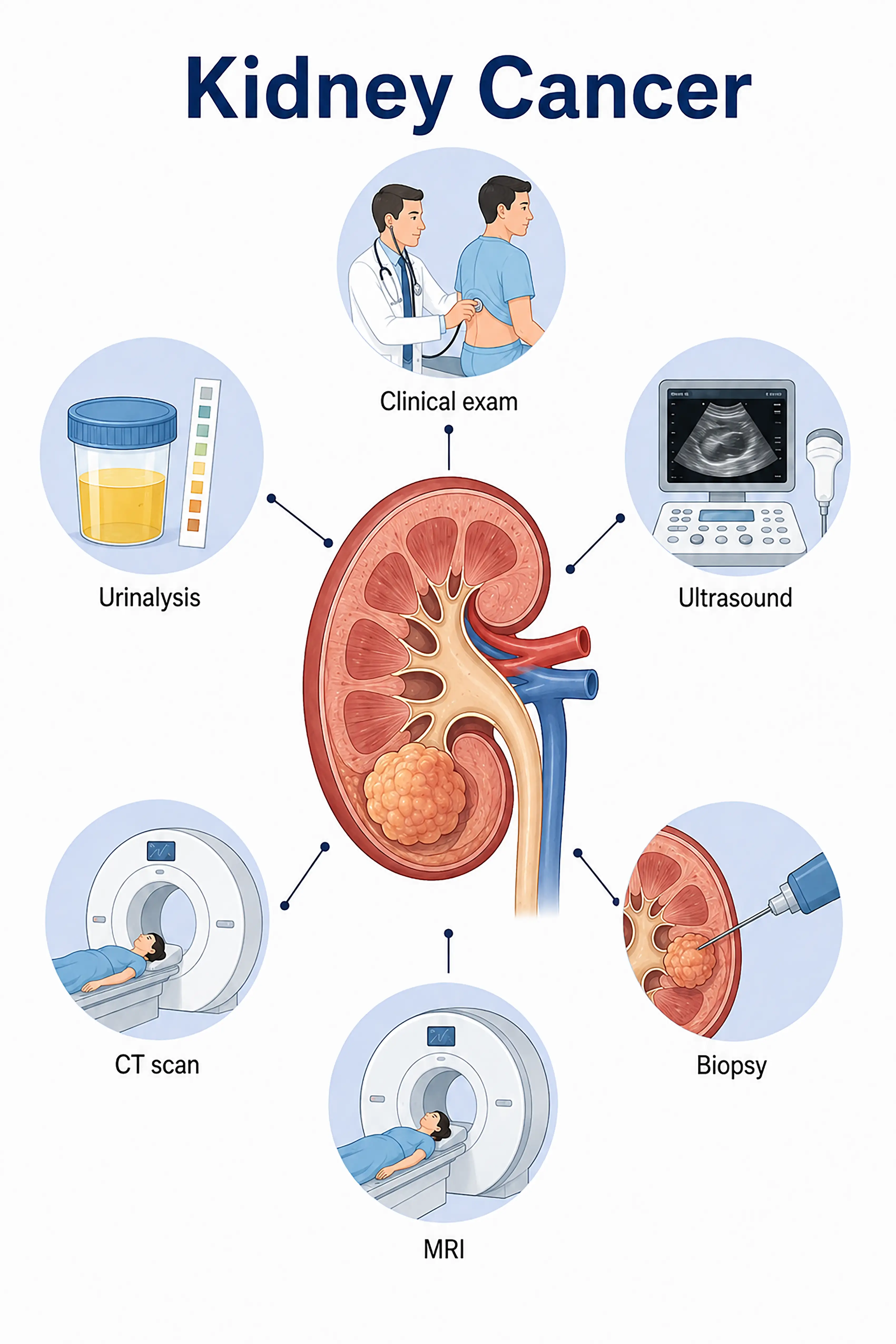
Diagnosis based on renal cancer stage
1.Early diagnosis of kidney cancer
The tumor is confined within the kidney (<7 cm) and is often asymptomatic.An intrarenal mass is incidentally detected via ultrasound; contrast-enhanced CT reveals a typical "rapid-in, rapid-out" enhancement pattern, allowing for clinical diagnosis, while needle biopsy is reserved for specific cases.
2.Diagnosis of mid-stage kidney cancer
Tumor enlargement (>7 cm) or invasion of perirenal fat.Contrast-enhanced CT and MRI are used to assess tumor extent and renal vein tumor thrombus; needle biopsy confirms the pathological type.
3.Diagnosis of advanced kidney cancer
Tumor invasion of adjacent organs or distant metastasis to the lungs, bones, and liver.Whole-body CT and PET-CT are used to assess the extent of metastasis, bone scans to evaluate bone metastasis, and needle biopsy to guide targeted therapy.
If renal cancer is not diagnosed promptly, approximately 30% of patients are already in the advanced stage at the time of diagnosis; the prognosis worsens significantly once distant metastasis occurs, with a five-year survival rate of less than 10%.
When to Seek Medical Attention
Early signs of kidney cancer include painless hematuria, lower back pain, and an abdominal mass.Please consult a doctor via the "Chat with a Doctor" feature to facilitate early detection.During the online consultation, the doctor will ask about your symptoms and risk factors, and guide you through the process of undergoing renal ultrasound and CT scans.
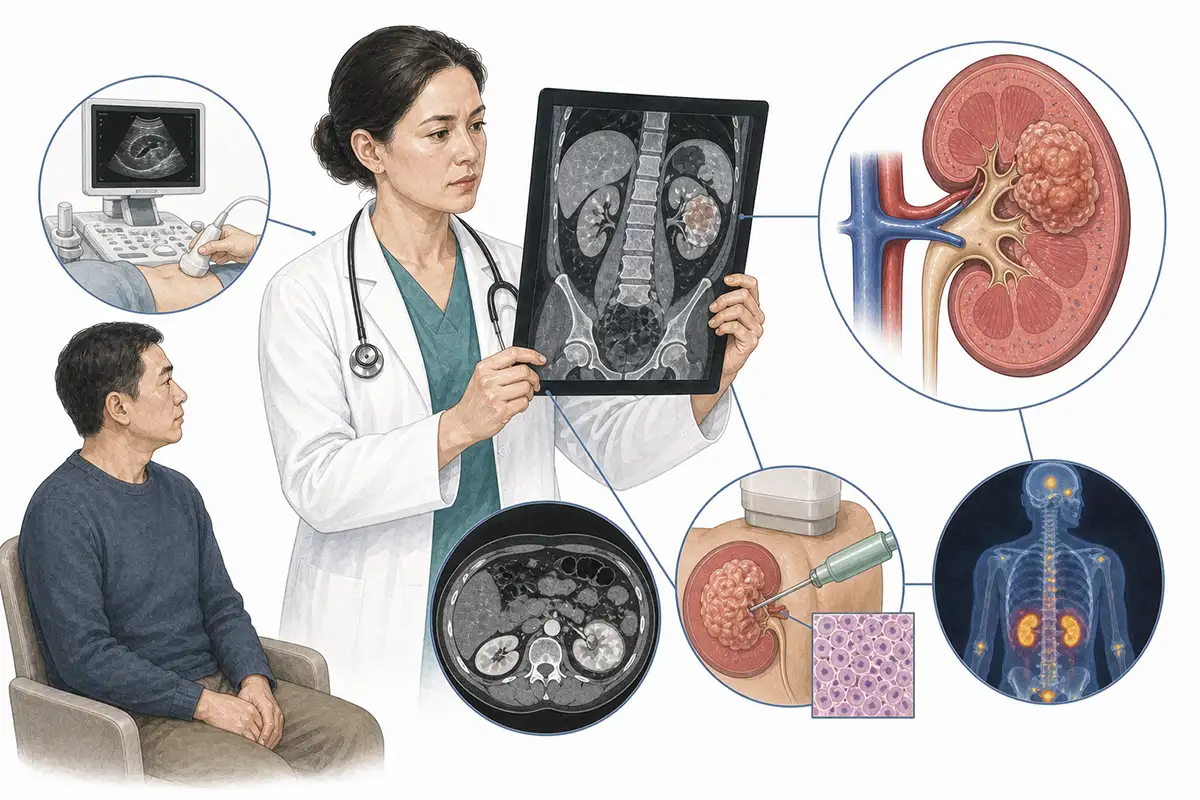
Basis for renal cancer diagnosis
1.Abdominal ultrasound
Ultrasound is the preferred method for screening for renal cancer; it can detect solid intra-renal masses and assess tumor size, location, and cystic/solid composition, serving as a non-invasive and convenient initial examination.
2.Contrast-enhanced CT scan
Contrast-enhanced CT is the primary imaging tool for diagnosing renal cancer; typical findings include a "fast-in, fast-out" pattern—marked enhancement during the cortical phase followed by washout during the medullary phase—enabling tumor staging.
3.Abdominal MRI
MRI offers high accuracy in staging renal cancer, particularly in evaluating tumor thrombi within the renal vein and inferior vena cava, and can differentiate between tumor tissue and blood clots.
4.Renal angiography
Selective renal arteriography reveals features such as abundant tumor vasculature, vascular tortuosity, and arteriovenous fistulas, facilitating preoperative assessment of blood supply and interventional embolization therapy.
5.Needle biopsy
For cases with atypical imaging findings, those scheduled for ablation therapy, or metastatic renal cell carcinoma requiring pathological typing, CT-guided needle biopsy is used to obtain tissue specimens for pathological examination.
6.Chest CT scan
Assesses for metastases in the lungs and mediastinal lymph nodes; renal cell carcinoma commonly metastasizes to the lungs, making this a standard examination for initial staging and follow-up.
7.Bone scan
Radionuclide bone scanning assesses the entire skeleton for metastases; it is particularly recommended for individuals with bone pain or elevated alkaline phosphatase levels.
8.Whole-body PET-CT assessment
Assesses systemic metastasis and provides valuable information for staging patients with high-grade renal cancer and sarcomatoid differentiation.
9.Urine cytology
Ruling out the possibility of urothelial carcinoma (renal pelvis carcinoma) is particularly important for patients with hematuria, allowing for differential diagnosis from renal cell carcinoma.
Daily Self-Check
Seek prompt medical attention if painless hematuria, flank pain, or an abdominal mass occurs.Regular abdominal ultrasound examinations help in the early detection of asymptomatic renal cancer.
Conclusion
Diagnosis of kidney cancer relies on contrast-enhanced CT (showing a characteristic "rapid wash-in and wash-out" enhancement pattern) and ultrasound.Early detection allows for a good prognosis through surgery, whereas advanced-stage cases are primarily treated with targeted therapy and immunotherapy.


