


Breast cancer prevalence worldwide
Breast cancer has the highest incidence among female malignancies worldwide, accounting for 24.2% of new cancers in women. In 2020, China recorded over 416,000 new cases in women, ranking first among female cancers. Incidence is relatively high in economically developed regions, and wider screening has increased early detection in recent years.
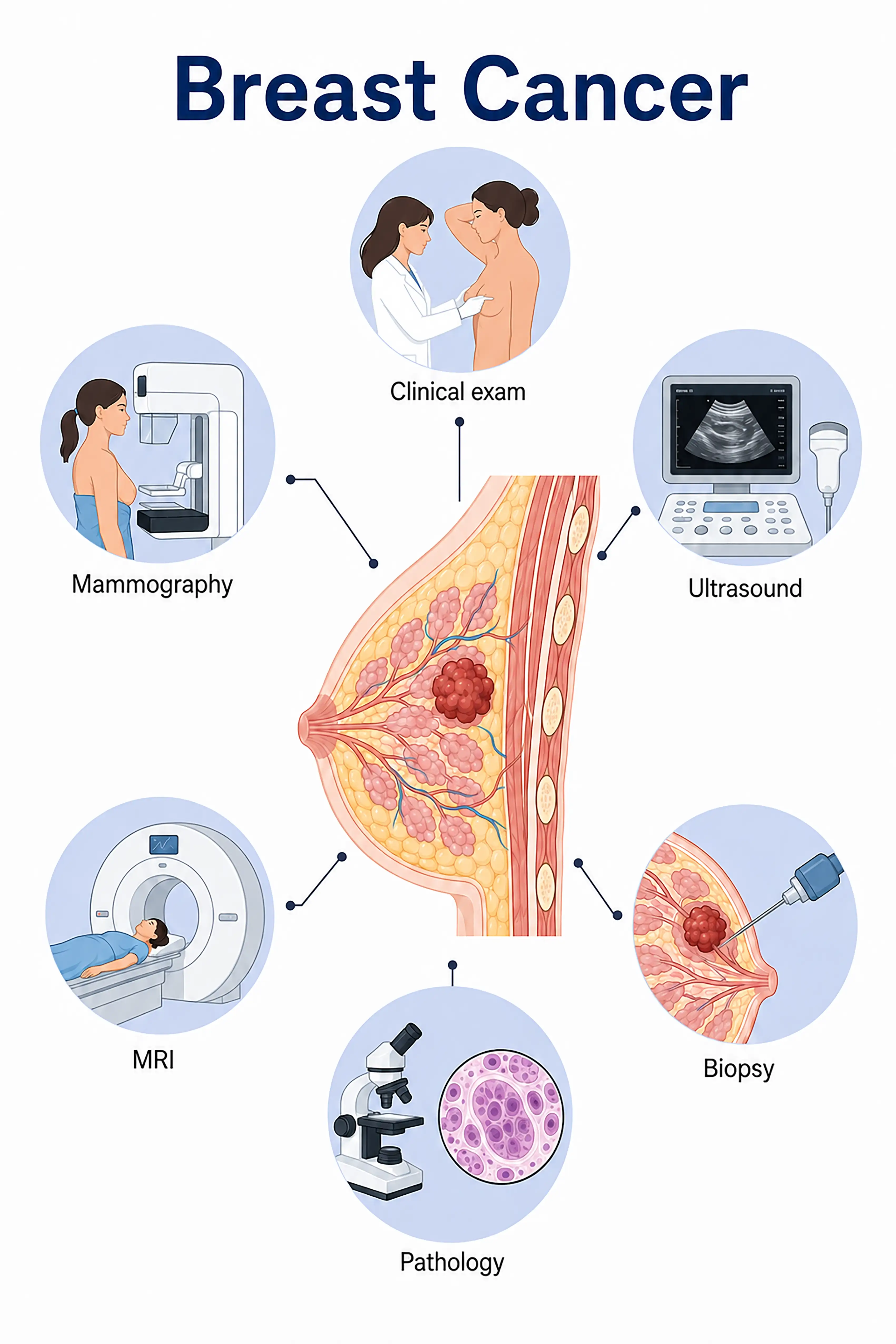
Breast cancer diagnosis by stage
1.Early-stage breast cancer diagnosis
The tumor is confined to mammary ducts or lobules. Mammographic screening or ultrasound can detect tiny calcifications or nodules, which require needle biopsy to establish their nature.
2.Intermediate-stage breast cancer diagnosis
The tumor measures two to five centimeters and may be accompanied by enlarged same-side axillary lymph nodes. Breast MRI is needed to assess invasion, and core needle biopsy obtains tissue samples.
3.Advanced-stage breast cancer diagnosis
The tumor exceeds five centimeters or is accompanied by distant metastases. Whole-body PET-CT is required to assess metastatic lesions, while needle biopsy identifies the pathological type to guide subsequent treatment.
Without timely diagnosis and treatment, breast cancer continues to grow and spreads to lymph nodes and distant sites, worsening the disease and seriously impairing quality of life.
When to Seek Medical Attention
Early warning signs of breast cancer include a painless breast lump, bloody nipple discharge, orange-peel skin changes, or enlarged axillary lymph nodes. Please consult a doctor through "Chat with a Doctor" to support early detection. During the online consultation, the doctor will ask about possible causes of your lump and guide you through further examinations.
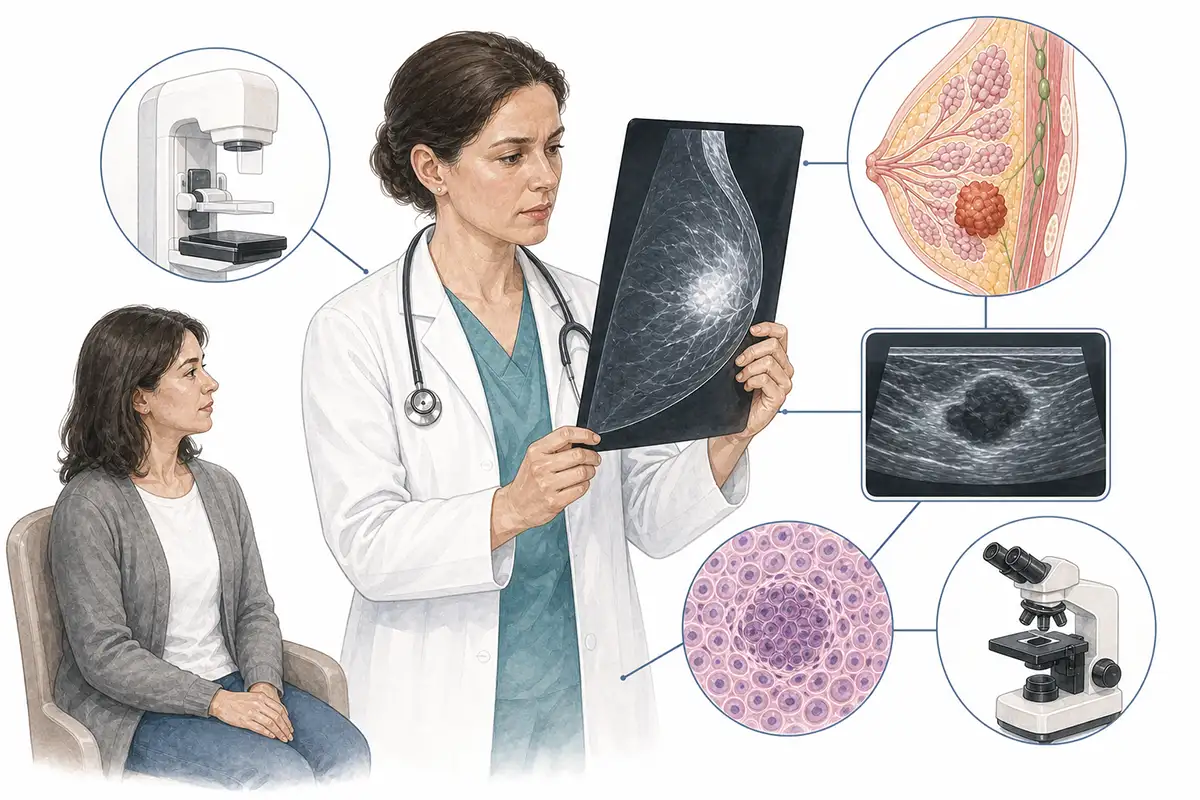
Basis for breast cancer diagnosis
1.Breast palpation
The doctor palpates the breasts to check for lumps, nipple discharge, and enlarged axillary nodes. This is an important initial screening method.
2.Breast ultrasound
High-frequency ultrasound distinguishes cystic from solid masses and assesses size, margins, and blood flow. It involves no radiation and is suitable for younger women and dense breasts.
3.Mammography
Mammography detects tiny clusters of calcifications and architectural distortion. It is an important screening and early diagnostic tool, particularly for women over 50.
4.Breast magnetic resonance imaging
MRI offers high soft-tissue resolution and can be used for high-risk screening and preoperative evaluation of tumor extent and multicentric lesions, including occult disease.
5.Core needle biopsy
Under imaging guidance, a core needle samples tissue strips from the lump. Pathology establishes the tumor's nature and grade, making this a key step in definitive diagnosis.
6.Vacuum-assisted biopsy
A vacuum-assisted cutting device obtains larger tissue samples to improve diagnostic accuracy, especially for small suspicious lesions and imaging abnormalities that cannot be palpated.
7.Sentinel lymph node biopsy
An injected tracer locates sentinel lymph nodes for removal. Assessing nodal metastasis guides the extent of surgery and reduces unnecessary axillary dissection.
8.Immunohistochemistry
Pathological specimens are tested for estrogen receptors, progesterone receptors, and HER2, providing an important basis for molecular classification and individualized treatment planning.
9.Routine breast self-examination
Women are advised to examine their breasts each month after menstruation. Observe changes in shape, then use the finger pads to feel each breast quadrant clockwise, checking for lumps, nipple discharge, or skin dimpling.
Daily Self-Check
Women are advised to examine their breasts each month after menstruation. Observe changes in shape, then use the finger pads to feel each breast quadrant clockwise, checking for lumps, nipple discharge, or skin dimpling. Women over 40 should undergo annual mammographic screening.
Conclusion
Early breast cancer diagnosis is essential to improving prognosis, as distant metastases in advanced disease can be life-threatening. Women in the appropriate age groups should receive regular screening and seek prompt medical diagnosis of abnormalities.


