


Global prevalence
Brain metastases are common secondary brain tumors worldwide; they occur frequently in patients with lung cancer, breast cancer, and melanoma, and are associated with a relatively poor prognosis.
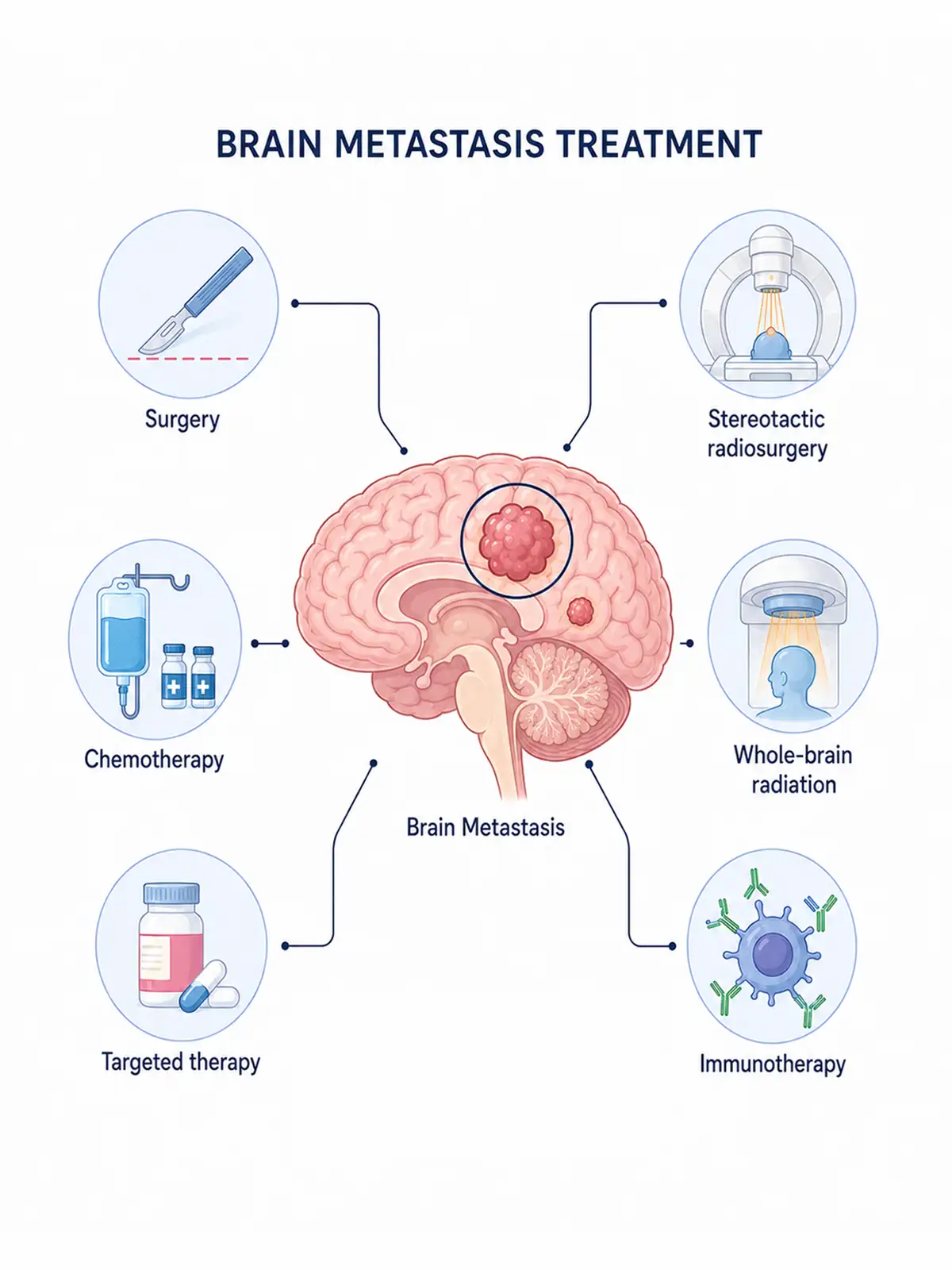
Staged treatment for brain metastases
Early treatment (localized lesion, reduced volume, favorable outcome)
Surgical resection of the lesion combined with adjuvant therapy can effectively control tumor progression and alleviate symptoms of increased intracranial pressure.
Intermediate-stage treatment (addressing an increase in lesions, inhibiting growth, and delaying progression)
employs a comprehensive approach—combining surgery with chemoradiotherapy—to control the further proliferation of metastatic lesions and slow the rate of disease deterioration.
Treatment for advanced disease (extensive metastasis; aimed at symptom relief and survival prolongation)
primarily employs systemic therapies such as chemoradiotherapy, targeted therapy, and others to alleviate clinical symptoms and extend patient survival as much as possible.
Why choose Fosun Health for brain metastasis treatment
Brain metastases are a common and serious complication of malignant tumors, requiring a multidisciplinary approach involving neurosurgery, radiation oncology, and medical oncology.The Department of Neurosurgery at Fosun Health’s Foshan Fosun Chancheng Hospital possesses deep expertise in the microsurgical total resection of intracranial metastatic tumors. Its Precision Oncology Center features an expert team specializing in CyberKnife therapy; notably, Professor Ye Gang has performed over 6,000 CyberKnife procedures, while experts such as Wang Enmin and Tan Feng have long focused on CyberKnife radiosurgery for brain metastases.
Leveraging the real-time image tracking and sub-millimeter positioning capabilities of the 6th-generation CyberKnife system, the center provides non-invasive, precise treatment for brain metastases, condensing the traditional radiotherapy course into just 1–5 sessions. Multidisciplinary team (MDT) consultations involving experts from both China and the US are held weekly, allowing patients to benefit from collaborative decision-making by international specialists without the need to travel abroad.
Furuitini, a next-generation ALK/ROS1 inhibitor with high central nervous system (CNS) penetration independently developed by Fosun Pharma, demonstrated an intracranial objective response rate (ORR) of 100% in patients with baseline brain metastases during Phase III clinical trials, offering a new targeted therapy option for this patient population.Fosun Health also provides international medical services covering 124 countries and regions, enabling patients to access precision diagnosis and treatment aligned with global standards.

Treatment methods for brain metastases
1.Microsurgical resection of brain metastases
For patients with solitary or limited metastatic lesions that are large and exert significant mass effect, or for those requiring a definitive pathological diagnosis, microsurgical resection may be considered based on the lesion's location and the patient's overall condition.
Treatment advantages:
① Relieves mass effect: For lesions causing significant mass effect, it can directly alleviate local compression caused by the tumor.
② Rapid tumor debulking: Can directly remove large or symptomatic brain metastases.
③ Obtain pathology: Resected tissue can be used to determine the pathological type and for further molecular testing.
④ Combination therapy: Postoperatively, radiotherapy or drug therapy may be selected based on the status of the residual cavity and other intracranial lesions.
2.CyberKnife precision radiotherapy
For select brain metastases that are limited in number, small in volume, and suitable for stereotactic radiotherapy, CyberKnife precision radiotherapy may be employed.Cases involving postoperative resection cavities or local recurrences may also be evaluated on an individual basis.
Treatment advantages:
① Precise focusing: Using image guidance to concentrate the therapeutic dose on metastatic lesions.
② Non-craniotomy treatment: Does not require traditional craniotomy.
③ Protection of normal tissue: Minimize radiation exposure to surrounding normal brain tissue through precise dose distribution.
④ Suitable for local lesions: Applicable to a limited number of small brain metastases and specific postoperative or recurrent lesions.
3. VitalBeam linear accelerator precision radiotherapy
Utilizing the VitalBeam linear accelerator platform, precise irradiation—such as stereotactic radiotherapy—can be administered to selected eligible brain metastases.
Treatment advantages:
① Precise radiotherapy: Formulate an individualized radiotherapy plan based on the location, size, and number of lesions.
② Dose optimization: Improves target area coverage by optimizing dose distribution.
③ Reduce radiation exposure to normal tissue: Minimize radiation exposure to surrounding brain tissue while meeting treatment requirements.
④ Flexible treatment approach: Single-fraction or fractionated stereotactic radiotherapy can be selected based on lesion characteristics.
4.Whole-brain radiotherapy
For patients with numerous intracranial metastases, diffuse brain metastases, or lesions unsuitable for local stereotactic therapy, whole-brain radiotherapy may be considered based on the clinical condition.
Treatment advantages:
① Broad coverage: Capable of covering known and potential micrometastatic lesions throughout the brain.
② Suitable for multiple lesions: Offers therapeutic value for certain patients with multiple brain metastases.
③ Adjunctive local therapy: Can be combined with other local treatments depending on the distribution of intracranial lesions.
④ Personalized selection: Evaluate treatment options based on the patient's prognosis, neurological function, and systemic disease status.
5.Targeted therapy
Targets specific gene mutations in the primary tumor for precision therapy; offers good efficacy with mild side effects, making it suitable for patients with identifiable therapeutic targets.
6.Chemotherapy
Systemic elimination of potential cancer cells using anti-cancer drugs to effectively control the rate of tumor progression; commonly used for patients with brain metastases.Therapeutic Efficacy
7.Immunotherapy
Activates the body's immune system to recognize and attack cancer cells, offering a new, effective treatment option—and helping to consolidate therapeutic efficacy—for select patients with brain metastases.
8.Comprehensive therapy
Formulate an individualized comprehensive treatment plan based on the patient's specific condition, combining modalities such as surgery, radiotherapy, and targeted therapy to enhance therapeutic efficacy.
9.Supportive care
Approaches such as nutritional support, psychological counseling, and symptom management can comprehensively improve the patient's physical condition and quality of life, as well as consolidate therapeutic efficacy.
Post-treatment care
Maintain a regular daily routine and a balanced diet; avoid strenuous exercise; attend scheduled follow-up appointments and actively cooperate with subsequent treatment as advised.
Post-treatment examinations
Periodic cranial MRI, tumor marker testing, and whole-body examinations are required after treatment to timely detect new metastatic lesions or changes in the disease status.
Conclusion
Brain metastases pose a serious threat. Successful treatment hinges on early detection, diagnosis, and intervention, as well as the selection of an appropriate treatment plan and adherence to follow-up to control disease progression.


