


Global prevalence: Pituitary tumors are among the most common intracranial tumors worldwide and account for a significant proportion of endocrine system tumors; most are benign and have a good prognosis.
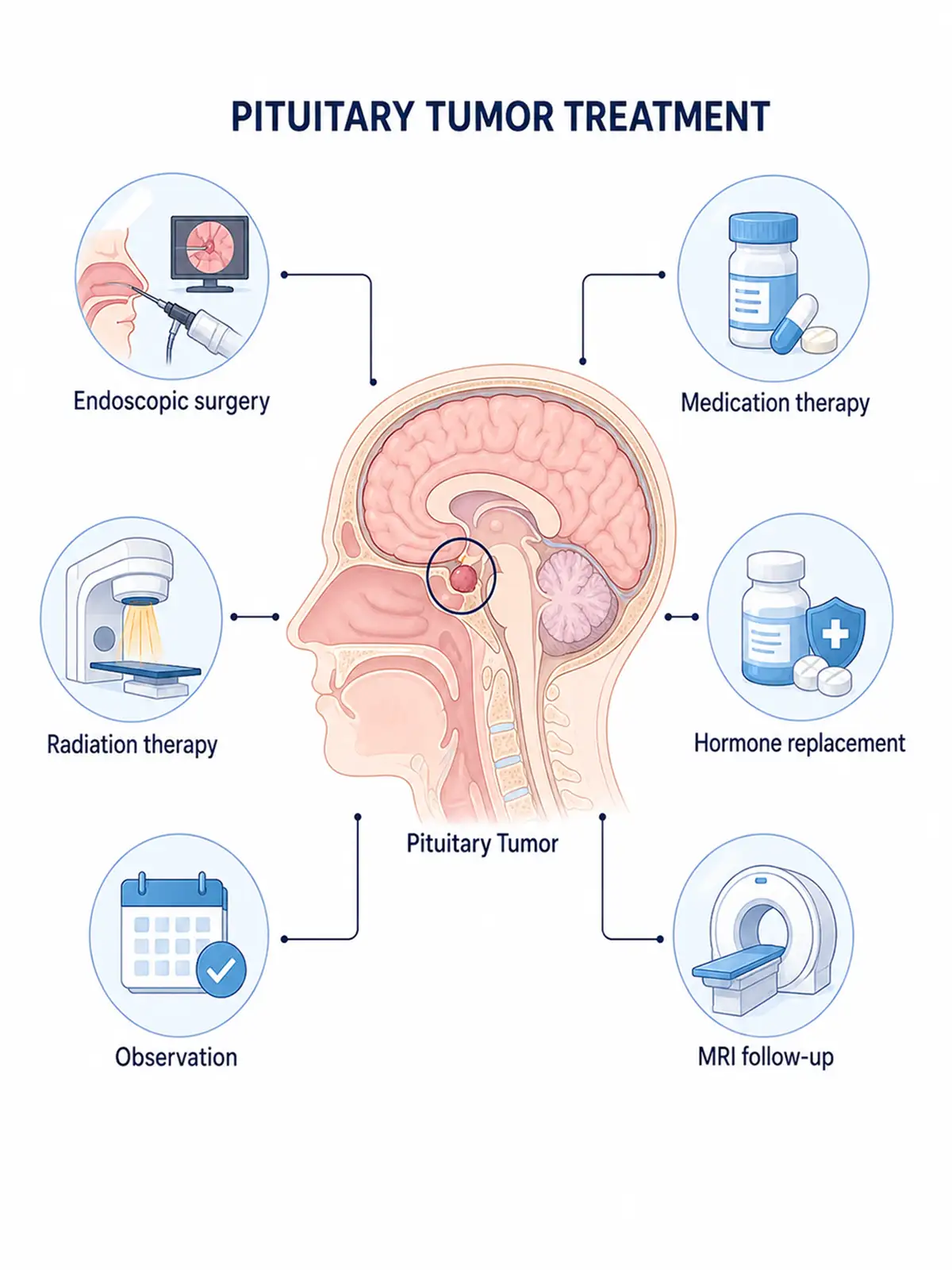
Staging-based treatment for pituitary tumors
Early treatment (when the tumor is localized and small, yielding good results)
involving surgical resection of the lesion combined with pharmacological therapy—can effectively control tumor progression and restore hormone levels.
Advanced-stage treatment (addressing severe compression, alleviating symptoms, and prolonging survival)
primarily employs systemic therapies such as radiotherapy and medication to relieve symptoms of neurological compression and maximize patient survival time.
Consequences of delayed early treatment: Failure to receive timely, standardized treatment in the early stages allows the tumor to continue enlarging and compressing the optic nerves and surrounding tissues; missing the optimal window for intervention leads to a worsening of the condition.
Why choose Fosun Health for pituitary tumor treatment
Leveraging the neurosurgery, endocrinology, ophthalmology, M6 CyberKnife, VitalBeam, and imaging platforms of its affiliated hospitals, Fosun Health facilitates multidisciplinary consultations involving experts in neurosurgery, endocrinology, ophthalmology, radiotherapy, and medical imaging.The team selects the appropriate treatment—whether medication, endoscopic transsphenoidal surgery, or precision radiotherapy—based on factors such as adenoma type, hormone levels, compression of the visual pathways, cavernous sinus invasion, and response to medication.
Transsphenoidal surgery utilizes a natural orifice approach, minimizing trauma associated with craniotomy; precise radiotherapy involves dose modulation based on the distance between the tumor and the optic nerves/optic chiasm to minimize radiation exposure to the visual pathways and normal brain tissue, thereby reducing the risk of certain treatment-related adverse effects.Continuous management of cortisol, thyroid, and gonadal function, as well as water-electrolyte balance, is required both pre- and post-operatively.

Treatment methods for pituitary tumors
1.M6 CyberKnife treatment
Indicated for functional adenomas with small residual or recurrent tumor volumes following transsphenoidal surgery that are poorly controlled by medication, as well as lesions that are inoperable but maintain a safe distance from the visual pathways.
Treatment advantages:
① Targeting sellar region lesions: Suitable for select small residual volumes or recurrent adenomas.
② Protection of surrounding brain tissue: Reduces radiation dose to the temporal lobes, brainstem, and tissues outside the cavernous sinus.
③ Hypofractionated treatment: Eliminates the need for repeat craniotomy or transnasal surgery.
④ Strict requirements regarding distance from the visual pathway: Radiation doses to the optic nerve and optic chiasm must be controlled.
2.VitalBeam precision radiotherapy
Suitable for pituitary adenomas that are large in volume, adjacent to the visual pathway, invading the cavernous sinus, or unsuitable for CyberKnife hypofractionated irradiation.
Treatment advantages:
① Suitable for complex targets in the sellar region: Covers residual disease in the cavernous sinus or irregular lesions.
② Reduce single-fraction dose to the visual pathway: Protect the optic nerve and optic chiasm through fractionated treatment.
③ Control hormone secretion: Can be used for functional adenomas that are inadequately controlled by surgery or medication.
④ Individualized treatment plans: Tailored based on tumor size, hormonal subtype, and prior treatments.
3.Endoscopic transsphenoidal pituitary tumor resection
Suitable for patients presenting with visual pathway compression, pituitary apoplexy, or lack of response to medical therapy, or those requiring decompression and pathological diagnosis.
4.Medication and endocrine function management
Hormone secretion is controlled based on the adenoma type, and postoperative hypopituitarism is managed through hormone replacement and fluid-electrolyte balance.
5.Proton beam therapy
Uses proton beams to precisely target tumor tissue while maximizing protection of surrounding normal tissue; suitable for patients with recurrent pituitary adenoma.
6.Pharmacotherapy
Inhibits tumor growth and hormone secretion using drugs such as dopamine agonists, providing an effective treatment option for patients with prolactinomas.
Post-treatment care
Regularly monitor hormone levels; maintain a regular daily routine and a balanced diet; attend scheduled follow-ups and actively cooperate with further treatment as advised.
Post-treatment examinations
After treatment, regular pituitary MRI scans, hormone level testing, and vision checks are required to detect changes in the condition in a timely manner.
Conclusion
Although most pituitary tumors are benign, the risks they pose cannot be ignored. The key to treatment lies in early detection, diagnosis, and intervention, as well as selecting an appropriate treatment plan and adhering to follow-up care.


