


A pituitary tumor is a neoplasm resulting from the proliferation of pituitary cells; the vast majority are benign adenomas.They are classified as functional or non-functional based on whether they secrete hormones. Common clinical manifestations include changes in vision or visual fields, headaches, and endocrine disorders.

Prevalence of pituitary tumors worldwide
Pituitary tumors account for approximately 10%–15% of intracranial tumors and are the most common tumors in the sellar region.The incidence is higher in women than in men, with the condition most frequently affecting individuals aged 20–40.Functional pituitary tumors secrete excess hormones, leading to corresponding clinical syndromes, whereas non-functional pituitary tumors primarily manifest through symptoms caused by compression.
Symptoms associated with pituitary tumor stages
1.Early symptoms of pituitary tumor
The tumor is small and often asymptomatic; mild headache, menstrual irregularities, or slight visual changes may occur, making it prone to being overlooked or misdiagnosed as another condition.
2.Intermediate-stage symptoms of pituitary tumors
Worsening headache, decreased visual acuity and visual field defects; prominent symptoms of endocrine dysfunction, such as amenorrhea-galactorrhea, hypogonadism, acromegaly, or signs of Cushing's syndrome.
3.Symptoms of advanced pituitary tumor
Massive tumor compressing the optic chiasm, causing bilateral blindness and severe endocrine disturbances, including hypopituitarism and systemic metabolic derangement.
When to Seek Medical Attention
Early signs of pituitary tumors include blurred vision, visual field defects, unexplained amenorrhea or galactorrhea, and headaches.Please consult a doctor via "Chat with a Doctor" for early detection.During the online consultation, the doctor will ask about your symptoms and endocrine status, and guide you through pituitary hormone testing and MRI scans.
Pituitary tumor staging
Pituitary tumor: Stage 0
This staging system is not applicable to pituitary adenomas.Pituitary adenomas are assessed using the Knosp grading system or Hardy classification, based on tumor size and the degree of invasiveness.
Pituitary tumor: Stage I
Microadenomas (diameter <1 cm) confined to the sella turcica, presenting with mild symptoms or solely endocrine abnormalities, respond well to surgical treatment.
Pituitary tumor: Stage II
Macroadenoma (1–3 cm in diameter) extending superiorly to compress the optic chiasm, resulting in changes to visual acuity and visual fields, as well as headache.
Pituitary tumor: Stage III
A giant adenoma (diameter >3 cm) invading the cavernous sinus in the parasellar region, causing cranial nerve deficits and severe endocrine dysfunction.
Pituitary tumor: Stage IV
Tumor extensively invades the skull base or hypothalamus, or metastasizes distantly (pituitary carcinoma is extremely rare); presents with severe neurological impairment.
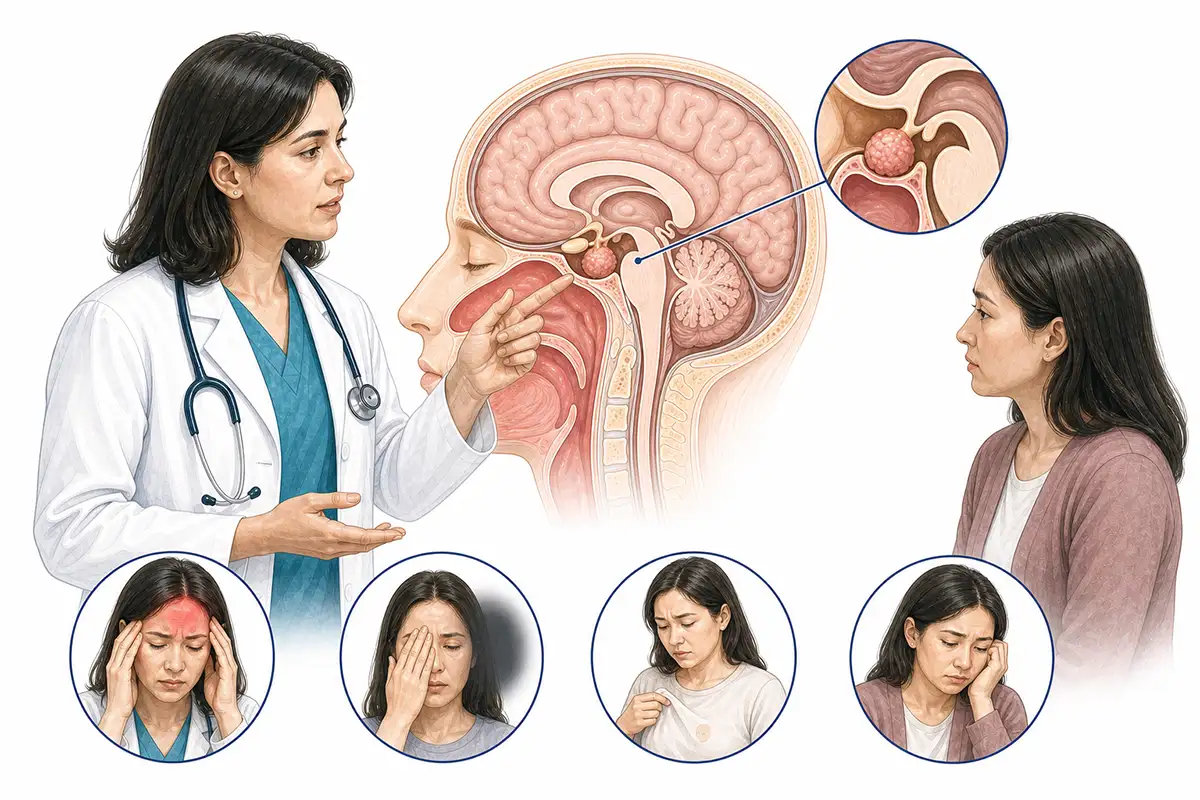
Detailed Symptoms of Pituitary Tumors
1.Changes in visual acuity and visual field
Upward compression of the optic chiasm by the tumor leads to decreased visual acuity and bitemporal visual field defects; patients are prone to bumping into doorframes, and severe cases can result in blindness.
2.Persistent headache
Tumor compression of the diaphragma sellae or surrounding structures causes persistent headache—typically a sensation of distension or aching in the frontal or retro-orbital regions—that responds poorly to standard analgesics.
3.Amenorrhea and galactorrhea
Prolactin-secreting pituitary tumors cause menstrual irregularities or amenorrhea in women, as well as abnormal milk secretion outside of lactation periods; these are the most common endocrine symptoms.
4.Decreased sexual function
Reduced gonadotropin secretion or elevated prolactin levels lead to decreased libido, impotence, and infertility; these symptoms can occur in both men and women.
5.Acromegaly
Growth hormone-secreting pituitary tumors cause signs of acromegaly, such as enlargement of the hands and feet, protrusion of facial bones, widening of the gaps between teeth, and enlargement of internal organs.
6.Moon face and buffalo hump
An adrenocorticotropic hormone (ACTH)-secreting pituitary tumor causes Cushing's syndrome, characterized by a moon face, buffalo hump, purple skin striae, and hypertension.
7.Hypothyroidism
Tumor compression of normal pituitary tissue leads to secondary hypothyroidism, manifesting as cold intolerance, fatigue, dry skin, and weight gain.
8.Changes in facial appearance
Growth hormone-secreting tumors cause coarse facial features, a prominent forehead, and a protruding jaw; ACTH-secreting tumors cause a "moon face" and acne.
9.Diabetes insipidus
Tumor invasion of the hypothalamus or posterior pituitary leads to insufficient antidiuretic hormone secretion, manifesting as diabetes insipidus (polydipsia and polyuria).
Conclusion
Pituitary tumors are predominantly benign; early detection and treatment can effectively control symptoms and preserve pituitary function.Surgery, medication, and radiotherapy are the primary treatment modalities, requiring a multidisciplinary approach to develop personalized treatment plans.


