


Parotid gland cancer arises from malignant transformation of parotid epithelial cells. Early symptoms are usually nonspecific, commonly including a painless lump below the earlobe, facial numbness, and muscle weakness. About 20% of parotid tumors are malignant.
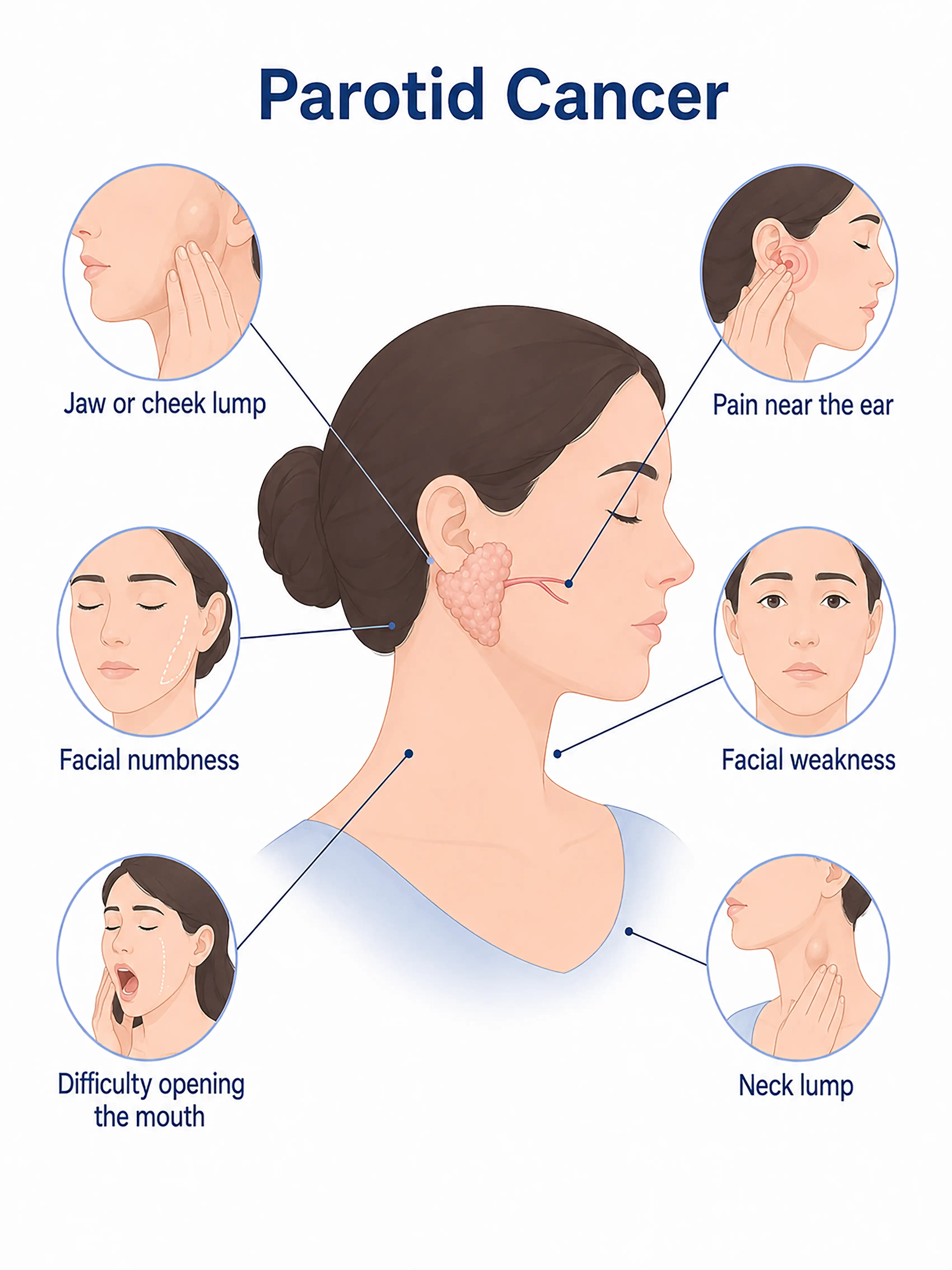
Parotid gland cancer prevalence worldwide
Parotid gland cancer is the most common salivary gland malignancy, accounting for about 80% of salivary gland tumors. Most parotid tumors are benign, with malignancies accounting for about 15%-20%. Incidence shows no marked regional differences. It can occur at any age but is more common in middle-aged and older people, with slightly more men than women affected.
Parotid gland cancer symptoms by stage
1.Early-stage parotid gland cancer symptoms
The tumor is confined to the parotid gland, usually presenting as a painless lump below the earlobe or in front of the ear. It grows slowly, feels firm, and has indistinct borders, with no obvious early pain or functional impairment.
2.Intermediate-stage parotid gland cancer symptoms
The tumor enlarges and invades surrounding tissues, causing local pain and tenderness, facial numbness, and restricted mouth opening. The lump adheres to surrounding tissue and becomes fixed, and enlarged cervical lymph nodes may be palpable.
3.Advanced-stage parotid gland cancer symptoms
Facial nerve invasion causes facial paralysis, with facial deformity and ulceration, extensive cervical lymph node metastasis, and distant spread to the lungs, bones, and liver.
When to Seek Medical Attention
Early signs of parotid gland cancer include a painless lump below the earlobe, facial numbness or muscle weakness, restricted mouth opening, and pain. Consult a doctor through "Chat with a Doctor" for early detection. During an online consultation, the doctor will ask about your symptoms and medical history and guide you toward ultrasound and fine-needle aspiration biopsy.
Parotid gland cancer stages
Stage 0 parotid gland cancer
Cancer cells are confined to the parotid duct epithelium, representing carcinoma in situ. There are usually no obvious clinical symptoms, but a small, slow-growing nodule may be palpable in the parotid region.
Stage I parotid gland cancer
The tumor is no more than two centimeters in diameter, confined to the parotid gland, and without lymph node metastasis. It presents as a painless lump below the earlobe with clear borders and reasonable mobility.
Stage II parotid gland cancer
The tumor is two to four centimeters in diameter, confined to the parotid gland or with invasion around the facial nerve. The lump enlarges, becomes harder, and loses mobility.
Stage III parotid gland cancer
The tumor exceeds four centimeters or invades surrounding skin, soft tissue, or nerves, causing facial numbness, pain, and difficulty opening the mouth, with ipsilateral cervical lymph node metastasis.
Stage IV parotid gland cancer
The tumor invades the skull base or spreads to the lungs, bones, and liver, causing facial paralysis, severe pain, and systemic wasting symptoms.
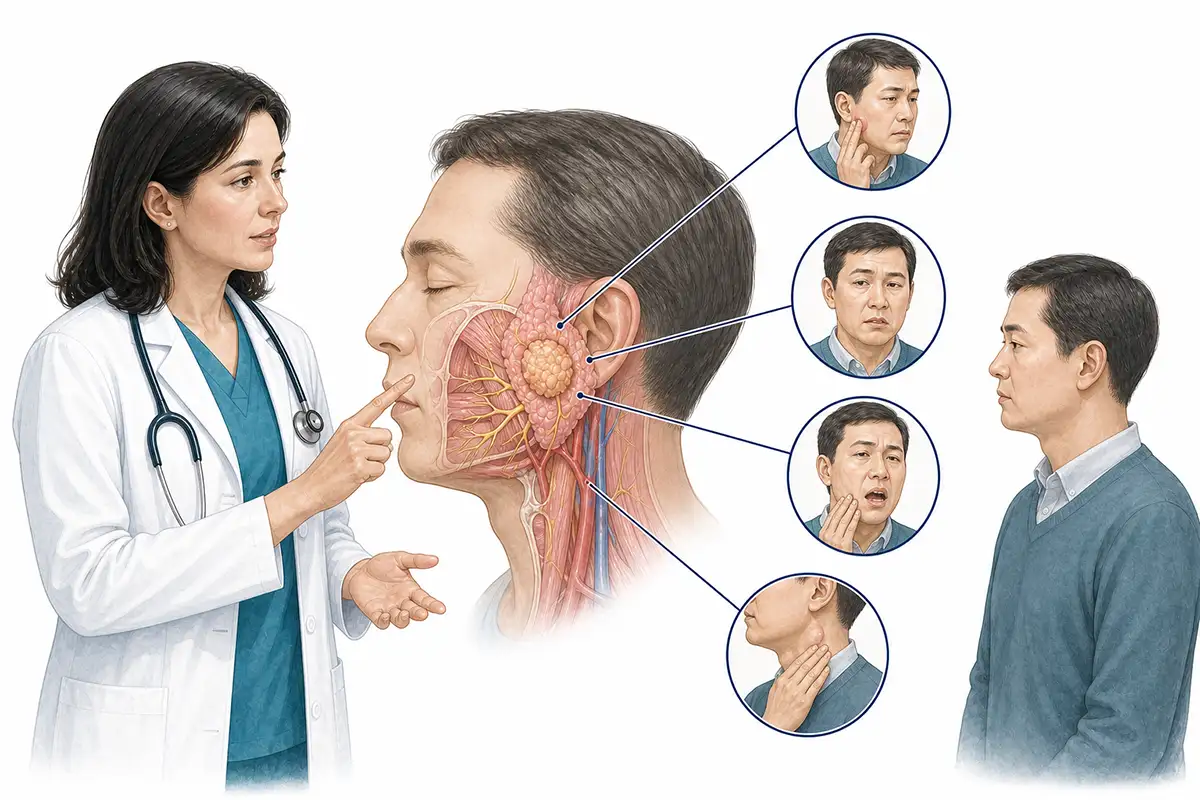
Parotid gland cancer symptoms in detail
1.Lump below the earlobe
The most common initial symptom is a painless lump below the earlobe or in front of the ear. It is usually nodular and relatively slow-growing, with variable firmness and some mobility early on.
2.Facial numbness
Invasion of the facial nerve or trigeminal nerve branches causes numbness in part of the face, sometimes with crawling or tingling sensations, suggesting invasion of surrounding nerves.
3.Muscle weakness
Compression or invasion of the facial nerve causes weakness or paralysis of ipsilateral facial expression muscles, making it difficult to purse the lips, puff out the cheeks, or close the eyes, manifestations of facial paralysis.
4.Markedly restricted mouth opening
Invasion of the masseter, temporalis, or pterygomandibular ligament causes difficulty opening the mouth. Severe cases may prevent mouth opening entirely, affecting eating and oral hygiene.
5.Increasing local pain
Benign parotid tumors are usually painless, while malignant tumors may cause persistent local pain or tenderness radiating to the ear. Advanced pain can be severe and unbearable.
6.Fixed, adherent lump
The enlarging tumor adheres to surrounding tissues such as skin and deep muscles, making the lump poorly mobile, indistinct in outline, and stone-hard.
7.Blood streaks in saliva
Invasion of the parotid duct or oral mucosa causes blood streaks in saliva, worsening with irritating foods, sometimes with an unpleasant oral odor and foul-smelling secretions.
8.Enlarged cervical lymph nodes
Parotid gland cancer may spread to cervical lymph nodes, producing painless, hard lumps on the side of the neck that progressively enlarge and are poorly mobile, indicating regional metastasis.
9.Skin breakdown and ulceration
Advanced tumor infiltration of the skin causes local breakdown and an exophytic cauliflower-like mass, with foul-smelling discharge and bleeding, affecting appearance and quality of life.
Conclusion
Early symptoms of parotid gland cancer are subtle. A lump in the parotid region warrants prompt medical evaluation. Surgery is the main treatment, and early treatment offers a better prognosis. Regular oral examinations help with early detection.


