


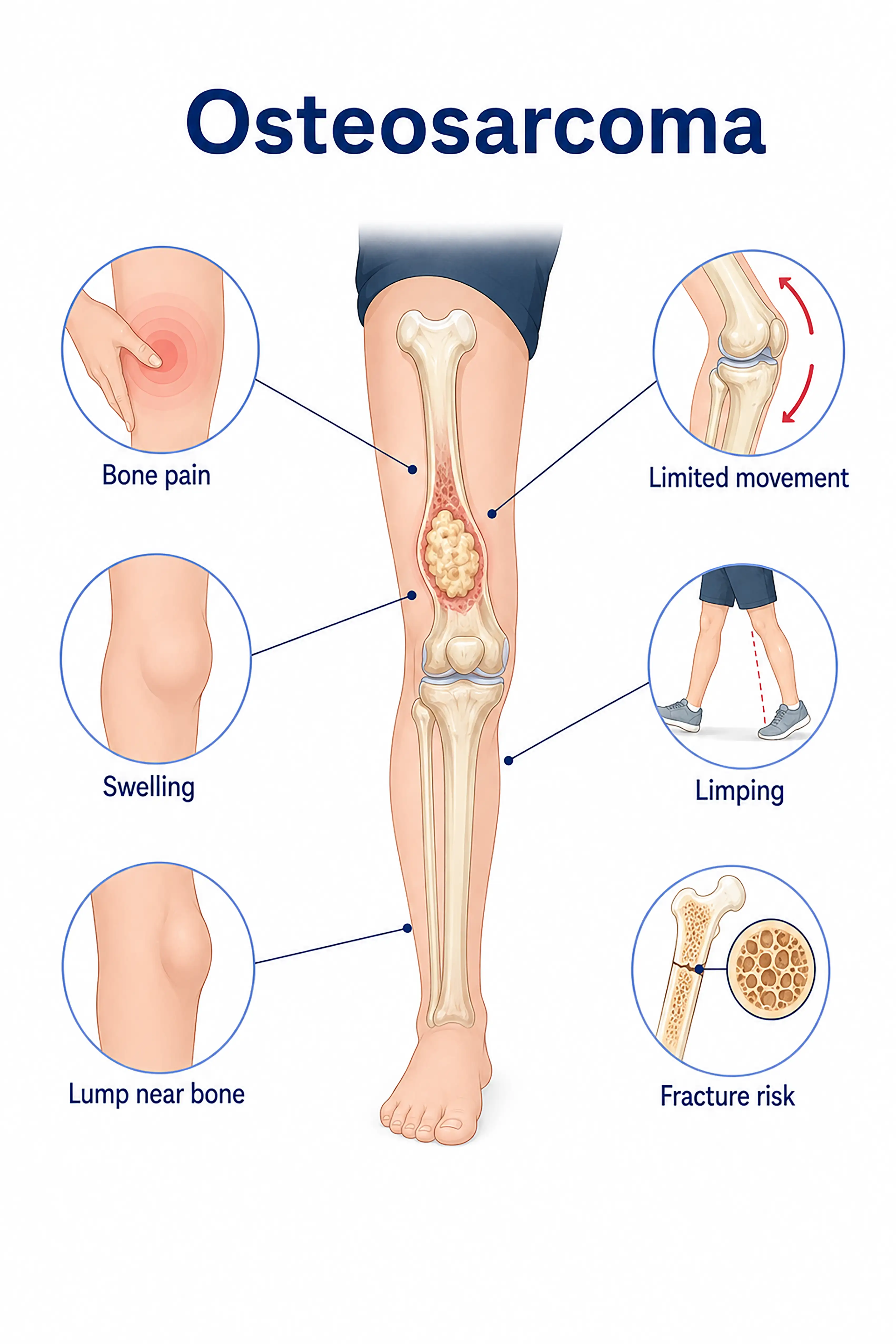
Osteosarcoma is a malignant tumor derived from mesenchymal tissue. Early symptoms are often nonspecific, with common manifestations including bone pain, localized swelling, and limited range of motion.It accounts for approximately 20% of all primary bone tumors.
Global prevalence of osteosarcoma
Osteosarcoma is the most common malignant bone tumor in children and adolescents, accounting for 20% of all primary bone tumors. It predominantly affects individuals aged 10–25, with a slightly higher incidence in males than in females.It most commonly occurs around the knee joint (distal femur and proximal tibia), accounting for approximately 60% of all cases.Conventional osteosarcoma is highly malignant, with the potential for early pulmonary metastasis.
Symptoms associated with osteosarcoma stages
1.Early symptoms of osteosarcoma
The tumor is confined to the bone and presents with intermittent dull pain that worsens at night and intensifies after physical activity; it is easily mistaken for growing pains or sports injuries.
2.Intermediate-stage symptoms of osteosarcoma
The tumor breaches the bone cortex to form a soft-tissue mass; pain becomes constant and severe, local skin temperature rises, and superficial varicose veins become visible.
3.Symptoms of advanced osteosarcoma
Extensive tumor invasion of surrounding soft tissues and pulmonary metastasis, presenting with severe pain, pathological fractures, dyspnea, and multi-organ failure.
When to Seek Medical Attention
Early signs of osteosarcoma include persistent bone pain, localized swelling, and limited mobility.Please consult a doctor via the "Chat with a Doctor" feature to facilitate early detection.During the online consultation, the doctor will ask about the characteristics of your pain and your activity levels, and guide you through the process of obtaining X-ray and MRI examinations.
Staging of osteosarcoma
Osteosarcoma Stage 0
This staging system is not applicable to osteosarcoma.Osteosarcoma utilizes the TNM staging system, which stages the disease based on tumor size, lymph node status, and distant metastasis.
Osteosarcoma Stage I
The tumor is confined to the bone and is low-grade; it presents with intermittent bone pain that worsens at night and responds poorly to standard analgesics.
Osteosarcoma Stage II
The tumor is confined to the bone and is high-grade; pain intensifies, accompanied by local swelling and increased skin temperature.
Osteosarcoma Stage III
The tumor is associated with local lymph node metastasis, presenting with persistent severe pain, a palpable mass, and restricted mobility.
Osteosarcoma Stage IV
Distant metastasis to the lungs, bones, and other organs occurs, leading to functional impairment of the affected organs and systemic wasting.

Detailed Symptoms of Osteosarcoma
1.Bone pain worsening at night
Early symptoms include intermittent dull pain that worsens at night and responds poorly to standard painkillers.The pain progresses from intermittent to constant and increases in intensity; a key characteristic is that the pain is unrelated to physical activity.
2.Localized swelling
Approximately 70% of patients present with a palpable, hard local mass.Upon breaching the bone cortex, the tumor forms a hard mass; the overlying skin feels warm, and superficial vein engorgement is visible.
3.Limited mobility
When the tumor is located near a joint, it restricts joint movement, leading to antalgic gait and atrophy of adjacent muscles, thereby affecting normal walking and activity.
4.Pathological fracture
Fractures occurring under minor or no external force following tumor-induced bone destruction—manifesting as sudden severe pain and deformity—indicate severe damage to the bone structure.
5.Rapid weight loss
Significant short-term weight loss accompanied by loss of appetite and fatigue is associated with tumor-induced wasting and systemic inflammatory response.
6.Fever and night sweats
Tumor necrosis or the secretion of pyrogenic factors causes low-grade fever and night sweats; some patients experience fever of unknown origin.
7.Dyspnea/cough
The lung is the most common site of distant metastasis for osteosarcoma;lung metastases cause persistent coughing, chest pain, and difficulty breathing, and are a leading cause of death.
8.Marked local tenderness
Marked tenderness at the tumor site, with pain intensifying upon touch, accompanied by local skin redness and elevated skin temperature.
9.Anemia and fatigue present
Long-term chronic wasting and tumor-induced suppression of bone marrow hematopoiesis lead to anemia, manifesting as pallor, fatigue, and reduced exercise tolerance.
Conclusion
Osteosarcoma is highly malignant, and pulmonary metastasis can occur at an early stage.Neoadjuvant chemotherapy combined with limb-salvage surgery is the standard treatment regimen; early diagnosis is crucial for improving prognosis.


