


Nasopharyngeal cancer arises from the nasopharyngeal epithelium. Early signs are often nonspecific and may include blood-stained postnasal discharge, unilateral nasal obstruction, ear symptoms, or enlarged cervical lymph nodes. Incidence varies markedly worldwide and is higher in selected Asian and North African populations.
Nasopharyngeal cancer prevalence worldwide
Nasopharyngeal cancer varies markedly by geography and population group. It is relatively common in Southeast Asia, North Africa, the Middle East, and some Arctic populations but rare in most Western settings. Incidence is usually higher in men and diagnosis often occurs in middle age. Epstein-Barr virus infection, inherited susceptibility, and long-term intake of salt-preserved foods are associated with higher risk.
Nasopharyngeal cancer symptoms by stage
1.Early-stage nasopharyngeal cancer symptoms
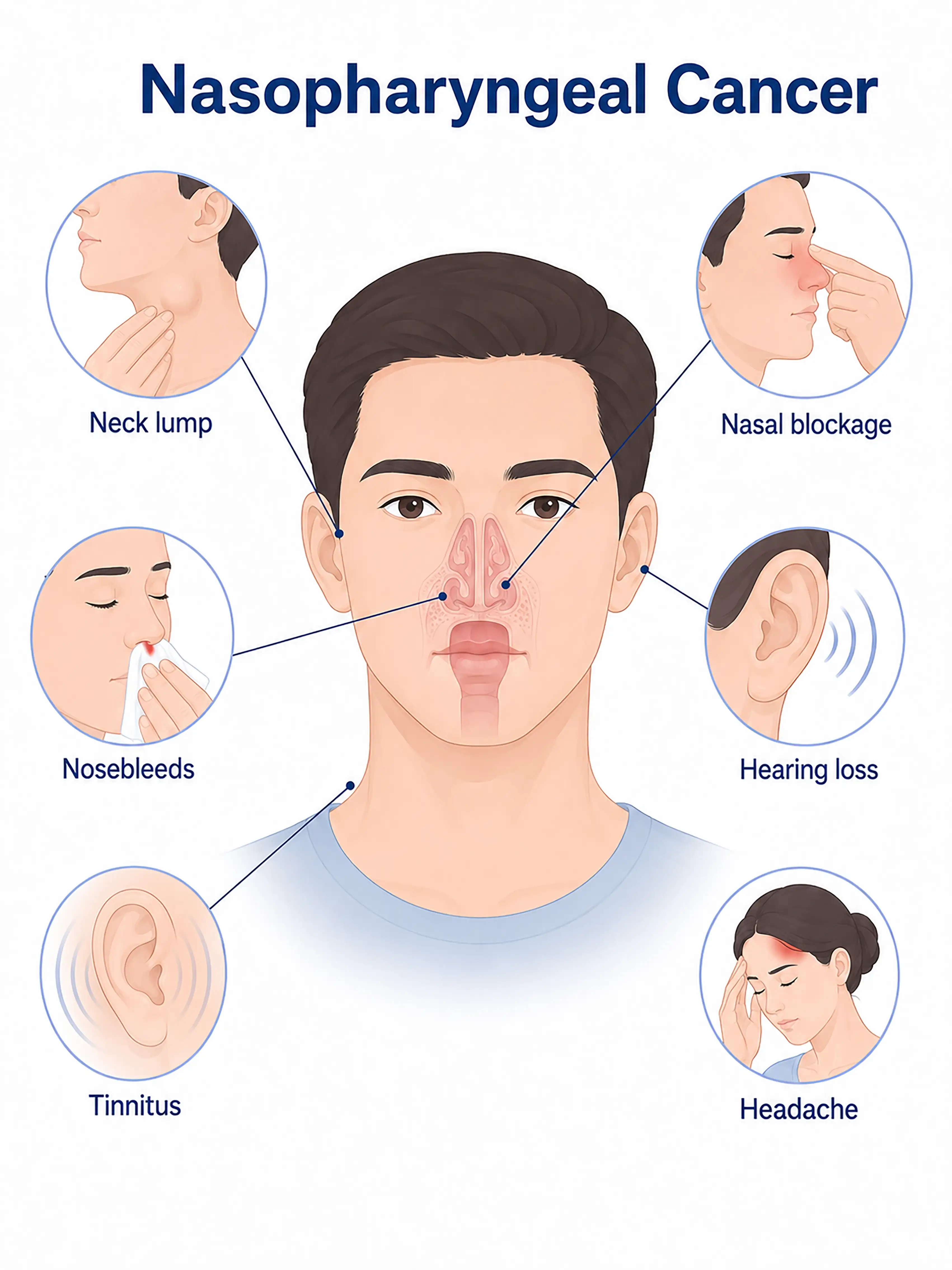
The tumor is confined to the nasopharynx, with mild, nonspecific symptoms such as blood-stained postnasal secretions, unilateral nasal obstruction, tinnitus, or ear fullness, which are easily mistaken for rhinitis or a cold.
2.Intermediate-stage nasopharyngeal cancer symptoms
As the tumor enlarges and invades surrounding structures, persistent nasal obstruction, hearing loss, a painless neck lump, headaches, and facial numbness develop. Cervical lymph node metastasis is common.
3.Advanced-stage nasopharyngeal cancer symptoms
Extensive invasion of the skull base and orbit and distant metastasis cause persistent severe headaches, double vision, facial paralysis, hoarseness, and systemic wasting symptoms.
When to Seek Medical Attention
Early signs of nasopharyngeal cancer include blood-stained postnasal secretions, persistent unilateral nasal obstruction, a painless neck lump, and tinnitus with hearing loss. Consult a doctor through "Chat with a Doctor" for early detection. During an online consultation, the doctor will ask about your symptoms and family history and guide you toward nasopharyngoscopy.
Nasopharyngeal cancer stages
Stage 0 nasopharyngeal cancer
Cancer cells are confined to the nasopharyngeal epithelium, representing carcinoma in situ. There are usually no obvious clinical symptoms, although occasional blood-stained postnasal secretions may occur. It is detected through nasopharyngoscopic screening.
Stage I nasopharyngeal cancer
The tumor is confined to the nasopharynx without invasion of surrounding tissues. Intermittent blood-stained postnasal secretions, unilateral nasal obstruction, and mild tinnitus may occur; these mild symptoms are easily overlooked.
Stage II nasopharyngeal cancer
The tumor invades the nasal cavity, oropharynx, or parapharyngeal space, with unilateral cervical lymph node metastasis, causing persistent nasal obstruction, worsening tinnitus, and an ipsilateral neck lump.
Stage III nasopharyngeal cancer
The tumor invades the skull base bone or paranasal sinuses, with bilateral cervical lymph node metastasis, causing persistent headaches, facial numbness, double vision, and marked hearing loss.
Stage IV nasopharyngeal cancer
The tumor invades intracranial structures or cranial nerves, or spreads to the lungs, liver, and bones, causing persistent severe pain, multiple cranial nerve deficits, and systemic wasting.
Nasopharyngeal cancer symptoms in detail
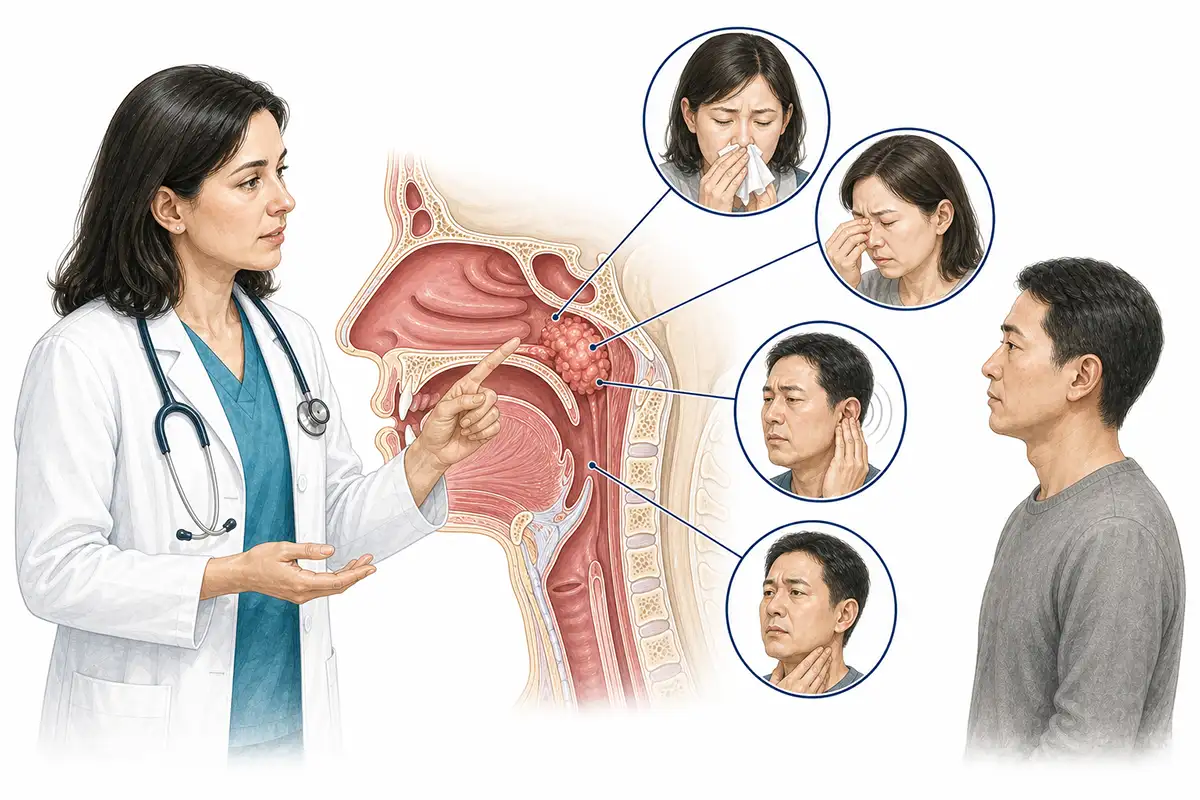
1.Blood-stained postnasal secretions
Blood streaks or clots in sputum when drawing nasal secretions back into the throat on waking are among the most common early symptoms of nasopharyngeal cancer. They result from erosion and bleeding of the tumor surface and are often mistaken for rhinitis or sinusitis.
2.Worsening unilateral nasal obstruction
Tumor blockage of the posterior nasal aperture causes progressively worsening unilateral nasal obstruction, initially intermittent and later persistent. Ordinary nasal drops provide little relief.
3.Appearance of a neck lump
Early lymphatic spread to the neck causes a painless, hard upper neck lump with poor mobility and progressive growth, often prompting patients to seek care.
4.Tinnitus and ear fullness
Compression or invasion of the pharyngeal opening of the Eustachian tube causes ipsilateral conductive hearing loss, tinnitus, and ear fullness, resembling otitis media with effusion.
5.Persistent headaches
Invasion of the skull base bone, cranial nerves, or intracranial structures causes persistent headaches, usually a distending pain in the temporal or occipital region. In advanced disease, pain is severe and responds poorly to analgesics.
6.Facial numbness
Trigeminal nerve invasion causes numbness of the skin over the ipsilateral cheek, temple, or jaw, sometimes with reduced sensation and pain, suggesting skull base involvement.
7.Double vision and fixed eyeball
Invasion of the orbital apex or skull base damages the abducens or oculomotor nerve, causing double vision, restricted eye movements, a fixed eyeball, or protrusion of the eye.
8.Hoarseness and swallowing symptoms
Direct tumor invasion or compression of the recurrent laryngeal nerve by metastatic cervical lymph nodes causes hoarseness, with difficulty swallowing and choking when drinking, indicating disease progression.
9.Complete nasal obstruction
In advanced disease, tumor enlargement completely blocks both posterior nasal apertures, causing mouth breathing, bad breath, and loss of smell, severely affecting eating and sleep.
Conclusion
The nonspecific early symptoms of nasopharyngeal cancer are easily overlooked. Blood-stained postnasal secretions and painless neck lumps warrant prompt medical evaluation. Epstein-Barr virus serology and nasopharyngoscopy help with early detection.


