


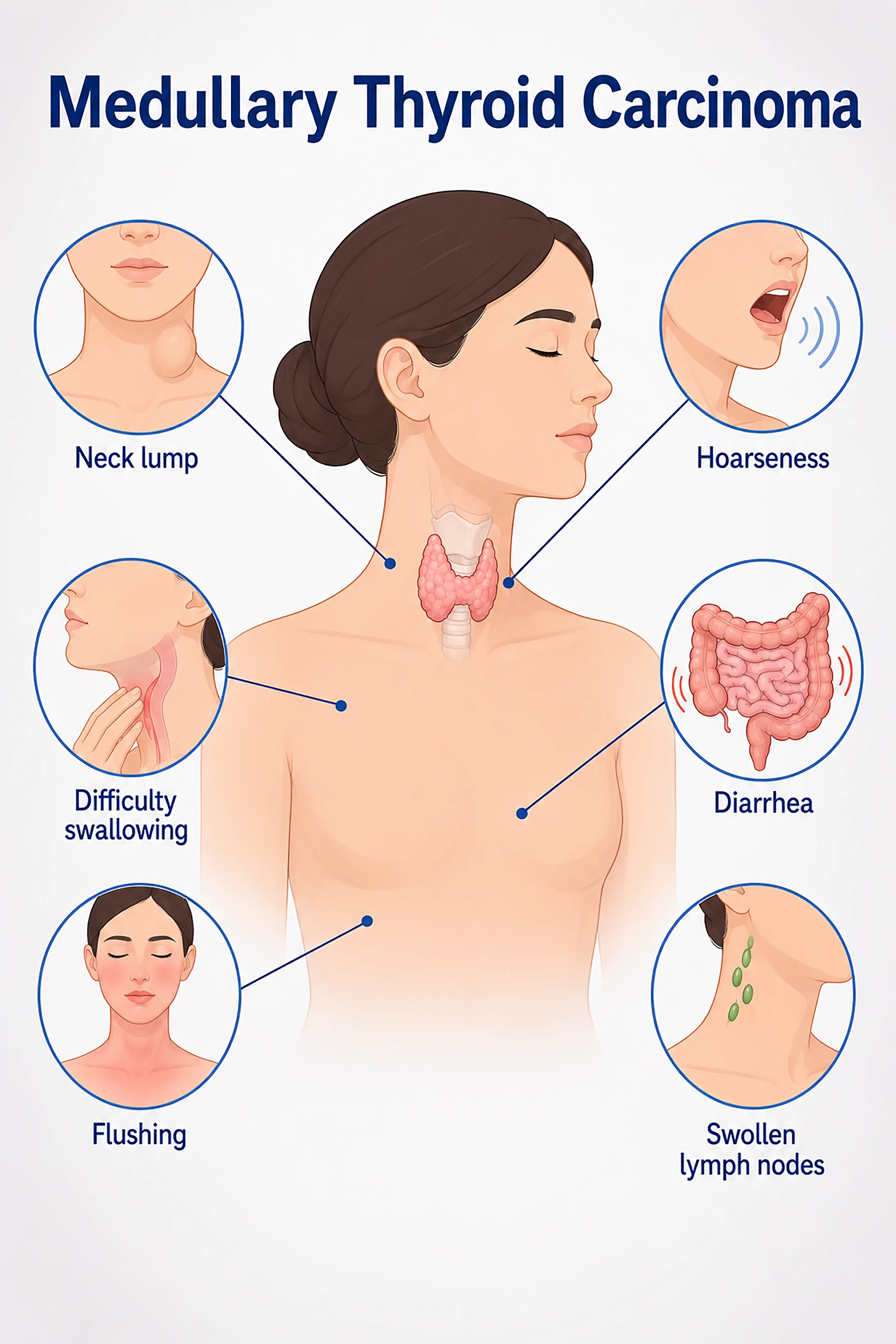
Medullary thyroid cancer is a neuroendocrine tumor arising from malignant transformation of thyroid parafollicular C cells. It may be sporadic or familial, commonly causing neck lumps, diarrhea, and facial flushing.
Medullary thyroid cancer prevalence worldwide
Medullary thyroid cancer accounts for 1%-4% of thyroid cancers and about 13% of thyroid cancer deaths. Seventy-five percent are sporadic and 25% are associated with MEN2A or MEN2B syndromes. Peak incidence is at ages 40-60, and prognosis lies between differentiated and anaplastic thyroid cancer.
Medullary thyroid cancer symptoms by stage
1 Early-stage medullary thyroid cancer symptoms
The tumor is confined to the thyroid, presenting as a painless, hard neck lump that moves with swallowing. Some patients have no obvious symptoms.
2 Intermediate-stage medullary thyroid cancer symptoms
The lump enlarges, with persistent diarrhea, facial flushing, palpitations, and enlarged cervical lymph nodes, suggesting secretion of large amounts of biologically active substances.
3 Advanced-stage medullary thyroid cancer symptoms
Extensive local invasion and distant metastasis cause severe diarrhea, persistent pain, extensive cervical lymph node metastasis, and symptoms from distant spread to sites such as lungs and bones.
When to Seek Medical Attention
Early signs include a neck lump with persistent diarrhea, facial flushing, and palpitations. Consult a doctor through "Chat with a Doctor" for early detection. During an online consultation, the doctor will ask about your family history and symptoms and guide you toward calcitonin testing and genetic screening.
Medullary thyroid cancer stages
Stage 0 medullary thyroid cancer
Cancer cells are confined to thyroid C cells, representing carcinoma in situ, usually without obvious clinical symptoms and detected through calcitonin screening.
Stage I medullary thyroid cancer
The tumor is less than two centimeters in diameter, confined to the thyroid, without lymph node metastasis, and usually asymptomatic or causes only a small neck lump.
Stage II medullary thyroid cancer
The tumor exceeds two centimeters or has minor extrathyroidal invasion and may cause a sense of pressure from a neck lump.
Stage III medullary thyroid cancer
The tumor invades surrounding tissues or spreads to cervical lymph nodes, causing symptoms such as hoarseness and difficulty swallowing.
Stage IV medullary thyroid cancer
Extensive invasion or distant spread to the lungs, bones, and liver causes persistent diarrhea and systemic wasting.

Medullary thyroid cancer symptoms in detail
1 Appearance of a neck lump
The most common initial symptom is a painless, hard thyroid-region lump with an uneven surface that adheres to surrounding tissue and later becomes fixed.
2 Persistent diarrhea
Large amounts of tumor-secreted calcitonin, prostaglandins, and other active substances cause persistent watery diarrhea more than ten times daily, responding poorly to ordinary antidiarrheal drugs.
3 Facial flushing
Vasoactive substances such as serotonin cause episodic facial flushing and burning, sometimes with palpitations and chest tightness.
4 Persistent hoarseness
Compression or invasion of the recurrent laryngeal nerve causes vocal cord paralysis and persistent hoarseness, suggesting spread beyond the thyroid.
5 Enlarged cervical lymph nodes
Medullary thyroid cancer readily spreads through lymphatics to the neck, causing hard, painless lateral neck lumps. About 15%-50% have lymph node metastasis at initial diagnosis.
6 Marked swallowing difficulty
An enlarging tumor compresses the esophagus, impairing swallowing with a neck foreign body sensation and pressure, affecting normal eating.
7 Severe breathing difficulty
Tracheal compression impairs breathing and causes stridor and respiratory difficulty. Severe cases may displace the trachea.
8 Persistent pain
Invasion of surrounding tissues and nerves causes persistent neck pain. Advanced bone metastases may cause severe bone pain and pathological fractures.
9 Rapid weight loss
Persistent diarrhea impairs nutrient absorption. Combined with tumor-related energy consumption, this causes marked short-term weight loss, weakness, and malnutrition.
Conclusion
Prognosis is closely associated with stage and hereditary background. People with a family history of MEN2 should undergo genetic screening and early preventive thyroidectomy. Calcitonin and CEA are important recurrence markers.


