


Prevalence worldwide
Laryngeal cancer is a common malignancy worldwide, with higher incidence in countries and regions with high smoking and drinking rates. Male patients outnumber female patients.
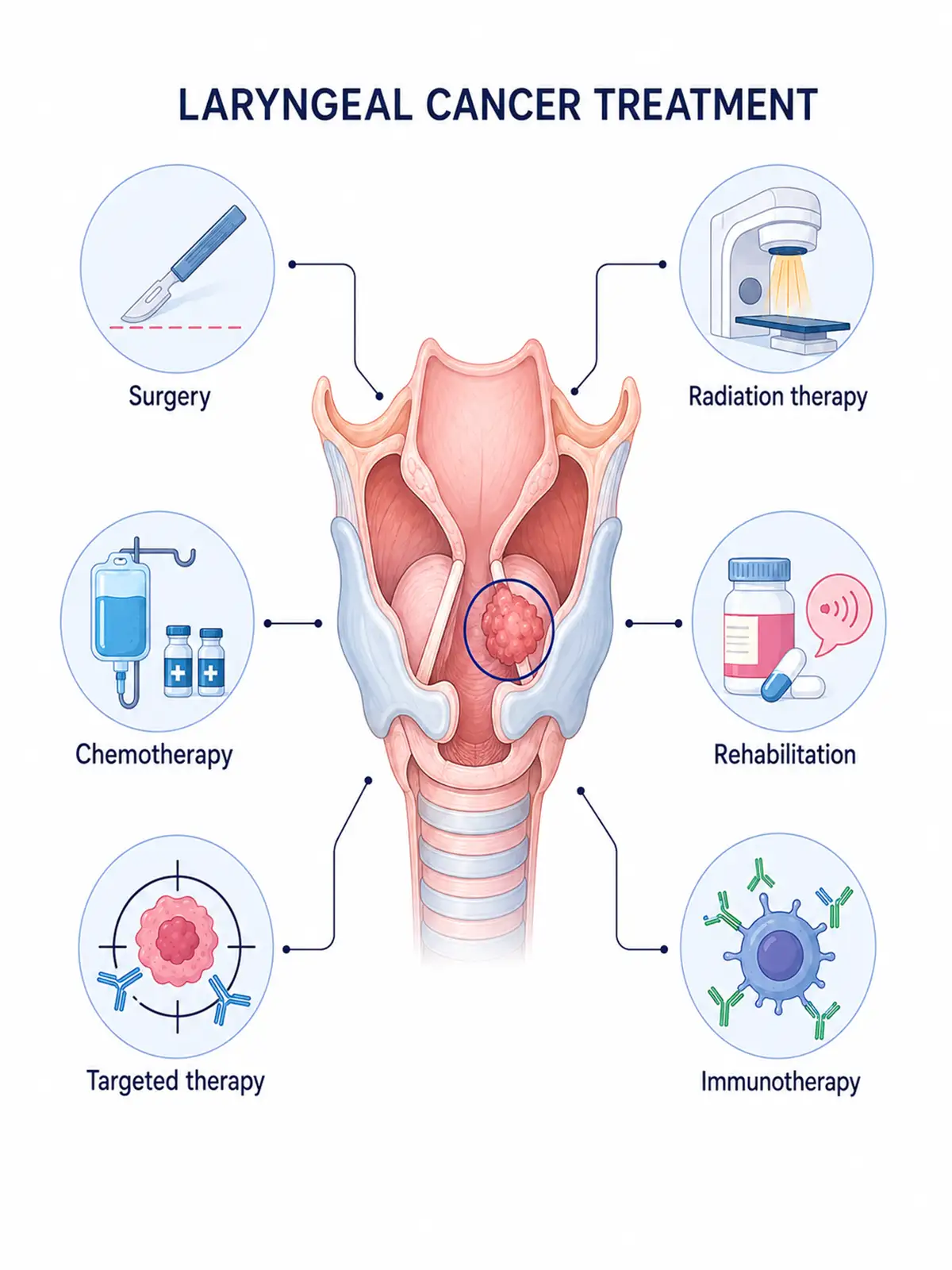
Laryngeal cancer treatment by stage
Early-stage treatment (localized tumor, tumor shrinkage, good response)
Surgical removal combined with adjuvant treatment effectively controls tumor progression and preserves laryngeal voice function.
Intermediate-stage treatment (local spread, growth inhibition, delayed progression)
Surgery combined with chemoradiotherapy and other modalities controls further tumor spread while preserving laryngeal function as much as possible.
Treatment for advanced disease (distant metastasis; aimed at symptom relief and survival prolongation)
primarily employs systemic therapies such as chemoradiotherapy, targeted therapy, and others to alleviate clinical symptoms and extend patient survival as much as possible.
Why choose Fosun Health for laryngeal cancer treatment
Fosun Health draws on its hospitals' M6 CyberKnife, VitalBeam, and ENT and head and neck surgery platforms to organize multidisciplinary consultations involving head and neck surgery, radiotherapy, imaging, pathology, medical oncology, and rehabilitation specialists. Based on tumor location, stage, cartilage invasion, and laryngeal function, the team selects microsurgery or larynx-preserving surgery, organ-preserving chemoradiotherapy, or total laryngectomy when necessary.
Precision radiotherapy covers the larynx and high-risk neck regions while minimizing exposure of the spinal cord, salivary glands, mandible, esophagus, and swallowing muscles, reducing some risks of dry mouth, swallowing difficulty, and neck tissue injury. Fosun Health provides one-stop medical services from diagnosis and treatment to airway management, swallowing training, voice rehabilitation, and nutritional support.

Laryngeal cancer treatment methods
1.M6 CyberKnife treatment
Robotic focused radiation from multiple angles is suitable for assessed small residual local lesions, recurrence, or oligometastases.
Treatment advantages:
①Focuses on small lesions: Suitable for carefully selected localized recurrent or residual lesions.
②Protects neck structures: Reduces doses to the spinal cord, carotid arteries, and pharyngeal constrictor muscles.
③Reduces treatment sessions: Lessens the impact of retreatment on swallowing and voice training.
④Addresses reirradiation risks: Cartilage necrosis, stenosis, and bleeding risks must be assessed.
2.VitalBeam precision radiotherapy
Image-guided and intensity-modulated radiotherapy treats laryngeal lesions and high-risk cervical lymphatic regions, suitable for early definitive treatment, larynx-preserving treatment of locally advanced disease, and high-risk postoperative patients.
Treatment advantages:
①Adapts to laryngeal subsites: Precisely covers glottic or supraglottic lesions.
②Protects swallowing structures: Reduces doses to the pharyngeal constrictors, esophagus, and oral cavity.
③Supports larynx preservation: Can be combined with concurrent chemotherapy in an organ-preserving regimen.
④Reduces neck injury: Protects the spinal cord, parotid glands, mandible, and thyroid.
3.Transoral laser microsurgery or laryngectomy
Transoral microsurgery, partial laryngectomy, or total laryngectomy is selected according to tumor subsite, cartilage invasion, and feasibility of larynx preservation.
4.Chemotherapy
Anticancer drugs systemically eliminate potential cancer cells and effectively control tumor progression, commonly for intermediate and advanced laryngeal cancer.
5.Immunotherapy
Activating the immune system to recognize and attack cancer cells offers a new effective treatment option for advanced laryngeal cancer.
6.Seed implantation:
Suitable as a selective local treatment for patients with residual or recurrent laryngeal cancer, limited options due to prior radiotherapy, and clearly defined lesion extent after multidisciplinary evaluation.
Post-treatment care
After treatment, you must quit smoking and limit alcohol intake, maintain oral hygiene, follow a balanced and nutritious diet, attend regular follow-up appointments as instructed, and actively cooperate with subsequent treatment.
Post-treatment examinations
Regular laryngoscopy, tumor marker testing, and follow-up imaging are needed to detect abnormal changes promptly.
Conclusion
Laryngeal cancer is a serious disease. Early detection, diagnosis, and intervention are central to treatment. An appropriate treatment plan and continued follow-up help improve quality of life and prolong survival.


