


Prevalence worldwide
Esophageal cancer is common worldwide, with higher incidence in parts of Asia and Africa, seriously threatening patients' health and quality of life.
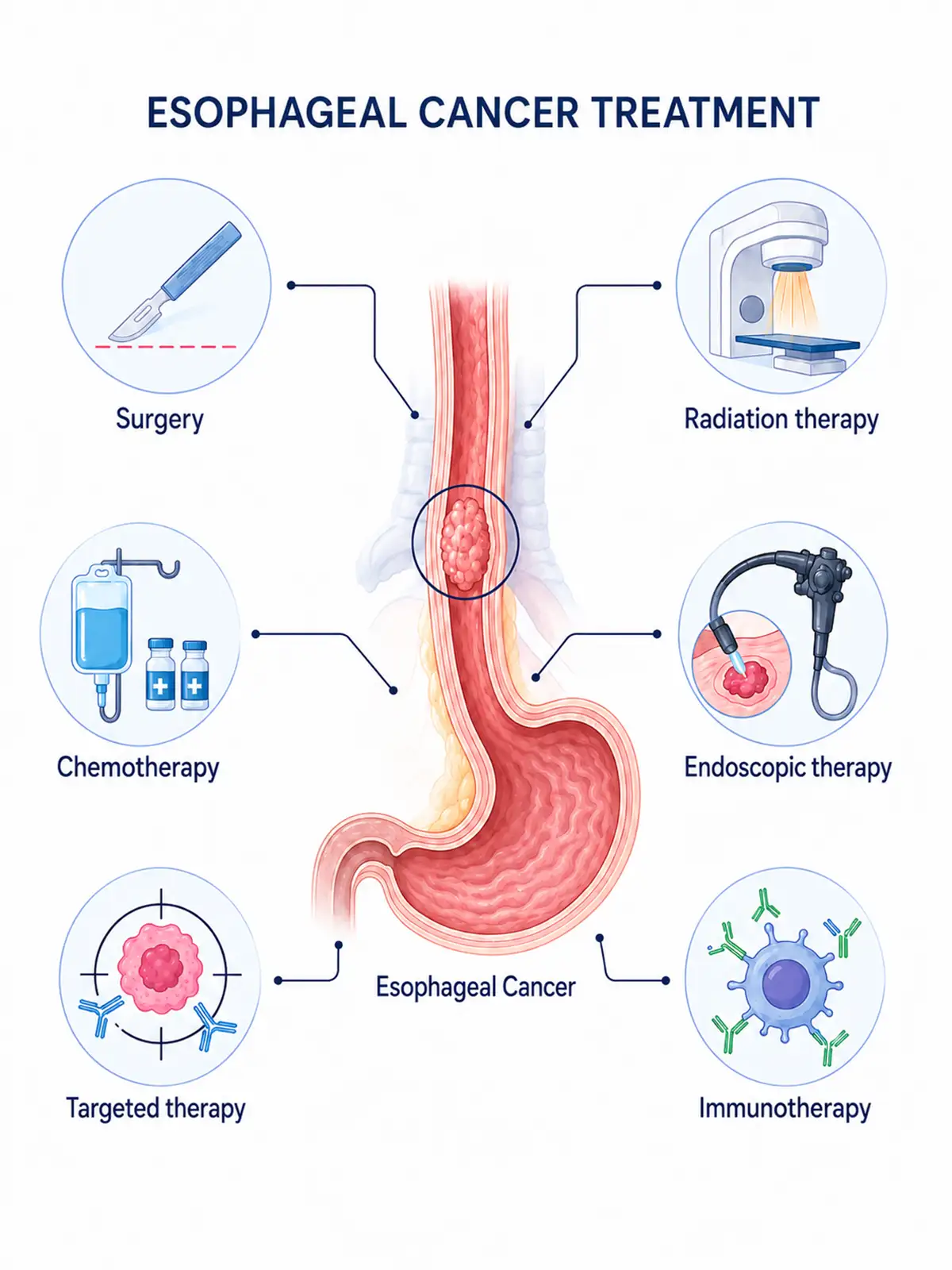
Esophageal cancer treatment by stage
Early treatment (involving a localized, small tumor with a favorable response)
specifically surgical resection combined with adjuvant therapy—can effectively control tumor progression, and the patient's prognosis is relatively good.
Treatment for the intermediate stage (involving local spread; aiming to inhibit growth and delay progression)
employs a comprehensive approach—such as surgery combined with radiotherapy and chemotherapy—to control further tumor spread and slow the rate of disease deterioration.
Treatment for advanced disease (distant metastasis; aimed at symptom relief and survival prolongation)
primarily employs systemic therapies such as chemoradiotherapy, immunotherapy, and others to alleviate clinical symptoms and extend patient survival as much as possible.
Why choose Fosun Health for esophageal cancer treatment
Fosun Health draws on M6 CyberKnife, VitalBeam, da Vinci robotic or thoracoscopic/laparoscopic surgery, gastrointestinal endoscopy, and medical oncology platforms at its hospitals, together with innovative drug resources within Fosun Pharma. Henlius-developed Hansizhuang (serplulimab), an anti-PD-1 monoclonal antibody, has been approved for esophageal squamous cell carcinoma. The team assesses corresponding immunotherapy combinations according to pathology, stage, physical condition, and approved indications.
Thoracic surgery, radiotherapy, pathology, imaging, and medical oncology specialists jointly plan surgery, chemoradiotherapy, or systemic treatment. Precision radiotherapy reduces exposure of lungs, heart, spinal cord, and normal esophagus to lower some cardiopulmonary and swallowing-related adverse-event risks. Treatment can also be coordinated with endoscopy, nutritional support, swallowing exercises, and recurrence surveillance.
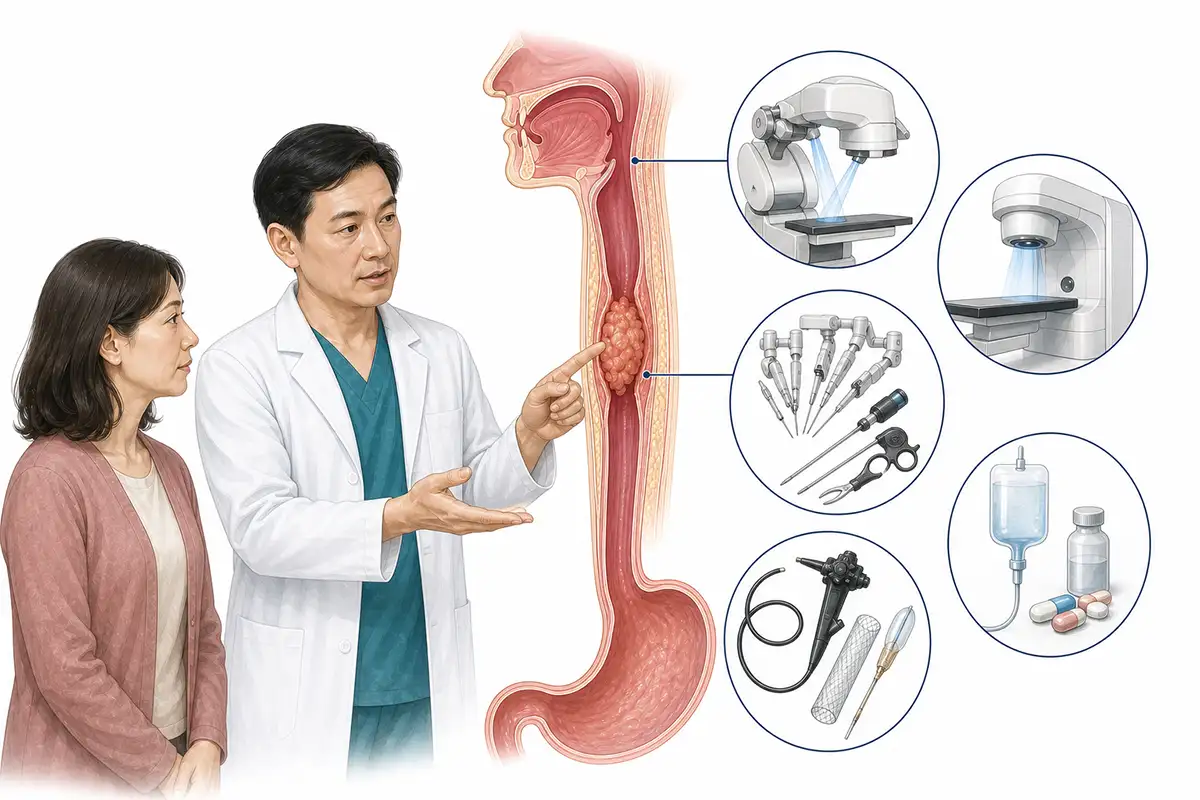
Esophageal cancer treatment methods
1.M6 CyberKnife treatment
Real-time image verification and robotic radiation from multiple angles are suitable for multidisciplinary-selected small local recurrences, oligometastases, or lesions requiring selective reirradiation.
Treatment advantages:
① Focused local treatment: Suitable for small recurrent or metastatic lesions with relatively clear boundaries.
② Thoracic organ protection: Reduces doses to the spinal cord, lungs, heart, and trachea.
③ Fewer treatment fractions: Reduces the nutritional and travel burdens of a lengthy course.
④ Defined indications: Does not replace standard surgery or definitive concurrent chemoradiotherapy.
2.VitalBeam precision radiotherapy
Image guidance and intensity-modulated radiotherapy treat the primary esophageal lesion and regional nodes, suitable for preoperative, definitive, selected postoperative, or palliative radiation.
Treatment advantages:
① Adaptation to elongated targets: Covers esophageal lesions and regional lymph nodes.
② Heart and lung protection: Reduces doses to lungs, heart, spinal cord, and normal esophagus.
③ Smooth treatment coordination: Can be combined with concurrent chemotherapy, immunotherapy, or surgery.
④ Multiple treatment settings: Suitable for definitive, adjuvant, and symptom-relieving treatment.
3.Da Vinci robotic or thoracoscopic/laparoscopic minimally invasive esophageal cancer surgery
Suitable for patients deemed resectable after staging and able to tolerate surgery. Robotic or thoracoscopic/laparoscopic techniques perform esophagectomy and nodal dissection.
Treatment advantages:
① Precise dissection: Facilitates work around recurrent laryngeal nerves, the trachea, and mediastinal nodes.
② Less chest and abdominal wall trauma: Supports postoperative breathing exercises and early mobilization.
③ Complete pathological assessment: Establishes margins, nodal status, and post-treatment pathological response.
④ Enhanced recovery coordination: Integrates nutritional, swallowing, and pulmonary function management.
4.Endoscopic or interventional treatment
For patients without curative options who have marked swallowing obstruction, bleeding, or local recurrence, options include endoscopic debulking, hemostasis, stenting, or other local treatments.
5.Esophageal cancer surgery
Surgical removal of the tumor and affected esophagus is the main early-stage treatment and effectively removes disease.
6.Chemotherapy
Anticancer drugs systemically destroy potential cancer cells and effectively control progression, commonly in intermediate and advanced esophageal cancer.
7.Targeted therapy
Precise targeting of specific cancer-cell molecules offers good efficacy with relatively fewer side effects and is suitable for selected advanced patients.
8.Immunotherapy
Activating the immune system to recognize and attack cancer cells offers a new effective treatment option for advanced esophageal cancer.
9.Neoadjuvant therapy
Preoperative chemotherapy shrinks the tumor, creates more favorable conditions for subsequent resection, and improves the likelihood of success.
Follow-up care after treatment
Maintain a regular routine and balanced diet, avoid irritating foods, attend examinations as advised, and cooperate with subsequent treatment.
Post-treatment examinations
Regular endoscopy, tumor marker testing, and imaging follow-up detect abnormalities promptly.
Conclusion
Esophageal cancer is a serious disease. Early detection, diagnosis, and intervention are central to treatment. An appropriate treatment plan and continued follow-up help improve quality of life and prolong survival.


