


Esophageal cancer develops from malignant transformation of cells lining the esophagus. Early symptoms are nonspecific; progressive swallowing difficulty, discomfort behind the breastbone, and weight loss may appear later. Incidence varies widely worldwide, with a heavier burden in parts of Asia and Africa.
Esophageal cancer prevalence worldwide
Esophageal cancer is a common malignancy with a high fatal burden worldwide, causing roughly half a million new cases each year. Incidence is generally higher in men, and mortality is especially heavy in resource-limited settings. Squamous cell carcinoma accounts for a large share of cases globally, while adenocarcinoma has become more common in parts of Europe and North America.
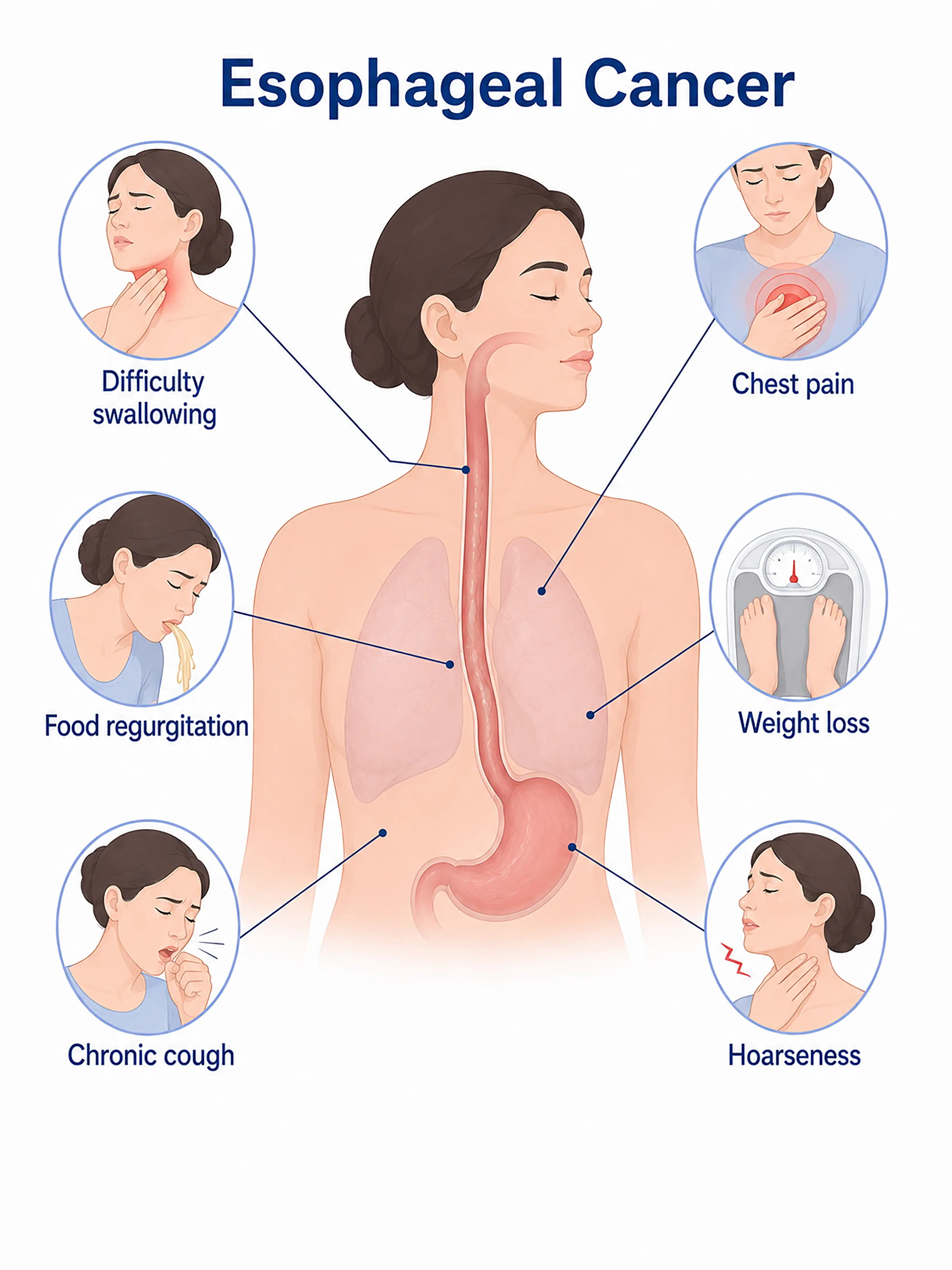
Esophageal cancer symptoms by stage
1.Early-stage esophageal cancer symptoms
The tumor remains within the mucosa, causing only slight sticking when swallowing coarse, hard food or discomfort behind the breastbone. Symptoms may be mistaken for pharyngitis or esophagitis and may disappear spontaneously but recur.
2.Intermediate-stage esophageal cancer symptoms
Tumor enlargement narrows the lumen, causing progressive difficulty swallowing solids and then semisolids, with persistent retrosternal pain, weight loss, and vomiting of mucus-like material.
3.Advanced-stage esophageal cancer symptoms
Local invasion and distant metastases cause persistent severe pain, hoarseness, tracheoesophageal fistula, massive vomiting of blood, severe malnutrition, and cachexia.
When to Seek Medical Attention
Early warning signs include a sticking sensation when swallowing, pain behind the breastbone, food regurgitation, and unexplained weight loss. Please consult a doctor through "Chat with a Doctor" to support early detection. The doctor will ask about dietary habits and symptoms and guide you through endoscopy and upper gastrointestinal contrast imaging.
Esophageal cancer stages
Stage 0 esophageal cancer
Cancer cells remain within the esophageal mucosal epithelium without breaching the basement membrane, representing high-grade dysplasia or carcinoma in situ. Usually asymptomatic, it is often found incidentally during endoscopic screening.
Stage I esophageal cancer
The tumor remains within the mucosa or submucosa without nodal metastasis. Dry or hard food causes slight sticking or retrosternal burning discomfort, with slow passage and a sense of blockage.
Stage II esophageal cancer
The tumor invades the muscle layer, sometimes with local nodal metastasis. Difficulty swallowing worsens markedly, retrosternal pain persists, weight loss begins, and food regurgitation occurs.
Stage III esophageal cancer
The tumor invades the adventitia or surrounding tissues, with regional nodal metastasis. Severe difficulty swallowing allows only liquids; hoarseness and palpable enlarged neck nodes may occur.
Stage IV esophageal cancer
Distant spread to organs such as the liver, lungs, and bones causes persistent severe pain, cachexia, and multiorgan failure, with a very poor prognosis.
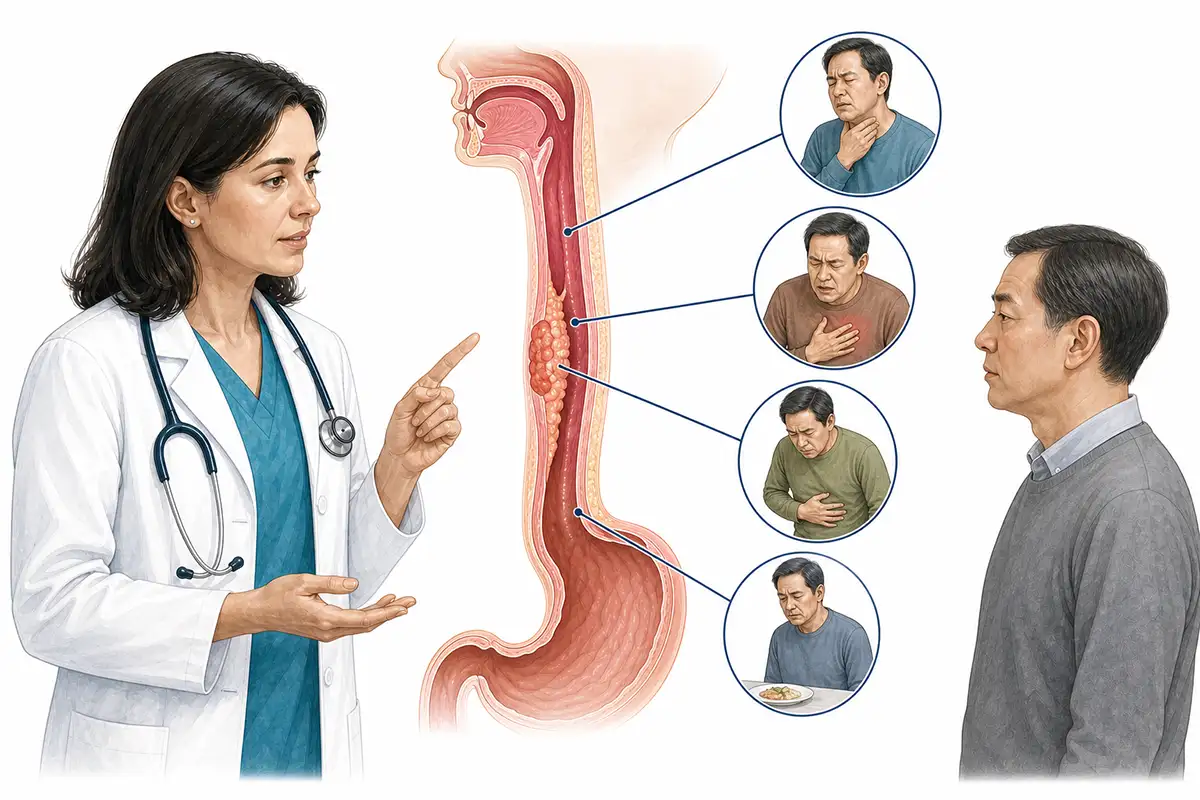
Esophageal cancer symptoms in detail
1.Food sticking during swallowing
Initially, only dry or hard food passes slowly or briefly sticks, often mistaken for pharyngitis or eating too quickly. Symptoms may disappear spontaneously but recur after an interval, gradually becoming more frequent and severe.
2.Pain behind the breastbone
Fullness, dull pain, stabbing pain, or burning behind the breastbone occurs mainly during swallowing. Upper or middle lesions cause retrosternal pain, while lower lesions cause subxiphoid or upper abdominal pain that may be mistaken for gastritis.
3.Progressive difficulty swallowing
Difficulty swallowing progresses from solid food to semisolids and eventually liquids and saliva. An initially difficult normal diet becomes restricted to semisolids or liquids.
4.Rapid weight loss
Difficulty eating and tumor-related wasting may cause weight loss of several to over ten kilograms within months, with fatigue, lethargy, weakness, and malnutrition, an important sign of progression.
5.Regurgitation and choking
Advanced invasion into the trachea creates a tracheoesophageal fistula and severe coughing during meals. Associated lung infection causes fever and purulent sputum. Marked esophageal dilation may cause copious mucus and food regurgitation.
6.Persistent hoarseness
Tumor or metastatic node compression of the recurrent laryngeal nerve causes same-side vocal cord paralysis, persistent hoarseness, and coughing when drinking, indicating invasion into mediastinal or deep neck tissues.
7.Vomiting blood and black stools
Tumor ulceration and rupture of major vessels cause massive vomiting of blood. Chronic oozing may cause black stools and anemia. These critical signs require emergency treatment.
8.Respiratory symptoms
Tracheoesophageal fistulas cause aspiration pneumonia, with cough, fever, and breathlessness. Lung metastases may cause coughing up blood and respiratory insufficiency.
9.Systemic wasting
Advanced disease causes extreme weight loss, anemia, dehydration, and systemic failure, known as cachexia, with persistent pain and fever severely impairing quality of life.
Conclusion
Early esophageal cancer symptoms are nonspecific and easily overlooked, and intermediate or advanced prognosis is poor. Reducing smoking and alcohol and avoiding very hot and pickled food help lower risk. Difficulty swallowing warrants prompt consultation.


