


Colorectal cancer is one of the most common malignant tumors worldwide, with an incidence rate that has been rising in recent years.Approximately 95% of cases are adenocarcinomas.While the five-year survival rate for early-stage colorectal cancer exceeds 90%, it is less than 20% for advanced-stage disease.Colonoscopy screening allows for the detection and removal of precancerous polyps, thereby preventing the development of colorectal cancer.
Diagnosis and staging of colorectal cancer
1.Early diagnosis of colorectal cancer
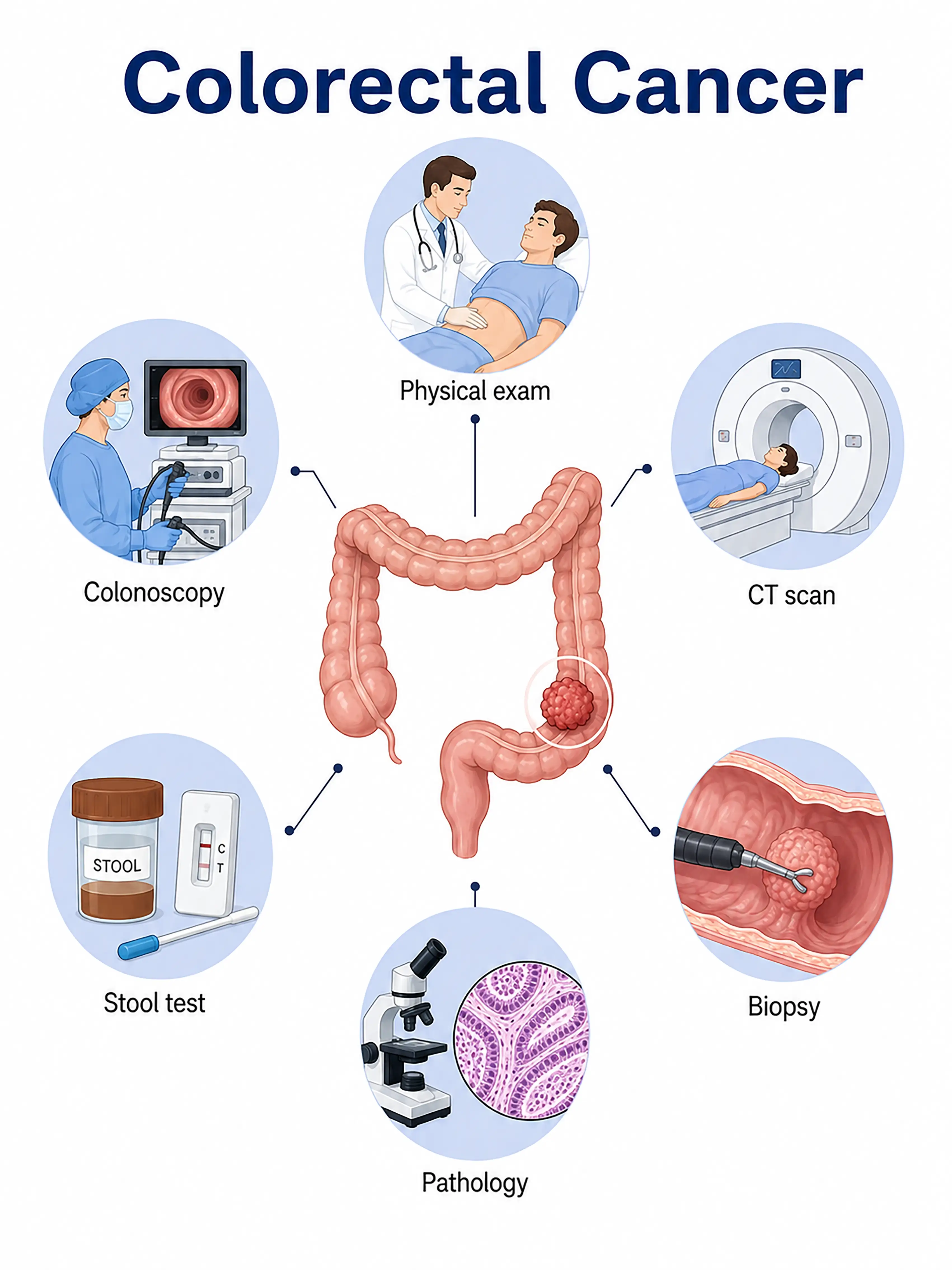
The tumor is confined to the mucosa or submucosa; patients are often asymptomatic or experience only mild rectal bleeding.Colonoscopy reveals polypoid lesions or superficial ulcers; diagnosis is confirmed via biopsy.A positive fecal occult blood test indicates the need for further examination.
2.Diagnosis of intermediate-stage colorectal cancer
Symptoms include bloody stools, abdominal pain, and changes in bowel habits.Colonoscopy reveals cauliflower-like masses or ulcerative lesions; biopsy confirms the pathological type.Contrast-enhanced CT assesses the depth of tumor invasion and regional lymph node metastasis.
3.Diagnosis of advanced colorectal cancer
Tumor penetrates the bowel wall, invading surrounding organs or metastasizing distantly to the liver or lungs.Whole-body CT and MRI assess the extent of metastasis; PET-CT detects micrometastases to clarify staging and guide treatment.
Without timely diagnosis, approximately 50% of colorectal cancer patients are already in the intermediate or advanced stages at the time of diagnosis, losing the opportunity for curative surgery;the five-year survival rate following liver metastasis is less than 10%.
When to Seek Medical Attention
Early signs of colorectal cancer include blood in the stool, abdominal pain, changes in bowel habits, and unexplained weight loss.Please consult a doctor via the "Chat with a Doctor" feature for early detection.During the online consultation, the doctor will ask about your symptoms and family history, and guide you through the process of undergoing a colonoscopy.
Basis for diagnosing colorectal cancer
1.Full colonoscopy
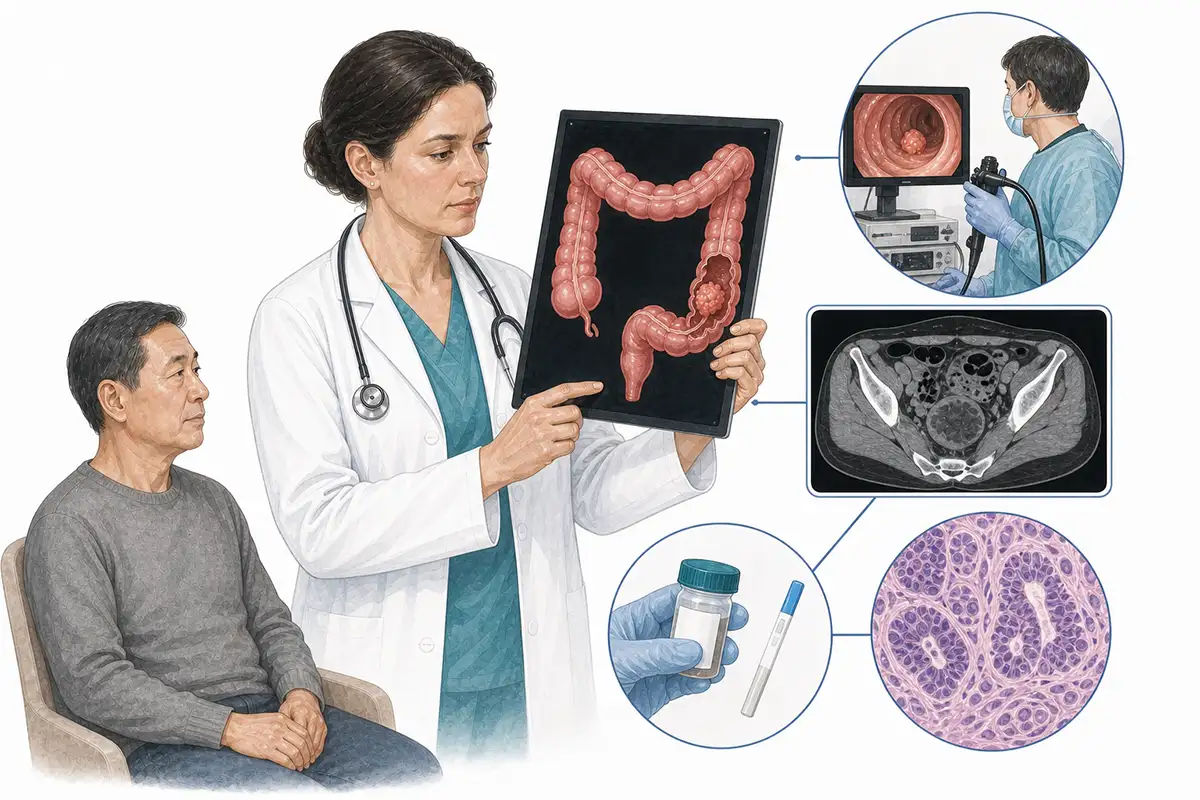
Total colonoscopy is the preferred method for diagnosing colorectal cancer; it allows for direct visualization of tumor morphology, location, and extent, as well as tissue sampling for pathological examination, serving as the gold standard for definitive diagnosis.
2.Pathological tissue biopsy
Endoscopic biopsy or resection of the lesion is performed for pathological examination to determine the histological type, degree of differentiation, and molecular characteristics (such as MMR/MSI status).
3.Abdominal and pelvic CT
Contrast-enhanced CT evaluates the location and extent of the primary tumor, as well as regional lymph node and distant organ metastases, making it the preferred imaging modality for staging diagnosis.
4.Pelvic MRI examination
MRI is a standard examination for rectal cancer; it allows for the assessment of the distance from the tumor's lower margin to the anal verge, the depth of bowel wall invasion, and the status of the mesorectal fascia, thereby guiding surgical planning.
5.Tumor marker test
Measurement of serum tumor markers such as CEA, CA19-9, and CA125 to assist in diagnosis, treatment efficacy assessment, and follow-up monitoring for recurrence.
6.Chest CT scan
Contrast-enhanced chest CT is recommended to rule out pulmonary metastasis and is a standard procedure for initial staging and follow-up.
7.Abdominal ultrasound
Ultrasound can assess the liver for metastatic lesions; ultrasound-guided needle biopsy can be performed on suspicious hepatic lesions that cannot be definitively diagnosed via other imaging modalities.
8.Fecal occult blood test
Fecal immunochemical testing (FIT) is a common method for colorectal cancer screening; a positive result requires further colonoscopy, enabling the early detection of asymptomatic cases.
9.Whole-body PET-CT assessment
It is not recommended as a routine examination but may serve as an adjunct diagnostic tool when conventional imaging fails to provide a definitive diagnosis or staging, or when recurrence is suspected.
Daily Self-Check
Individuals over the age of 50 should undergo regular colonoscopy screening.Medical attention should be sought promptly if symptoms such as blood in the stool, changes in bowel habits, or abdominal pain occur.Those with a family history should begin screening at an earlier age.
Conclusion
Early screening for colorectal cancer can significantly reduce mortality rates.Colonoscopy combined with pathological biopsy is the gold standard for diagnosis; regular screening is recommended for individuals aged 50 and older.


