


Brain cancer encompasses both primary and metastatic brain tumors; gliomas account for 40%–60% of primary brain tumors. In my country, the annual incidence of glioma is 5–8 per 100,000 people, and its 5-year mortality rate ranks third among all cancers, following only pancreatic and lung cancers.It is more common in men than in women and typically affects individuals aged 40–60.
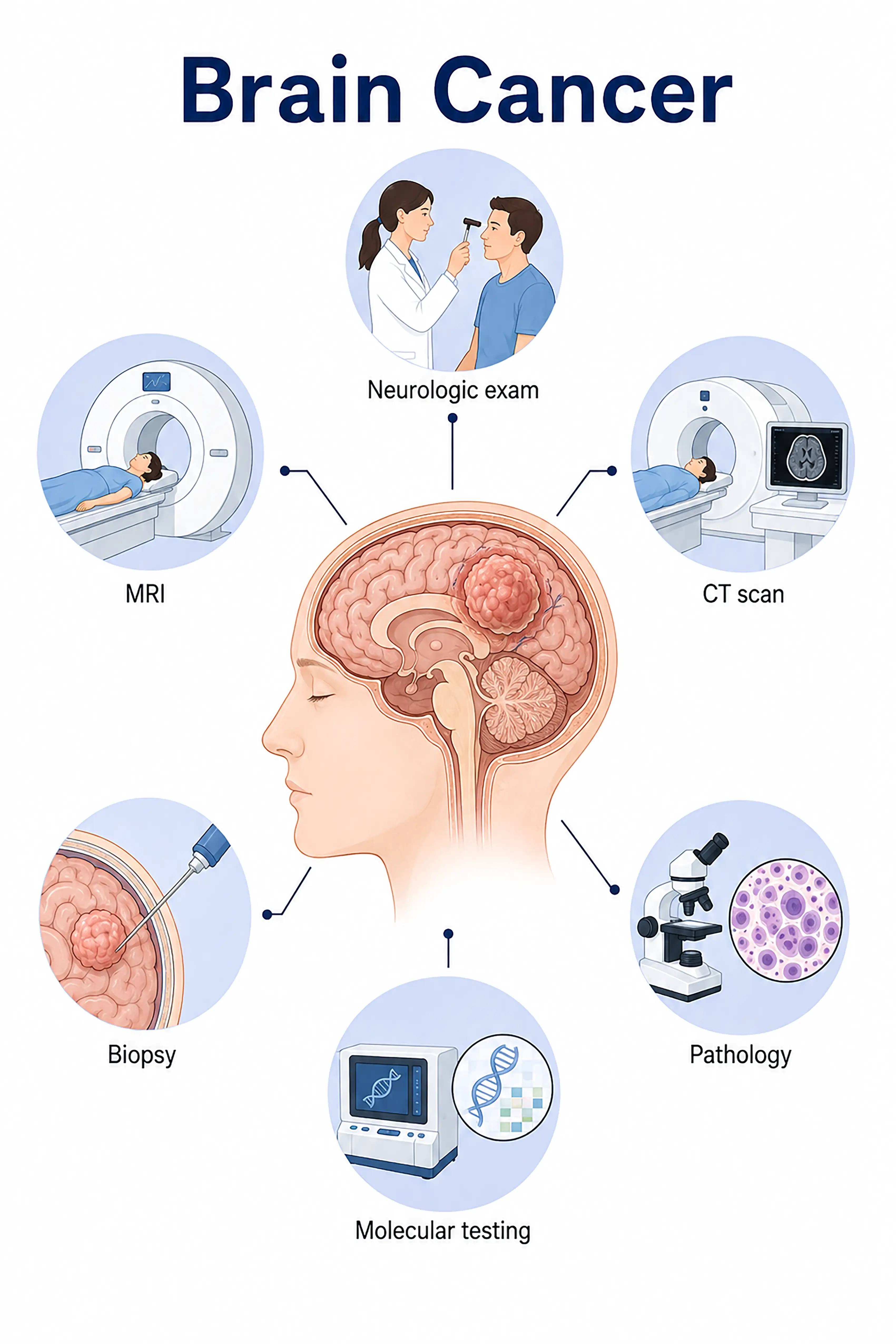
Diagnosis based on brain cancer stage
1.Early diagnosis of brain cancer
An intracranial lesion with abnormal signal intensity is incidentally detected on MRI.It appears hypointense on T1WI and hyperintense on T2WI, with variable enhancement (or lack thereof) following contrast administration; stereotactic or open-skull biopsy is required to confirm the pathological type.
2.Diagnosis of intermediate-stage brain cancer
Symptoms include headache, seizures, or neurological deficits.MRI reveals a tumor with peritumoral edema and mass effect, showing heterogeneous enhancement upon contrast administration; surgery or biopsy is required to determine the pathological and molecular subtypes.
3.Diagnosis of advanced brain cancer
Severe elevation of intracranial pressure and extensive neurological impairment.MRI shows a large space-occupying lesion with midline shift and brain herniation; surgical decompression and specimen acquisition are performed to determine the WHO grade and guide chemoradiotherapy.
If brain cancer is not diagnosed promptly, high-grade gliomas can progress rapidly and extensively infiltrate brain tissue, potentially resulting in the loss of surgical options and significantly shortened survival.
When to Seek Medical Attention
Early signs of brain cancer include persistent headaches, nausea and vomiting, seizures, and limb weakness.Please consult a doctor via the "Chat with a Doctor" feature to facilitate early detection.During the online consultation, the doctor will ask about your symptoms and the progression of the condition, and guide you through the process of undergoing a cranial MRI.
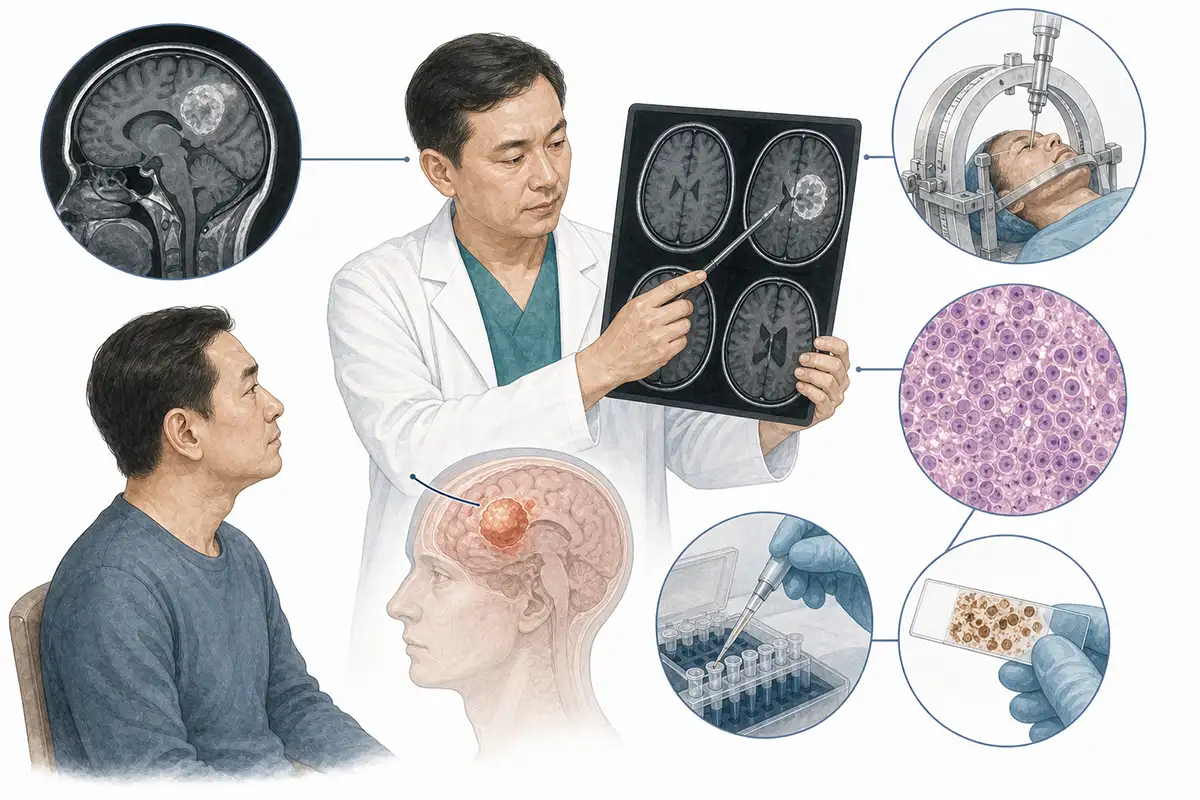
Basis for brain cancer diagnosis
1.Cranial MRI (plain + contrast-enhanced)
MRI is the preferred imaging modality for diagnosing brain cancer; it clearly displays tumor location, size, morphology, and surrounding edema, while enhancement characteristics help determine the tumor grade.
2.Multimodal MRI
Diffusion-weighted imaging (DWI), perfusion-weighted imaging (PWI), and magnetic resonance spectroscopy (MRS) assist in differentiating between neoplastic and non-neoplastic lesions and in assessing the degree of tumor malignancy.
3.Stereotactic biopsy
Precise image-guided needle biopsy to obtain tumor tissue samples for pathological and molecular testing is a key method for diagnosing deep-seated tumors or those located in functional areas.
4.Craniotomy pathology
Craniotomy is performed to resect the tumor and obtain a specimen for integrated histopathological and molecular pathological diagnosis, thereby clarifying the WHO grade and molecular subtype.
5.IDH gene testing
Determining IDH1/IDH2 gene mutation status serves as the primary stratification criterion in the 2021 WHO classification; IDH-mutant tumors have a better prognosis than wild-type tumors.
6.1p/19q testing
Testing for the 1p/19q co-deletion status; its presence confirms a diagnosis of oligodendroglioma, which is sensitive to chemotherapy and serves as a molecular marker for a favorable prognosis.
7.CT scan
CT allows for rapid assessment of tumor size, calcification, and hemorrhage, as well as evaluation of brain herniation and hydrocephalus in emergency settings; it is superior to MRI for visualizing bony structures.
8.PET-CT assessment
18F-FDG PET-CT can differentiate between low-grade and high-grade tumors, assess tumor metabolic activity and distant metastasis, and assist in staging and treatment efficacy evaluation.
9.Molecular pathology integration
An integrated diagnosis combining histological morphology with molecular markers (such as IDH, 1p/19q, MGMT, and TERT) is a requirement of the 2021 WHO classification.
Daily Self-Check
Seek medical attention promptly if unexplained persistent headache, seizures, limb weakness, or personality changes occur.Regular physical examinations help in the early detection of asymptomatic lesions.
Conclusion
Diagnosis of brain cancer relies on MRI and pathological biopsy.Molecular testing (e.g., IDH, 1p/19q) forms the basis for modern classification and treatment decisions.


