


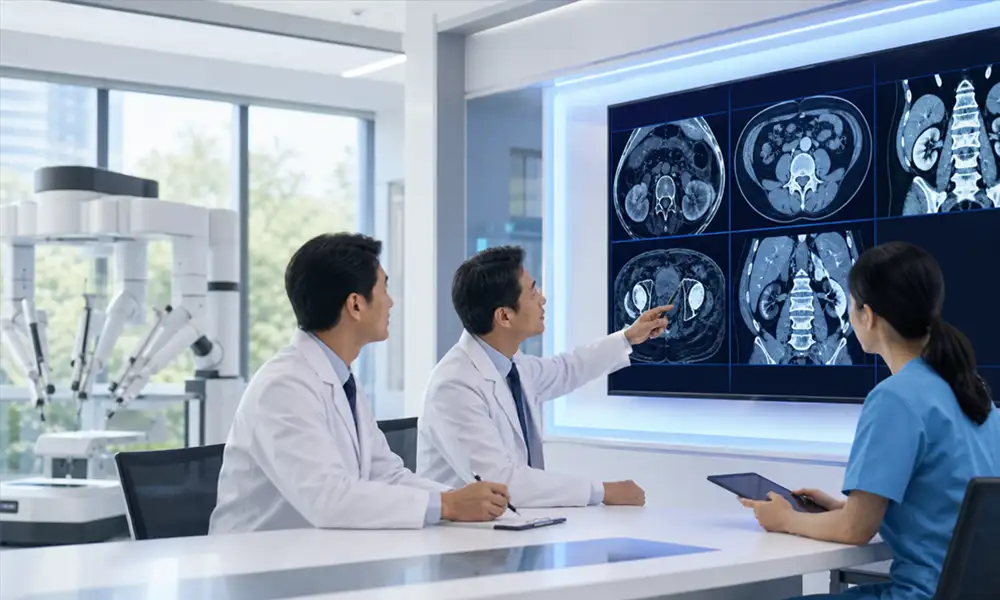
Fosun Health Urology Cancer Treatment Center mainly diagnoses and treats diseases such as kidney cancer, bladder cancer, prostate cancer, testicular cancer and adrenal tumors, relying on the urology department, medical oncology, radiotherapy, imaging, pathology and rehabilitation teams to carry out multidisciplinary assessments. Diagnosis and treatment will be based on imaging, pathology, staging, renal function, urinary status and the patient's overall condition.
For patients who are suitable for surgery, the center can perform laparoscopic or robot-assisted surgery according to the location and scope of the lesion, including partial nephrectomy, radical nephrectomy, cystectomy and prostate cancer surgery. Specific surgical procedures need to balance tumor control with protection of renal, urinary, and sexual functions, and determine whether adjuvant treatment is needed based on postoperative pathology.
For diseases that are not suitable for surgery, locally advanced, recurrent or metastatic, precise radiotherapy, endocrine therapy, targeted therapy, immunity or chemotherapy can be selected according to the type of cancer. Prostate cancer treatment needs to be combined with risk stratification and life expectancy, and some low-risk patients can be evaluated for active surveillance; bladder cancer needs to distinguish between non-muscle invasive and muscle invasive types before selecting a path.
The center also attaches great importance to urostomy, urinary function, renal function, pain, bone health and psychological support, and arranges imaging, laboratory indicators and necessary endoscopic follow-up after treatment. Help patients understand relapse monitoring and functional rehabilitation requirements through continuum management.
Common treatment pathways for urinary system tumors
1. Kidney cancer: Surgery is the main treatment, and it is pointed out that comprehensive treatment is required when the tumor is large, penetrates the renal capsule, has lymph node metastasis, or is inoperable. Modern diagnosis and treatment can choose partial nephrectomy or radical nephrectomy based on the size and location of the lesion; patients with recurrence and metastasis are mainly evaluated for targeted, immune and local treatments.
2. Bladder cancer: distinguish between superficial and invasive bladder cancer. Non-muscle invasive bladder cancer is usually treated with transurethral resection and intravesical instillation; patients with muscle invasive bladder cancer can choose radical cystectomy, or under strict screening, use transurethral resection combined with radiotherapy and chemotherapy to preserve the bladder.
3. Prostate cancer: Radiation therapy has become an important method for intermediate and advanced prostate cancer. Actual treatment requires active surveillance, radical surgery, external radiation, brachytherapy, endocrine and other drug treatments based on risk stratification, taking into account urination, sexual function and bone health.
4. Testicular malignant tumors: distinguish between seminomas and non-seminomas. Radical orchiectomy is usually performed first, followed by observation, chemotherapy or, in certain cases, radiotherapy based on pathological type, stage and tumor markers.
5. Penile cancer and other genitourinary tumors: Radiotherapy is the first choice in the early stage, and some patients require surgery. Modern treatment emphasizes the selection of organ-sparing local treatment, surgery or radiotherapy according to the scope of the disease, and the evaluation of inguinal lymph nodes.


