


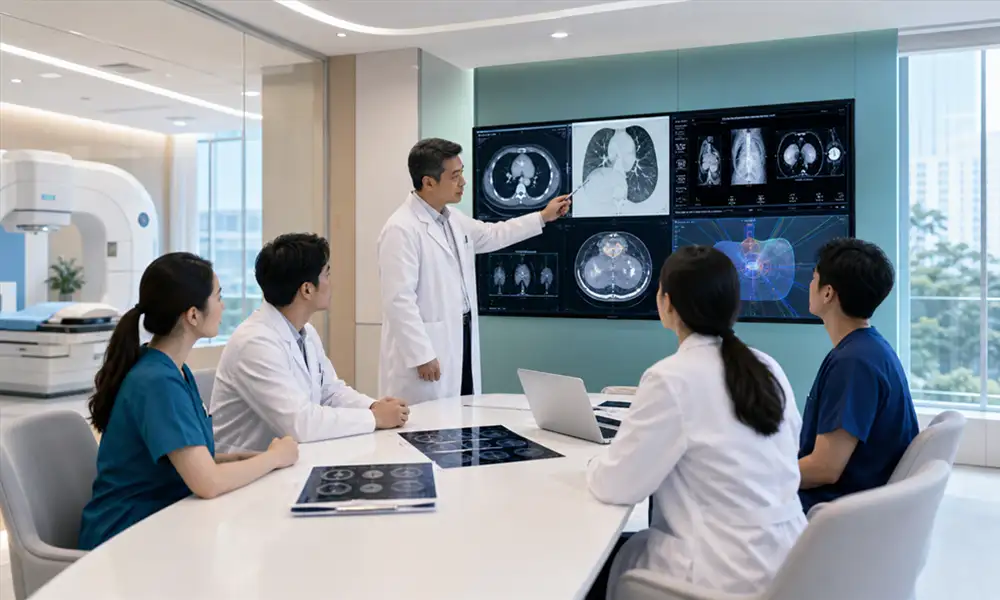
Fosun Health International Cancer Treatment Center relies on the oncology, imaging, pathology, surgery, radiotherapy, medical oncology and rehabilitation support capabilities of its affiliated hospitals to provide continuous services from prevention, screening, diagnosis to treatment, nursing, nutrition, psychology and rehabilitation for different cancer types and different treatment stages. The center insists on putting the patient at the core, first clarifying the scope of the disease, treatment goals and physical tolerance, and then formulating an executable and re-evaluable diagnosis and treatment path.
Diagnosis and treatment decisions are based on multidisciplinary consultation (MDT). The team can combine imaging examinations, pathological diagnosis, staging assessment and necessary molecular testing, and discuss it together from the disciplines of surgery, radiotherapy, medical oncology, imaging, pathology, interventional, nutrition and rehabilitation. For patients with newly diagnosed, relapsed, metastasized or complex conditions after previous treatment, MDT can help clarify the treatment sequence, expected benefits and risks, and adjust the plan after re-evaluation at key nodes.
In terms of treatment implementation, the center can connect surgery, precision radiotherapy, chemotherapy, targeted therapy, endocrine therapy, immunotherapy and minimally invasive intervention according to indications. Relevant hospitals under Fosun Health have been equipped with equipment such as M6 CyberKnife, Vital Beam linear accelerator, PET/CT, and equipped with robotic or minimally invasive surgery platforms. More equipment and technologies are not always better. The team will make selections based on the location of the tumor, size of the lesion, movement characteristics, distance from vital organs and previous treatments to take into account both tumor control and normal tissue protection.
The center also attaches great importance to safety management and quality of life during the treatment process. Relevant teams can provide continuous assessment and intervention around needs such as pain, nutrition, intravenous access, treatment response, psychological support and functional rehabilitation; after treatment, a review rhythm is developed based on cancer type, stage and recurrence risk to help patients connect imaging re-evaluations, laboratory tests, medication management and rehabilitation follow-up.
For cross-border and international patients, Fosun Health can provide support such as online pre-review of information, consultation coordination, multi-language communication, transportation and admission arrangements, and can assist in connecting with some international insurance services according to insurance terms. Patients can submit pathology, imaging and previous treatment data before coming to the hospital, and the medical team will evaluate and give preliminary medical advice; the final diagnosis and treatment plan still need to be determined based on hospital examination and multidisciplinary evaluation.
The center’s diagnosis and treatment scope covers head and neck tumors, chest tumors, abdominal and digestive system tumors, urinary system tumors, female reproductive system tumors, central nervous system tumors, and bone and soft tissue tumors. There are obvious differences in the main treatment methods for different types of diseases: nasopharyngeal cancer usually focuses on radiotherapy, early-stage lung cancer and most resectable gastrointestinal tumors require surgery as an important method, cervical cancer can choose surgery or radiotherapy and chemotherapy according to the stage, and breast cancer requires a combination of breast-conserving or resection surgery, radiotherapy and drug treatment.
For locally advanced, recurrent or metastatic tumors, the center will further combine modern targeted, immune, endocrine and minimally invasive interventional treatments on the basic paths such as surgery, radiotherapy and chemotherapy as shown in the picture. The specific selection needs to be determined based on the pathological type, stage, molecular markers, previous treatments and physical condition, and will be adjusted through imaging and efficacy re-evaluation during the treatment process.


