


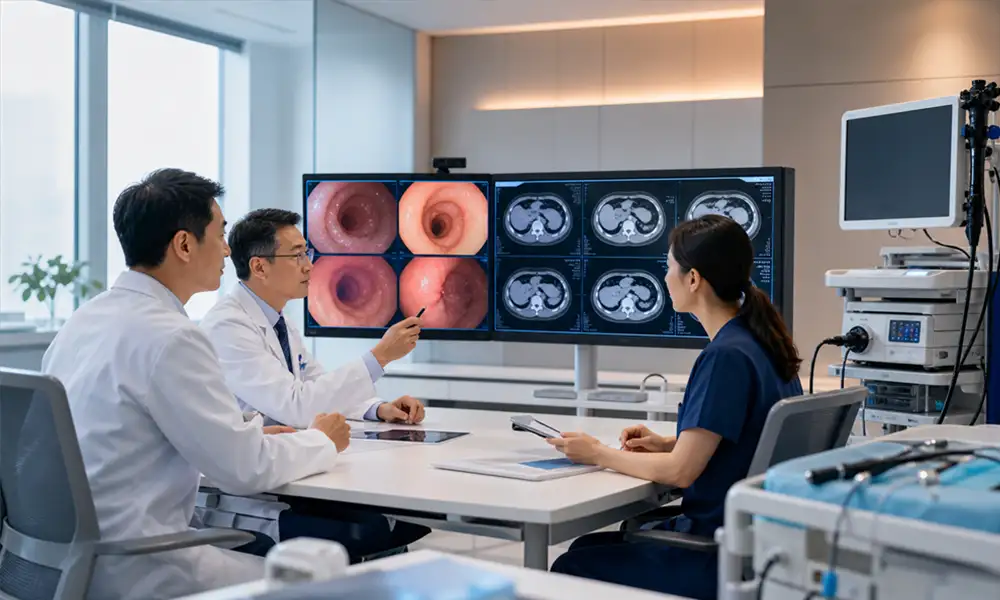
Fosun Health Digestive Cancer Treatment Center focuses on common digestive tract tumors such as esophageal cancer, gastric cancer, colon cancer, and rectal cancer, and collaboratively handles complex conditions such as liver metastasis, peritoneal metastasis, and nutritional risks. The center integrates digestive endoscopy, imaging staging, pathological diagnosis, molecular testing and nutritional assessment into a multidisciplinary process. It first determines the current treatment goals and then arranges surgery, radiotherapy or drug treatment.
For resectable lesions, the team can rely on laparoscopy, thoraco-laparoscopic or robotic surgical platforms to carry out minimally invasive treatment, and determine whether neoadjuvant treatment is needed based on preoperative staging. Surgery for gastric cancer and colorectal cancer emphasizes complete resection, standardized lymph node processing, and protection of organ function; while rectal cancer also requires a comprehensive assessment of tumor location, possibility of anal preservation, and pelvic function.
For patients who need radiotherapy or local therapy, the center can combine VitalBeam precision radiotherapy, M6 CyberKnife and interventional ablation and other platforms to formulate plans for esophageal cancer, rectal cancer, localized recurrence or oligometastatic lesions. Specific techniques need to be selected based on the scope of the lesion, previous treatments, distance to important organs and the pace of systemic treatment, and follow-up arrangements will be determined through phased imaging re-evaluation.
During the treatment, the team focused on managing problems such as dysphagia, nausea, diarrhea, bowel movement changes, weight loss, and pain, and provided nutrition, stoma, and rehabilitation support. After treatment, endoscopy, imaging, tumor markers and long-term follow-up are arranged based on pathological risk and efficacy assessment.
Common treatment pathways for abdominal and digestive tract tumors
1. Esophageal cancer and cardiac cancer: Stages I and II are mainly surgical, and some stage III uses preoperative radiotherapy followed by surgery or radical chemoradiotherapy. Modern diagnosis and treatment also needs to combine tumor location, pathology, resectability and nutritional status to choose endoscopic treatment, minimally invasive surgery, preoperative comprehensive treatment or radical concurrent chemoradiotherapy.
2. Gastric cancer: Surgery is the main treatment in the early stage, and adjuvant treatment is required in the middle and late stages. The center evaluates early endoscopic resection, laparoscopic or robotic gastric cancer surgery, as well as perioperative chemotherapy, targeted or immunotherapy based on endoscopic, imaging and pathological staging.
3. Colon cancer and rectal cancer: Surgery is the core of colon cancer, while radiotherapy and chemotherapy can be combined with radiotherapy and chemotherapy before or after surgery for rectal cancer. Whether to receive adjuvant treatment after surgery for colon cancer depends on the pathological risk; mid- to low-lying locally advanced rectal cancer often requires neoadjuvant radiotherapy or full neoadjuvant treatment followed by evaluation of the possibility of surgery and anal preservation.
4. Liver cancer, pancreatic cancer and biliary tract tumors: The actual plan needs to select surgery, ablation, intervention, precision radiotherapy or systemic treatment based on resectability, liver function, vascular invasion and metastasis extent, and decide whether to convert to surgery through staged re-evaluation.


