


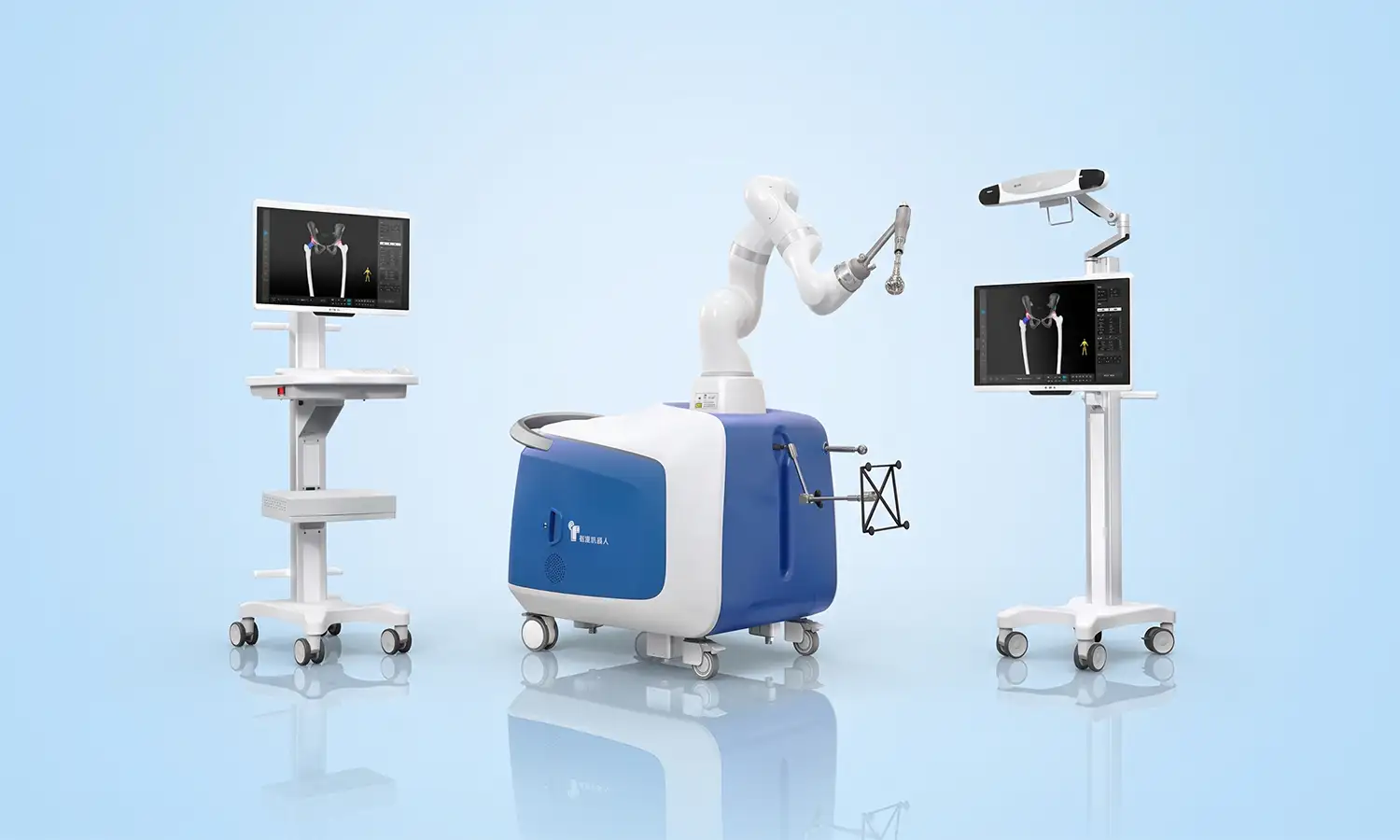
The Jianjia Arthrobot surgical robot system, developed by Hangzhou Jianjia Medical Technology Co., Ltd., is China's first seven-axis collaborative surgical robot compatible with both hip and knee replacements. It was developed based on critical clinical needs and possesses fully independent intellectual property rights.As the first domestic surgical robot platform capable of covering both hip and knee joint replacement procedures, it has broken the long-standing monopoly held by imported surgical robots in this field.The system comprises a robotic arm system, an optical positioning system, a navigation and control system, and preoperative planning software.
Core Technologies
What is the Jianjia Arthrobot surgical robot system?
The Jianjia Arthrobot surgical robot system is a high-precision navigation and positioning system designed to assist joint surgeons in performing precise joint replacement procedures.Rather than performing surgery autonomously, the system comprises three integrated components: a robotic arm system (acting as the "hand"), an optical positioning system (the "eye"), and a navigation control system (the "brain").It constructs a 3D joint model from preoperative CT data and utilizes an AI-driven planning system to generate a customized surgical plan. During the procedure, an optical tracker monitors the real-time positions of the patient's bones and surgical instruments, seamlessly aligning this data with the preoperative plan, while the robotic arm executes bone resection and implant placement with high precision, effectively enhancing overall surgical accuracy.
1. AI-powered preoperative planning and 3D modeling
Based on preoperative 3D CT scan data, the system constructs a 1:1 scale 3D model of the patient's joint.An AI-driven planning system automatically identifies lesions and optimizes the design regarding prosthesis selection, sizing, and placement angles and positioning.Surgeons can simulate the osteotomy scope and the entire prosthesis implantation process in a preoperative virtual environment, thereby tailoring a customized surgical plan for each patient.
2. Real-time optical navigation and precise execution by robotic arms
During the procedure, an optical positioning system uses optical trackers to monitor the real-time positions of the patient's bones and surgical instruments.The system seamlessly integrates real-time positional data with the preoperative plan, allowing the robotic arm to execute osteotomy and implant placement with precision while operating within safety boundaries.Safety features such as virtual boundaries and force feedback are provided, and the robotic arm achieves sub-millimeter repeatability in positioning.The precision and stability of the robotic arm effectively eliminate deviations caused by factors such as physiological tremor or fatigue associated with manual operation.
Scope of Indications
The Jianjia Arthrobot surgical robot system is widely used in fields such as hip and knee replacement surgeries.
1. Areas for treatment/surgery
Field Primary Applications
Hip replacement: Total hip arthroplasty, hip revision surgery, etc.
Knee replacement Total knee arthroplasty, unicompartmental knee arthroplasty, etc.
Complex joint replacement; primary joint replacement for patients with severe joint deformity or massive bone defects
2. Suitable patient population
• Patients with end-stage joint disease requiring hip or knee replacement
Artificial joint replacement is recognized as the most effective treatment for end-stage hip and knee osteoarthritis.For patients requiring joint replacement due to conditions such as osteoarthritis, femoral head necrosis, or joint deformity, the Jianjia Arthrobot system enables precise osteotomy and prosthesis placement with sub-millimeter accuracy.
• Individuals seeking joint replacement procedures that are more precise and offer faster recovery
Unlike traditional joint replacement surgeries that rely heavily on the surgeon's visual assessment and clinical experience, the Jianjia Arthrobot system utilizes AI-driven planning and real-time intraoperative navigation. It determines the prosthesis size, placement, and angle with millimeter-level precision, ensuring "zero-deviation" placement and significantly extending the implant's lifespan while improving postoperative joint function.
• Patients requiring complex joint replacement or revision surgery
For patients with severe joint deformity, massive bone defects, or a history of prior surgery around the joint—as well as those requiring revision surgery for complications like aseptic loosening or periprosthetic infection—robot-assisted surgery offers greater precision in both preoperative planning and intraoperative execution.
Core Strengths
Comparison Dimension Conventional Joint Replacement Surgery Jianjia Arthrobot Surgical Robot System
Surgical Planning Relies on surgeon experience and spatial visualization AI-driven preoperative planning; precise design using 1:1 3D models
Surgical Precision Millimeter-level; relies on the surgeon's naked-eye observation Sub-millimeter level; ensures "zero-deviation" implant placement
Operational stability Subject to physiological tremor and fatigue-induced errors Stable execution by robotic arm; safety ensured via virtual walls and force feedback
Intraoperative radiation Requires repeated fluoroscopy;high radiation exposure Substantial reduction in intraoperative radiation
Prosthesis placement Subject to some subjectivity and potential error Precise positioning and angle control extend the prosthesis's lifespan
Postoperative recovery Slower recovery Less trauma, faster recovery
Learning curve Long Significantly shortens the physician's learning curve
Conventional Joint Replacement Surgery
Conventional joint replacement surgery relies heavily on the surgeon's experience for preoperative assessment and intraoperative execution; the surgical plan and prosthesis placement are influenced to some extent by the surgeon's expertise and spatial judgment.Physiological tremors and errors in visual judgment associated with manual operation can affect the precision of the prosthesis's implantation angle and position.Additionally, some procedures require repeated intraoperative imaging verification, leading to increased radiation exposure.Postoperative recovery time and functional outcomes are also closely linked to surgical precision.
Jianjia Arthrobot Surgical Robot System
The Jianjia Arthrobot surgical robot system enhances the precision and stability of joint replacement surgeries through intelligent preoperative planning and precise robotic arm assistance.The system generates 3D models based on patient-specific data to assist surgeons in formulating precise surgical plans, while enabling fine positioning and operational control during the procedure.Compared to traditional surgical methods, robot-assisted technology reduces human error; through stable robotic arm execution, virtual safety boundaries, and real-time feedback mechanisms, it improves the accuracy of implant positioning and angulation, thereby optimizing the restoration of joint alignment.Additionally, the system reduces the need for intraoperative imaging and lowers radiation exposure; by enabling more precise surgical maneuvers, it minimizes tissue damage and facilitates faster postoperative recovery for patients.
FAQ
1. Does Arthrobot automatically perform joint replacement surgery for the doctor?
No. Arthrobot is a planning and navigation assistance system for joint replacement surgery; the surgical plan is formulated by the physician, and the device provides positioning or operational assistance based on the physician's actions.Ultimate judgment and responsibility for the procedure remain with the surgical team.
2. Which patients might be suitable for Arthrobot-assisted hip replacement?
For patients indicated for hip replacement surgery, a physician can evaluate the suitability of robot-assisted procedures.Suitability is determined based on a comprehensive assessment of joint pathology, bone quality, the degree of deformity, previous surgical history, and overall health status.
3. What are the benefits of robot-assisted joint replacement?
The system enables preoperative planning based on imaging and assists doctors in verifying positioning and executing the plan intraoperatively to enhance procedural consistency and precision.However, it cannot eliminate surgical risks or guarantee identical functional recovery outcomes for every patient.
4. Are anesthesia and postoperative rehabilitation still required when using Arthrobot?
Joint replacement is a surgical procedure that typically requires anesthesia;post-operative care involves planned pain management, mobilization (getting out of bed), and functional rehabilitation exercises.The pace of recovery depends on factors such as the surgical technique used, underlying medical conditions, muscle strength, and patient compliance; patients should follow the guidance of the medical team.
5. How do I inquire about Arthrobot robot-assisted joint replacement therapy?
To determine your suitability for Arthrobot robot-assisted joint replacement, please bring relevant medical records, such as hip X-rays or CT scans, details of past treatments and surgeries, a list of current medications, and information on underlying medical conditions.An orthopedic surgeon will first confirm the indications for replacement surgery, then explain the differences between robot-assisted procedures and other treatment options, as well as the associated risks and expected outcomes.